
Ear Jackets for a Curated Ear Stack: 2026 Guide
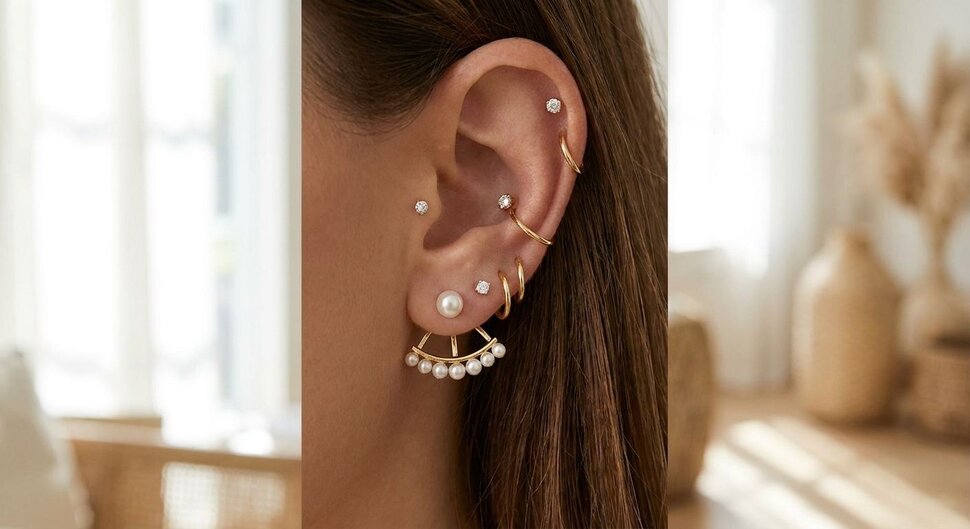
Curated ear stack builders need ear jackets that bridge a single piercing into a two-part silhouette, turning one stud into a front-and-back statement without adding a new hole. A jacket earring sits through your existing lobe piercing and wraps a decorative back piece around the earlobe, so it reads as two earrings while requiring the fitting logic of one. For anyone assembling a multi-piercing ear in 2026, that single-hole efficiency is exactly why ear jackets have become the anchor piece rather than an afterthought.
TL;DR
- Ear jackets pair a front stud with a sculptural back drop through one lobe piercing for a curated ear stack in 2026.
- Match the jacket's metal to at least one existing piece before adding it to your stack.
- Post length determines whether the back piece sits flat or crooked against the earlobe.
- Element 79 fits ear jackets from Artemer and Spinelli Kilcollin alongside existing lobe and cartilage pieces.
- Book a fitting for asymmetric or multi-piercing layouts rather than guessing at scale online.
Why ear jackets matter for a curated ear stack
A curated ear stack is judged on composition, not piece count. Ear jackets solve the composition problem because they occupy the visual space of two earrings while asking for a single piercing commitment, which matters if you're not ready to add a third or fourth hole in 2026 but still want a stack that looks deliberate.
The curated ear approach outlined in Element 79's stacking guide treats every piece as a layer with a role: anchor, accent, or connector. An ear jacket almost always plays anchor, since its scale and shape set the tone for everything placed around it on the helix, tragus, or second lobe hole.
Verdict: an ear jacket is the fastest way to add visual complexity to a curated ear stack without adding a new piercing.
Map your piercing layout before buying
Before you shop, know exactly which hole the jacket anchors and how much room the rest of your ear has to work with.
- Confirm the jacket's post gauge and length match your existing lobe piercing
- Note whether your first piercing sits centered or slightly off-center on the lobe
- Count additional piercings (second lobe, helix, tragus, flat) to plan balance around the jacket
- Decide whether the jacket becomes the focal point or a quiet base layer under bolder pieces
Choose a front-back silhouette that suits your ear shape
Not every jacket silhouette sits the same way on every lobe, and the wrong proportion is the most common reason people stop wearing one.
- Symmetrical geometric jackets sit cleaner on petite or narrow lobes
- Sculptural or asymmetric designs need a larger lobe surface to avoid crowding
- Open wire jackets let more of the natural ear show through than solid pave designs
- Curved back pieces follow the earlobe's edge; straight bars tend to shift throughout the day
Match metals across your stack
This is where a curated ear stack either looks intentional or looks like a drawer of mismatched earrings got emptied into one ear. Audit what you're already wearing before adding anything new.
- List every metal currently in your stack: yellow gold, white gold, rose gold, mixed-metal pieces
- Choose a jacket that repeats at least one metal already present in the ear
- Reference the mixed-metal stacking approach if your stack already blends tones
- Treat gold-filled or plated jackets as short-term pieces; they won't hold up next to solid gold daily-wear studs
Layer helix and cartilage pieces around the jacket
Once the jacket anchors the lobe, everything else should support it rather than compete with it.
- Add a single hoop or huggie on a second lobe piercing to echo the jacket's metal
- Keep helix studs small and flat-backed so they don't visually outweigh the jacket
- Choose threader-style earrings for the tragus or forward helix for a minimalist connecting line
- Space cartilage pieces so the eye moves in one direction, not scattered across the ear
Test scale and weight for daily wear
A jacket that photographs well in a product shot can still feel heavy after eight hours of actual wear. This is where buying online without trying it on first goes wrong for a lot of stack builders.
- Try the piece on before buying whenever possible to judge earlobe weight over a full day
- Confirm the post is solid 14k gold or platinum if you plan to wear it daily through 2026 and beyond
- Check whether the design is compact enough to sleep in comfortably, or if it needs to come off at night
Add texture instead of more color
Once metal and scale are settled, texture is the easiest way to add depth to a curated ear stack without it looking busy.
- Pair a textured or sculptural jacket with a smooth, plain hoop elsewhere in the stack for contrast
- Limit gemstone placement to one focal point; a jacket with pave next to a gemstone stud competes for attention
- Use hammered or matte finishes as a quiet counterweight to a high-polish jacket
Book a professional fitting for asymmetric or multi-piercing ears
Once your stack includes three or more piercings, guessing at proportions from a product photo stops working. A short in-person fitting settles scale, post length, and placement in one visit instead of a round of returns.
Book an ear stack fitting
See ear jackets on your actual ear before you commit to a piece.
Ear jacket styles compared
Classic double-stud jacket
- Best for: Minimalist stackers with one lobe piercing
- Key limitation: Front stud reads plain if worn alone without the back piece
Threader-chain jacket
- Best for: Second-piercing wearers who want movement
- Key limitation: Chain length must be matched to post length or it tangles
Sculptural cuff-style jacket
- Best for: Statement-focused stackers building an editorial ear
- Key limitation: Larger silhouette can overwhelm a petite earlobe
Convertible stud-to-jacket set
- Best for: Buyers who want one piece that works two ways
- Key limitation: Added hardware for the convertible back adds slight bulk
Common mistakes curated ear stack builders make
- Sizing for one piercing when you have two. A jacket built for a single lobe hole can overlap or press against a second piercing placed too close.
- Mixing metals with no anchor point. A stack without at least one repeated metal tone looks accidental instead of curated.
- Ignoring post length. A back piece with too short a post sits crooked against the earlobe instead of lying flat.
- Stacking gemstones next to gemstones. Two sparkle points fighting for attention cancel each other out visually.
- Skipping a fitting for asymmetric layouts. Buying blind for a three-or-more-piercing stack is the most common reason ear jackets get returned.
For sensitive or newly healed piercings, check hypoallergenic options for sensitive skin before adding a jacket to an ear that already has multiple metal pieces in it. If you're still deciding where a second piercing fits into the plan, the guide on choosing earrings for a second piercing covers placement before you add a jacket around it.
Element 79's Cherry Creek boutique stocks designer ear jackets from Artëmer and Spinelli Kilcollin built for exactly this kind of layered fitting, not just single-earring wear.
FAQ
What is an ear jacket earring?
An ear jacket is a single-piercing earring made of a front stud and a decorative back piece that wraps around the earlobe, creating the look of two earrings from one hole. It's designed to sit through your existing lobe piercing rather than requiring a new one.
How many piercings do you need for an ear jacket?
Just one. An ear jacket uses your standard lobe piercing and adds visual complexity through its back piece, which is why it works well for people not ready to add another hole in 2026.
Are ear jackets good for a curated ear stack?
Yes, ear jackets work well as the anchor piece in a curated ear stack because they occupy the visual weight of two earrings while asking for only one piercing. They set the scale that other stacked pieces build around.
What metal should an ear jacket be for sensitive skin?
Solid 14k gold or platinum posts are the safest choice for sensitive or newly pierced ears, since plated or gold-filled posts can wear down and irritate the skin over time.
How much post length does an ear jacket need?
Post length depends on earlobe thickness and how the back piece is designed to move; a post that's too short causes the back piece to sit crooked instead of flat against the lobe. A fitting settles this faster than guessing from a product photo.
Can you wear an ear jacket with hoops?
Yes, an ear jacket on one lobe piercing pairs well with a hoop or huggie on a second lobe hole, as long as the metals repeat somewhere in the stack. Keeping one shared metal tone is what keeps the combination looking curated instead of random.
Do ear jackets work for second piercings?
Ear jackets are typically built for a first, standard lobe piercing rather than a second hole placed higher on the lobe, since the back piece needs room to sit flat. A second piercing is better suited to a simple stud or small hoop layered underneath the jacket.
How do I clean an ear jacket earring?
Wipe the front stud and back piece separately with a soft, dry cloth after wear, since the two-part design traps oils and skin contact in more surface area than a standard stud. Avoid ultrasonic cleaners on pieces with pave or delicate chain connections.
One last thing
The detail most people skip when buying an ear jacket is checking how the back piece behaves once the earlobe warms up over a few hours of wear. A back piece that sits flat in a cold showroom case can shift once body heat softens the lobe's cartilage-adjacent tissue, which is the real reason a professional fitting outperforms an online guess for anyone stacking three or more pieces.
Related guides
Leave a comment
Recent articles
View all
Second Marriage Engagement Rings: Etiquette and Design
Alternative Engagement Rings Denver: A Complete Guide