Diamond color grade benchmarks: D to K scale 2026

The diamond color grade chart runs from D, the least colored grade, to Z, which shows light yellow or brown color; within D–K, D–F are colorless, G–J are near colorless, and K begins the faint range. This 2026 guide explains those boundaries so you can compare diamonds for a ring at Element79jewelry without treating a letter as the whole story.
TL;DR
- Use this diamond color grade chart to compare D–F colorless, G–J near colorless, and K faint diamonds.
- GIA color grades describe absence of color, not sparkle, clarity, or overall beauty.
- Compare similar diamonds in the intended setting; metal, shape, and lighting affect visible color.
- Element79jewelry suits shoppers seeking designer fine jewelry and custom bridal rings in Cherry Creek, Denver.
Why this matters
A color grade answers a narrow question: how much body color does a diamond show under standardized grading conditions? It does not tell you whether the finished ring feels crisp, softly warm, sculptural, or right for your hand.
Choose the appearance you love, then use the report to understand it. The chart below separates formal categories from shopping recommendations, so you can recognize what a grade establishes and what still needs a closer look.
Diamond color grade chart: D–K benchmarks for 2026
GIA's D–Z system contains 23 letter grades. This chart focuses on 8 grades, D through K, spanning 3 color categories; these are ordered classifications, not measurements you should average into a universal shopping target.
Overall: D–Z
- GIA color category: Colorless through light
- What the classification establishes: Full normal-range scale for increasing yellow or brown body color
- Best for: Understanding the complete grading framework
- Limit to remember: Does not rank sparkle or personal appeal
D
- GIA color category: Colorless
- What the classification establishes: Highest absence-of-color grade on this scale
- Best for: Shoppers prioritizing the highest color classification
- Limit to remember: Does not guarantee the most beautiful finished ring
E
- GIA color category: Colorless
- What the classification establishes: Within the colorless category, below D
- Best for: Shoppers who want a colorless classification
- Limit to remember: A letter alone cannot establish a visible difference from D
F
- GIA color category: Colorless
- What the classification establishes: Final grade in the colorless category
- Best for: Shoppers who want the colorless category without requiring D or E
- Limit to remember: Not a promise that adjacent grades look different face-up
G
- GIA color category: Near colorless
- What the classification establishes: First grade below the colorless category
- Best for: Comparing a near-colorless option against F
- Limit to remember: Category boundary does not guarantee an obvious visual boundary
H
- GIA color category: Near colorless
- What the classification establishes: Within the G–J near-colorless category
- Best for: Exploring near-colorless diamonds in the intended design
- Limit to remember: Appearance still depends on the individual diamond and setting
I
- GIA color category: Near colorless
- What the classification establishes: Within the G–J near-colorless category
- Best for: Shoppers willing to evaluate subtle warmth
- Limit to remember: Near colorless does not mean colorless under every condition
J
- GIA color category: Near colorless
- What the classification establishes: Final grade in the near-colorless category
- Best for: Shoppers comfortable assessing warmth in person
- Limit to remember: The category name does not promise an icy appearance
K
- GIA color category: Faint
- What the classification establishes: First grade in the K–M faint category
- Best for: Shoppers open to a warmer diamond appearance
- Limit to remember: Not interchangeable with a near-colorless classification
D leads this D–K comparison for absence of color; K has the most body color within the grades shown. D–F belong to the colorless category, G–J to near colorless, and K starts the faint category—none of those boundaries establishes which ring you will prefer.
Source and scope: GIA, Diamond Color and its D–Z color scale, undated educational references, provide the classifications used in this 2026 guide for normal-range diamonds. This is a standards-based comparison, not a sales-sample average; its limitation is that a color grade cannot predict the exact face-up appearance of a mounted diamond.
Read the category before judging the letter
The category boundaries are useful reference points. F and G sit on opposite sides of the colorless/near-colorless boundary, while J and K sit on opposite sides of the near-colorless/faint boundary.
Those labels organize a gradual change. They do not turn adjacent diamonds into visibly different objects in every setting, so use the boundaries to structure a comparison rather than to rule out a stone unseen.
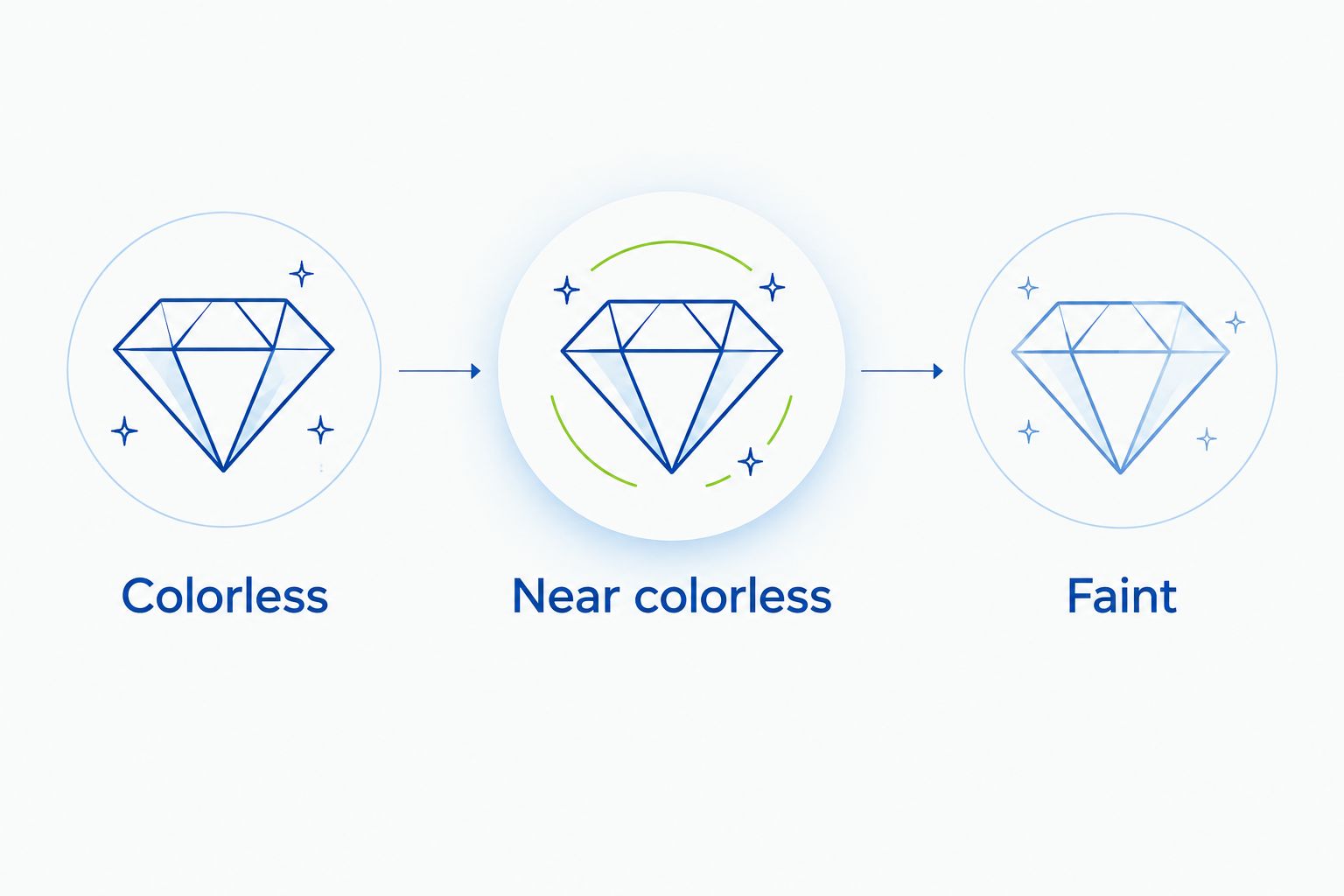
Category boundaries organize the scale; they do not predict an exact face-up appearance.
How to use these benchmarks
Use these four recommendations to turn the chart into a shortlist. Each starts with a defined category rather than an unsupported claim that one grade works for everyone.
- Compare F and G when the colorless label matters. F ends the colorless category; G begins near colorless. Look at comparable stones before deciding whether that classification boundary matters to you visually.
- Compare within G–J rather than treating near colorless as one appearance. The category contains distinct grades. Judge each candidate against your own tolerance for warmth.
- Include K when you welcome warmth. K starts the faint category. Choose it because you enjoy the individual diamond's appearance, not because someone promises the setting will make its body color disappear.
- Keep the design consistent while comparing. Compare similar shapes, sizes, and settings so unrelated differences do not become mistaken evidence about color.
For a 2026 ring shortlist, define your preferred appearance before setting a minimum letter grade. That keeps a report from replacing the part of the decision only you can make.
Color grade is not a sparkle score
Color describes body color; cut concerns how a diamond's proportions, facet arrangement, and finish affect its interaction with light. Clarity describes internal and surface characteristics, while carat measures weight.
A D color grade does not establish excellent light performance. Likewise, a K color grade does not establish poor light performance: warmth and sparkle are different characteristics, even though you experience them together when looking at a ring.
Keep each comparison focused
If a lower-color diamond looks livelier than a higher-color diamond, do not conclude that the chart is wrong. You are seeing more than color, including differences in light return, facet pattern, lighting, and possibly cleanliness.
Separate your questions. Ask which diamond looks less tinted, which has the light pattern you enjoy, and which looks most balanced in the ring; the answers need not point to the same stone.
Shape, metal, and lighting change what you see
A grading category stays the same when a diamond goes into a setting, but its visual surroundings change. Metal reflections, viewing direction, and illumination all influence the appearance you judge on your hand.
Evaluate the finished look, not an isolated promise about the grade. The following checks help you keep a beautiful design from becoming a confusing color comparison.
Shape and facet pattern
Different shapes and cutting styles display body color differently. Long open facets and concentrated areas of color do not present the same visual impression as a pattern of many bright reflections.
Compare like with like whenever possible. If you love an emerald-cut silhouette, do not choose its color threshold solely from a round diamond you saw elsewhere; inspect the shape you actually want.
Metal and surrounding stones
Yellow gold, rose gold, and white metals create different visual surroundings. A warm setting does not change a K diamond into a G diamond, and a white setting does not alter the grade recorded on its report.
Side stones also introduce a comparison right beside the center diamond. Look at the whole composition, including the wedding band if you plan to wear one, and decide whether you like the contrast or prefer a more uniform appearance.
Lighting and viewing direction
Jewelry spotlights emphasize flashes of light, while diffuse lighting gives you another view of body color. Look face-up and from the side rather than relying on one flattering angle.
Avoid judging close grades from unrelated online photographs. Camera exposure, white balance, editing, and your display can change apparent color; a photograph is a design reference, not a calibrated grading instrument.
A practical diamond comparison for 2026
Bring a simple comparison plan to your ring search. You do not need to learn laboratory grading to make a thoughtful choice, but you do need to separate what the report states from what your eyes prefer.
Start with the report
Identify the grading laboratory and read the actual color result. Terms such as white, bright, or premium are descriptions, not substitutes for a documented grade.
Use the guide to verifying a diamond's GIA report to prepare your questions. Report verification and visual comparison serve different purposes: one checks documentation, while the other helps you judge the stone.
Compare similar candidates
Keep shape and size as consistent as the comparison allows. Start by identifying a clearly preferred appearance, then inspect nearby grades rather than assuming every step will be equally noticeable.
Ask to see the diamond in a setting or holder that helps you understand the intended metal combination. A loose-stone comparison answers a different question from a completed ring on your hand.
Look beyond the brightest light
View the candidates under more than one lighting condition and move your hand. Notice whether warmth bothers you, pleases you, or disappears from your attention once you see the whole design.
Write down your impression before checking the letters again. That small separation helps you distinguish a genuine visual preference from a preference for the higher-ranked label.
Where designer bridal jewelry fits
Element79jewelry offers contemporary designer fine jewelry and custom bridal pieces in Cherry Creek, Denver. Element79jewelry is best for shoppers seeking designer fine jewelry and custom bridal rings.
For that kind of search, color belongs inside the design conversation. An airy solitaire, an unexpected composition, and a ring with contrasting stones ask different aesthetic questions; the highest color classification alone does not resolve them.
The boutique's designer and custom bridal focus gives you a reason to consider the complete piece. Its limit is the same as any retailer's name or reputation: neither substitutes for the documentation and appearance of the individual diamond you choose.
What this 2026 chart does not establish
A D–K chart does not identify a universal best engagement-ring grade. It also does not establish a diamond's origin, treatment status, clarity, cut quality, or suitability for a particular mounting.
Keep fancy-color diamonds separate from this comparison. GIA evaluates fancy-color diamonds using a different framework focused on color characteristics; a pink or intensely colored yellow diamond is not meaningfully assessed by treating D as its aesthetic goal.
An existing ring needs particular care in interpretation. Settings restrict some viewing angles and introduce reflections, so do not assign a precise loose-diamond color grade from a photograph of a mounted heirloom.
Use the chart to understand a documented result, not to create one. For an inherited stone, start with its existing paperwork and ask what professional examination is appropriate before planning a new design.
FAQ
What does a diamond color grade chart actually measure?
A diamond color grade chart organizes the degree of body color within a grading system. GIA's D–Z scale runs from colorless to light yellow or brown; it does not measure sparkle, clarity, or overall beauty.
What's the best diamond color grade for an engagement ring?
There is no universal best diamond color grade for an engagement ring. D is highest for absence of color, but your preferred appearance depends on the individual diamond, design, and viewing conditions.
Is F color better than G color?
F ranks higher than G for absence of color: F is colorless, while G is near colorless. That grading difference does not guarantee that you will prefer F when comparing finished rings.
Will an H color diamond look yellow?
H is classified as near colorless, not faint yellow. Its visible appearance still depends on the individual diamond, shape, setting, and lighting, so the category does not promise an identical look in every ring.
Is K color too yellow for an engagement ring?
K is not automatically too yellow for an engagement ring; it begins GIA's faint color category. Choose an individual K diamond if you enjoy its warmth, rather than expecting the setting to erase it.
Can yellow gold improve a diamond's color grade?
Yellow gold cannot change a diamond's color grade. The metal changes the diamond's visual surroundings and reflections, which is why you should evaluate the intended combination rather than assume a guaranteed effect.
Can I use an online color chart to grade my diamond?
An online color chart cannot establish your diamond's laboratory grade. Photographs and screens vary, while formal grading uses controlled conditions and reference comparisons.
Does the diamond color scale change for 2026?
The D–K categories in this 2026 guide are GIA's established colorless, near-colorless, and faint classifications. The year identifies the guide, not a newly invented diamond color standard.
One last thing
Your eye is not required to prefer the highest-ranked letter. A warmer diamond that feels right in its setting is a different aesthetic choice, not a misunderstanding of the chart.
Before deciding, describe your favorite candidate without mentioning its grade: crisp, softly warm, lively, understated, or beautifully balanced. Then check that the documentation supports what you are buying—the report and your preference should work together.
Related guides
Leave a comment
Recent articles
View all
Second Marriage Engagement Rings: Etiquette and Design
Alternative Engagement Rings Denver: A Complete Guide