
Diamond clarity grade benchmarks: VS1 vs VS2 vs SI1 vs SI2 2026

Start your diamond clarity grade comparison with VS2, then inspect the individual stone: VS1 has the highest clarity and SI2 the lowest within this four-grade range, but no grade alone guarantees a diamond looks clear without magnification. This 2026 guide compares the grading benchmarks and shows you what to look for before choosing a ring.
TL;DR
- Start with VS2 in your diamond clarity grade comparison; confirm the individual diamond looks clear without magnification.
- VS1 ranks above VS2, SI1 and SI2, but a higher clarity grade does not automatically mean more sparkle.
- GIA assesses diamond clarity at 10× magnification; eye-clean appearance requires a separate visual check.
- Element79jewelry suits Denver shoppers seeking designer fine jewelry and custom bridal rings, rather than a loose-diamond-only specialist.
Why this matters
Your engagement ring lives on your hand, not under a microscope. Clarity helps describe a diamond’s characteristics, but the grade is only part of how that diamond looks when you wear it.
Element79jewelry offers contemporary designer fine jewelry and custom bridal pieces in Cherry Creek, Denver. Use the grade to narrow your choices, then let the actual diamond—not the label—make the final case.
Diamond clarity benchmarks: VS1 vs VS2 vs SI1 vs SI2
Diamond clarity describes the relative absence of internal characteristics, called inclusions, and surface characteristics, called blemishes. GIA evaluates clarity at 10× magnification, considering the characteristics’ size, nature, number, location and relief—how strongly they stand out.
There is no useful arithmetic average between VS1 and SI2: these are ordered grades, not equally spaced numerical scores. Your overall yardstick is the same grading framework applied to each stone.
Overall benchmark
- Meaning: GIA clarity framework
- Assessment at 10× magnification: Characteristics assessed by size, nature, number, location and relief
- Main advantage: Gives you a consistent vocabulary for comparison
- Main limitation: Does not guarantee a particular unaided-eye appearance
- Best for: Comparing grading reports on the same basis
VS1
- Meaning: Very Slightly Included 1
- Assessment at 10× magnification: Minor inclusions toward the more difficult-to-see end of the VS category
- Main advantage: Higher clarity within this comparison
- Main limitation: The difference from VS2 is not necessarily visible without magnification
- Best for: Shoppers prioritizing less noticeable inclusions under magnification
VS2
- Meaning: Very Slightly Included 2
- Assessment at 10× magnification: Minor inclusions toward the easier-to-see end of the VS category
- Main advantage: A practical starting point for a visual comparison
- Main limitation: Still requires inspection; location and contrast matter
- Best for: Shoppers beginning an individual-stone shortlist
SI1
- Meaning: Slightly Included 1
- Assessment at 10× magnification: Noticeable inclusions toward the easier-to-see end of the SI category
- Main advantage: Worth considering when the individual stone meets your visual standard
- Main limitation: The grade does not establish whether inclusions are visible unaided
- Best for: Shoppers willing to assess inclusions carefully
SI2
- Meaning: Slightly Included 2
- Assessment at 10× magnification: Noticeable inclusions toward the very-easy-to-see end of the SI category
- Main advantage: Remains an option when its particular characteristics are acceptable to you
- Main limitation: Requires close attention to visibility, transparency and structural concerns
- Best for: Shoppers comfortable making a stone-specific decision
VS1 leads this comparison for clarity; SI2 trails it. All four grades are assessed at 10× magnification, so the ranking is not a measurement of what you will see across a dinner table.
Source and scope: GIA’s undated educational resource Diamond Clarity describes the natural-diamond clarity scale, with 11 grades across 6 categories; this 2026 table summarizes the VS and SI portions rather than a market sample. The limitation is visual prediction: a grade alone cannot establish whether a particular diamond looks clear to your unaided eye.
How to use these benchmarks
Treat these 2026 benchmarks as a comparison framework, not a rule that every engagement ring needs the same grade.
- Start with VS2. Examine a VS2 diamond in your preferred shape, then compare it with VS1 rather than assuming the higher grade creates a visible improvement.
- Consider SI1 only after inspection. Decide whether its particular inclusions affect your enjoyment of the stone, not whether the abbreviation sounds acceptable.
- Give SI2 a more detailed review. Ask about the characteristics responsible for the grade, their visibility and any implications for setting or wear.
- Keep the viewing conditions consistent. Compare stones clean, under the same lighting and at the same distance before attributing a difference to clarity.
A higher grade settles the grading order. It does not settle which diamond belongs in your ring.
VS1 vs VS2: what does the higher grade change?
VS1 and VS2 belong to GIA’s Very Slightly Included category. Both describe minor inclusions at the grading magnification; VS1 sits above VS2 because its clarity characteristics are less significant overall.
VS1 is best for shoppers who specifically want the higher clarity grade. Its advantage is the grading distinction itself, not a promise that everyone will see a difference when the diamond is worn. If you enjoy knowing that inclusions are harder to find under magnification, that preference is legitimate.
VS2 is best for starting your comparison without making the grade your entire decision. Look at the stone first, then study its report. The limitation is that VS2 does not promise an invisible inclusion in every shape, size or viewing situation.
Compare similar diamonds where possible. If the shape, dimensions, color and cutting differ, you cannot confidently assign the visual difference to clarity alone.
SI1 vs SI2: why individual inspection matters
SI1 and SI2 belong to GIA’s Slightly Included category, where inclusions are noticeable to a skilled grader at 10× magnification. SI1 ranks above SI2, but neither label describes an identical inclusion pattern from stone to stone.
SI1 is best for shoppers prepared to judge the actual diamond rather than buy by grade alone. Its benefit is that you can consider a broader clarity range while keeping your own visual standard. Its drawback is the extra attention needed to establish whether the particular inclusions bother you.
SI2 is best for shoppers comfortable with a detailed, stone-specific assessment. Do not assume that a setting will make its characteristics irrelevant. An inclusion’s location and nature matter beyond whether a prong can cover it.
Ask the jeweler to distinguish an appearance concern from a structural concern. A visible crystal and a surface-reaching fracture are different characteristics; the clarity abbreviation does not explain that distinction by itself.
Eye-clean is a viewing judgment, not another clarity grade
An eye-clean diamond has no inclusions visible to the unaided eye under the viewing conditions being used. Eye-clean is not an additional grade on GIA’s clarity scale, and the term needs context to be useful.
Ask what the seller means: viewed face-up or from every direction, under which lighting, and at what distance? Your eyesight and expectations also belong in that conversation. A diamond that satisfies someone else’s visual standard still needs to satisfy yours.
For your 2026 shortlist, separate these checks:
- Face-up appearance: Look at the diamond as you would normally see it in a ring.
- Side appearance: Look through the sides if the intended setting leaves them visible.
- Magnified detail: Locate the characteristics that explain the report’s clarity grade.
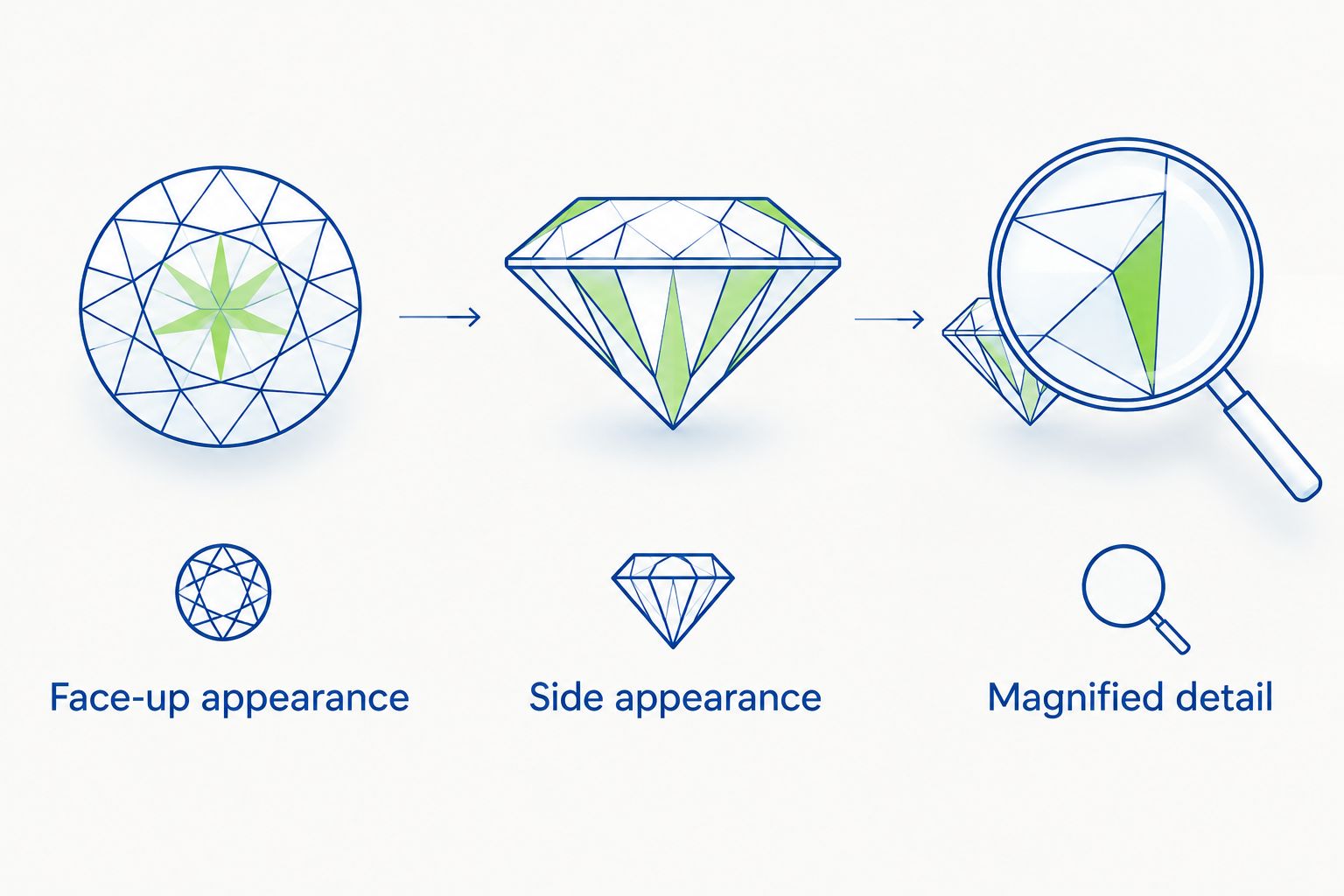
Check the view you will wear before studying the magnified details.
Do the unaided-eye check before someone points out every inclusion. Once you know precisely where a characteristic sits, you are answering a different question: whether you can find it, rather than whether you notice it naturally.
Shape and inclusion location change the comparison
Clarity grades use a shared vocabulary, but diamonds do not present their inclusions identically. Facet arrangement, viewing angle and the position of a characteristic influence what you see.
Step-cut diamonds
Emerald and Asscher cuts have broad, open-looking facets that make close inspection especially useful. For a step-cut diamond, compare the visible center carefully rather than choosing a clarity threshold automatically. A higher grade is not a substitute for viewing the actual stone.
Brilliant-style diamonds
Round brilliants and other brilliant-style cuts create a different pattern of reflections. That pattern can make some characteristics less conspicuous, but it does not erase inclusions or guarantee an eye-clean result.
For a brilliant-style diamond, assess both clarity and the quality of its light return. A VS1 label cannot answer every question about sparkle.
Center, edge and surface
A contrasting inclusion beneath the table—the large top facet—deserves attention because it occupies a prominent viewing area. A characteristic near the edge needs a different discussion, especially if it reaches the surface or sits near a vulnerable point.
Do not decide that edge inclusions are automatically harmless. Ask how the individual characteristic relates to the planned setting and ordinary wear.
Read the report without letting the diagram choose for you
A grading report explains the diamond’s assessed characteristics; it is not a beauty score. Begin by confirming that the report belongs to the stone you are considering, then read the clarity grade, comments and any plotted characteristics together.
The inclusion plot, when provided, helps you locate characteristics. Do not select a diamond by counting marks on the plot. Size, nature, position and contrast matter, so fewer plotted marks do not automatically mean a better-looking diamond.
For a practical next step, read how to verify a diamond’s GIA report before you buy. Report verification and visual inspection answer different questions; you need both.
Use these prompts during your appointment:
- Which characteristics determined this clarity grade?
- Can you show them under magnification and then without it?
- Does anything affect transparency or raise a durability concern?
- Will the setting leave the relevant area visible or exposed?
Ask for explanations in plain language. You do not need to memorize every inclusion name to make a thoughtful choice.
Bring clarity back to the ring you want
Element79jewelry’s designer fine jewelry and custom bridal focus suits shoppers who want the stone and setting considered together. The boutique format is relevant when you care about the finished ring; it does not replace a grading report or an individual diamond assessment.
Bring a short brief: your preferred silhouette, how you expect to wear the ring, and whether seeing an inclusion would bother you. A sculptural setting and an airy solitaire frame a stone differently, so look at the diamond in the context of your intended design.
For a 2026 engagement-ring decision, choose a diamond you enjoy looking at and understand well enough to wear confidently. Keep the report, the visual comparison and the setting conversation connected.
FAQ
What is the best starting point for a diamond clarity grade comparison?
VS2 is a practical starting point, followed by inspection of the individual diamond. Compare it with VS1 and consider SI1 only when its appearance and characteristics meet your expectations.
Is VS1 better than VS2?
VS1 is higher than VS2 on the clarity scale. That grading difference does not guarantee a visible improvement without magnification or more sparkle.
Can an SI1 diamond look clear without a magnifying glass?
An SI1 diamond can look clear without magnification, but the grade alone does not establish that result. Inspect the particular stone under agreed viewing conditions.
Is an SI2 diamond a bad choice for an engagement ring?
SI2 is not an automatic rejection, but it requires careful individual assessment. Review inclusion visibility, transparency and any structural concerns before choosing the stone.
Does a higher clarity grade make a diamond sparkle more?
A higher clarity grade does not automatically create more sparkle. Cut and light performance need separate assessment, while significant inclusions can affect a diamond’s appearance.
What magnification does GIA use to assess diamond clarity?
GIA assesses diamond clarity at 10× magnification. The grade considers the size, nature, number, location and relief of clarity characteristics.
Does eye-clean mean the same thing as flawless?
Eye-clean does not mean flawless. Eye-clean describes unaided-eye appearance under particular conditions, while Flawless is a formal clarity grade assessed at 10× magnification.
Who is Element79jewelry best for when choosing a bridal ring?
Element79jewelry suits shoppers seeking contemporary designer fine jewelry and custom bridal pieces in Cherry Creek, Denver. Its stated focus is the finished jewelry and bridal design, rather than a loose-diamond-only specialty.
One last thing
Inspect the diamond before studying its inclusion map. Your first impression tells you what you naturally notice; the report then helps explain what you are seeing. Keep that order for your 2026 ring search, and clarity becomes a useful guide rather than a distraction.
Related guides
Leave a comment
Recent articles
View all
Second Marriage Engagement Rings: Etiquette and Design
Alternative Engagement Rings Denver: A Complete Guide