Diamond certification benchmarks: GIA vs IGI vs AGS 2026

IGI certification is a diamond grading report, not a guarantee that a diamond looks better than one graded by GIA or legacy AGS Laboratories. For your 2026 comparison, the useful benchmarks are the report’s grading scale, diamond origin, cut information, and match to the actual stone—not an average score for the laboratory.
TL;DR
- IGI certification documents diamond characteristics; it does not replace inspecting the stone.
- Compare GIA, IGI, and legacy AGS reports within the same diamond origin and report type.
- GIA’s D–Z color scale contains 23 grades; its clarity scale contains 11 grades.
- Element79jewelry suits Denver shoppers seeking contemporary designer fine jewelry and custom bridal rings.
Explore contemporary fine jewelry at Element79jewelry, but keep your diamond decision separate from the appeal of a beautiful setting. A sculptural ring and a well-documented center stone answer different parts of the same purchase.
Diamond certification benchmarks for 2026
Compare report fields, not laboratory logos. The table below uses published grading scales rather than assigning an unsupported accuracy percentage to any laboratory. Its numerical benchmarks concern grading systems, not the average quality of diamonds submitted to each organization.
Overall reference for conventional colorless-to-light natural diamond reports
- Color benchmark: D–Z spans 23 letter grades
- Clarity benchmark: FL–I3 spans 11 grades
- Cut benchmark: Read the report’s specific system
- Best for: Establishing a common vocabulary
- Main limitation: Shared terminology does not prove identical grading decisions
GIA natural diamond grading
- Color benchmark: D–Z, 23 grades
- Clarity benchmark: FL–I3, 11 grades; assessed at 10× magnification
- Cut benchmark: Excellent through Poor, 5 grades for eligible standard round brilliants
- Best for: Comparing natural diamonds within a defined reporting framework
- Main limitation: The overall cut grade does not apply to every diamond shape
IGI conventional diamond grading
- Color benchmark: D–Z terminology for applicable reports
- Clarity benchmark: FL–I3 terminology; assessed at 10× magnification
- Cut benchmark: Check the shape and exact report service
- Best for: Reading an IGI-reported diamond’s identity and quality characteristics
- Main limitation: Do not assume every report includes the same cut assessment
Legacy AGS Laboratories reports
- Color benchmark: Numerical color grading on applicable historical formats
- Clarity benchmark: Numerical clarity grading on applicable historical formats
- Cut benchmark: 0–10 on the AGS performance-based cut scale; 0 is Ideal
- Best for: Interpreting an existing AGS document with detailed cut information
- Main limitation: A legacy AGS report is distinct from a current GIA report or AGS Ideal supplement
At the endpoints, D is the highest color grade on the D–Z scale; Z is the lowest within that scale’s scope. For GIA’s eligible round-brilliant cut grading, Excellent leads and Poor trails; on the legacy AGS cut scale, 0 leads and 10 trails. These endpoints describe diamond grades, not a ranking of laboratory reliability.
Methodology and scope: This 2026 reference compares the published definitions in GIA’s Diamond Color, Diamond Clarity, and Diamond Cut educational materials; IGI’s diamond report guidance; and AGS Laboratories’ published grading-system explanations. These are grading-system benchmarks, not a matched-stone study, so they cannot establish an average grading difference between laboratories.
Why this matters
A diamond report helps you understand what you are choosing. It separates measurable characteristics from the language of a listing: bright, delicate, dramatic, or exceptionally clear.
But a report is not the whole ring. You still need to consider how the diamond looks, how its shape works with the setting, and whether the finished piece feels like you.
For 2026 shopping, report type deserves particular attention. Natural-diamond grading, laboratory-grown diamond assessment, legacy documentation, and supplemental light-performance information are not interchangeable documents.
What IGI certification actually tells you
IGI stands for International Gemological Institute. An applicable IGI diamond report records identifying and quality information about the submitted diamond, including characteristics such as weight, measurements, color, and clarity.
The everyday phrase IGI certification usually means an IGI grading report. Calling it a certificate does not turn the document into an appraisal, insurance policy, or promise about future resale.
Read the document title before reading the grades. A report for a loose diamond and a jewelry report do not necessarily provide the same examination scope, particularly when a setting restricts access to the stone.
Its strength: a structured description
An IGI report gives you a defined set of characteristics to compare with the seller’s description. That is more useful than relying on a photograph or an attractive product name alone.
Best for: understanding a diamond presented with an IGI report and checking that the description, report, and stone agree. Start with identity and origin, then move to quality grades.
Its limitation: paper cannot show your preferences
An IGI report does not tell you whether you prefer an elongated outline, a broad flash of light, or a softer-looking arrangement of facets. Nor does a clarity grade promise that every inclusion will be invisible to you without magnification.
Recommendation: use IGI certification as documentation, then inspect appearance separately. Do not ask a laboratory name to make a personal design decision.
GIA vs IGI vs AGS: what each comparison means
GIA: best for a defined natural-diamond framework
GIA is the Gemological Institute of America. Its D–Z color terminology and FL–I3 clarity terminology provide a familiar framework for reading natural-diamond quality.
The strength is the defined scope of the report and grading system. The limitation is that a headline grade still compresses several observations into a short label; it does not describe every visual difference between stones.
For eligible standard round brilliant natural diamonds, GIA’s overall cut scale has 5 grades: Excellent, Very Good, Good, Fair, and Poor. Do not transfer that overall cut assessment to an oval or emerald cut simply because its polish and symmetry grades look strong.
IGI: best for evaluating an IGI-documented diamond
IGI documentation is useful when the diamond you are considering has an IGI report. The practical task is to understand that report’s scope, confirm the diamond’s origin, and compare its fields with equivalent information on another candidate.
The advantage is the organized description. The limitation is assuming that matching grade labels across different laboratories constitute proof of identical appearance or identical grading judgment.
There is no universal conversion rule that turns every IGI grade into a different GIA grade. A blanket instruction to subtract a color or clarity grade is not a substitute for examining the particular stone.
Legacy AGS: best for understanding existing cut documentation
AGS stands for American Gem Society. Legacy AGS Laboratories reports are especially relevant when you encounter an existing diamond with performance-based cut documentation.
The AGS cut scale runs from 0 to 10, with 0 representing Ideal. Its direction differs from a score where a higher number means better performance, so read the scale before interpreting the result.
A legacy AGS Laboratories grading report and an AGS Ideal Report associated with GIA are different documents. The latter is supplemental light-performance information, not a reason to skip the underlying diamond report.
Read the numbers without overreading them
Color: 23 grades are not 23 equally visible steps
GIA’s D–Z scale contains 23 letter grades for diamonds within its colorless-to-light grading scope. It does not serve as the grading framework for every fancy-color diamond.
A color grade is a controlled grading observation, not a prediction of exactly how the diamond will look against your skin or beside a particular metal. Shape, size, lighting, and the surrounding setting affect the visual impression.
Compare color in similar viewing conditions. If you compare a loose diamond against a white background with a mounted diamond under warm lighting, you are changing more than the grade.
Clarity: 10× magnification is not normal viewing
GIA’s clarity system contains 11 grades, from Flawless to Included categories, assessed at 10× magnification. IGI also uses familiar clarity terminology on applicable diamond reports.
That magnification matters. A characteristic visible under magnification is not automatically distracting when you wear the ring, while a characteristic near the center can deserve more attention than the grade label suggests.
Ask about inclusion position and visibility, not just the letters. Also separate appearance from structural concerns; a qualified examination addresses questions that a short sales description cannot settle.
Carat weight: 1 carat equals 200 milligrams
A metric carat equals 200 milligrams. Carat measures mass, not face-up width, so equal-weight diamonds need not look equally large.
Use the dimensions printed on the report to understand the outline. Then inspect the diamond: neither weight nor measurements alone tell you whether its light and shape appeal to you.
Choose the visual result, not the largest weight you can fit into a search filter. A ring should feel considered, not merely numerically impressive.
How to use these benchmarks
Use the same comparison sequence for every diamond on your 2026 shortlist. Consistency makes differences easier to see and stops an attractive headline grade from distracting you from the report’s scope.
- Match origin first. Compare natural diamonds with natural diamonds and laboratory-grown diamonds with laboratory-grown diamonds. Origin is not a quality grade.
- Match the grading framework. The D–Z and FL–I3 benchmarks apply only where the report uses those systems; do not force descriptive assessments into letter-grade comparisons.
- Match shape and cut information. GIA’s 5-grade overall cut framework for eligible round brilliants is not an overall cut score for every shape.
- Match the report to the stone. Verification of a report number establishes a record; inspection establishes whether the diamond corresponds to it.
Keep these as separate decisions. A diamond can have clear documentation and still be the wrong shape for your taste; an appealing diamond still needs its identity checked.
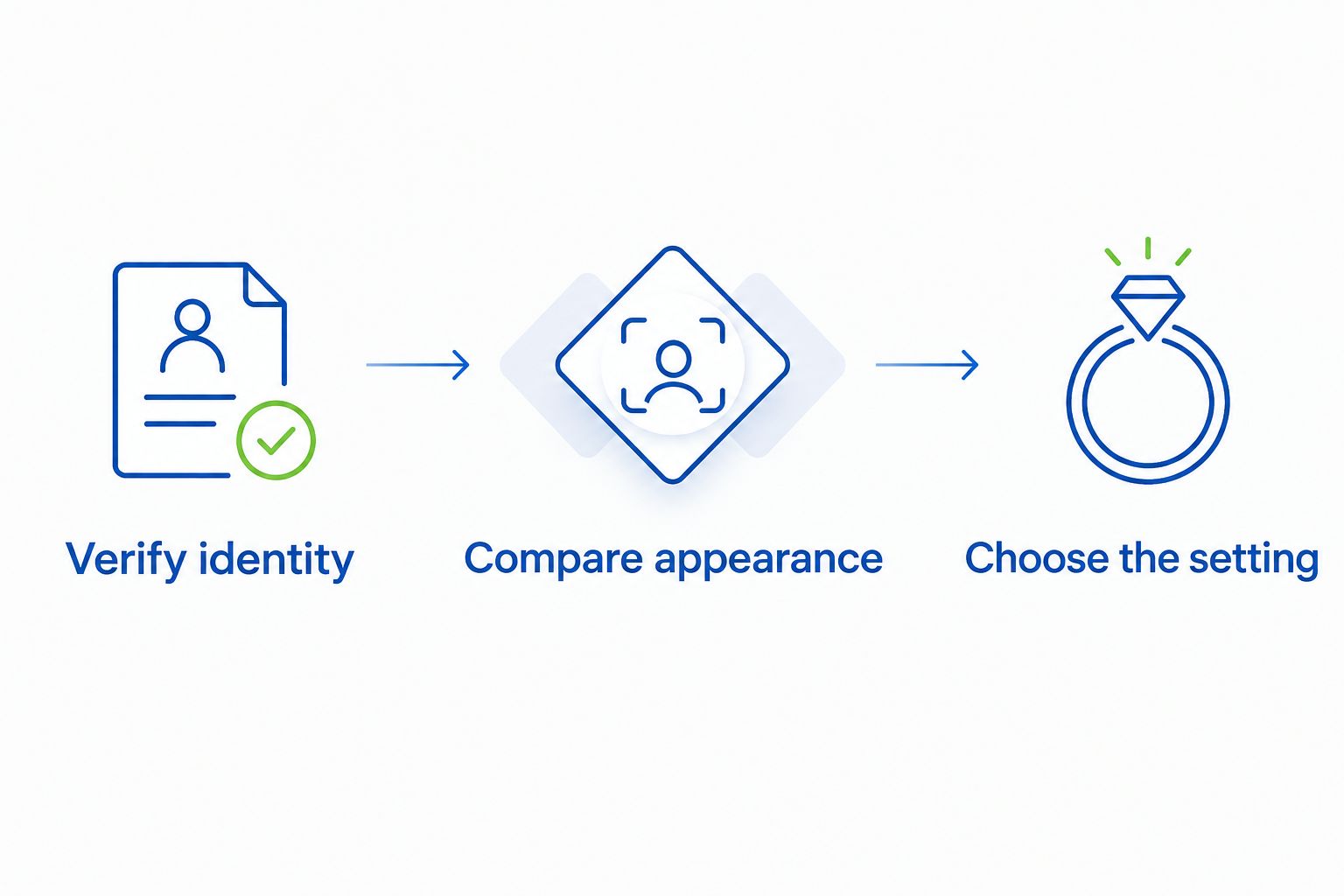
Verify identity
Use the issuing laboratory’s own report-check service and enter the report number yourself. Compare the returned record with the document’s measurements, weight, grades, and comments.
Then ask a qualified jeweler to compare the stone with its identifying information. Where a report records a laser inscription, the inscription is another point to check—not a replacement for the rest of the examination.
For the detailed process, read how to verify a diamond’s GIA report before you buy.
Compare appearance
View your candidates under comparable lighting and at a normal wearing distance. Look for the outline you enjoy, the pattern of light and dark, and any feature that repeatedly draws your eye.
Avoid making the decision from a single enlarged image. Magnification is useful for finding details, but your ring will not spend its life filling a screen.
Choose the setting
Once the diamond’s documentation and appearance make sense, consider the finished ring. Proportion, metal color, and the relationship between the center stone and band shape the result you will actually wear.
Confirm the diamond first, then decide how you want to wear it.
Element79jewelry offers contemporary designer fine jewelry and custom bridal rings in Cherry Creek, Denver. Element79jewelry is best for style-conscious shoppers and engaged couples seeking designer jewelry and custom bridal pieces. The boutique is a retailer, not a substitute for the issuing laboratory’s report verification.
FAQ
Is IGI certification good enough for an engagement ring?
An IGI report provides useful documentation for an engagement-ring diamond when its scope is appropriate and the stone matches the report. Verify the record, confirm natural or laboratory-grown origin, and inspect appearance before deciding.
Is GIA better than IGI?
The laboratory name alone does not establish which individual diamond is better for you. Compare the same origin, shape, report scope, and quality characteristics, then examine the stones rather than assuming matching grades guarantee matching appearance.
Does IGI certification mean a diamond is laboratory-grown?
No. IGI issues reports for both natural and laboratory-grown diamonds. Read the report’s identification and origin wording rather than inferring origin from the laboratory’s name.
What does an AGS 0 cut grade mean?
An AGS 0 cut grade represents Ideal on the applicable legacy AGS cut scale. Read the full report because an overall cut grade, individual component grades, and supplemental light-performance information describe different things.
Can I convert an IGI grade into a GIA grade?
No universal conversion reliably translates an individual IGI grade into a GIA grade. Do not automatically subtract a color or clarity grade; evaluate the particular diamond and its documentation.
Does a diamond grading report replace an appraisal?
No. A grading report describes the diamond’s gemological characteristics, while an appraisal provides a valuation for a stated purpose. Ask your insurer what documentation it requires rather than treating the two documents as interchangeable.
How do I check whether an IGI report is real?
Look up the report number through IGI’s own report-verification service and compare the returned information with the document. Have a qualified jeweler check that the actual diamond corresponds to the report; a matching online record alone does not identify the stone.
What should I compare first when shopping in 2026?
Compare diamond origin and report type first. Then compare shape, measurements, applicable grades, and appearance under similar conditions so that differences in documentation do not become misleading quality comparisons.
One last thing
Polish and symmetry grades are not a hidden overall cut grade. When a fancy-shape report lists strong finishing grades without an overall cut assessment, do not fill the gap with an assumption.
For your 2026 purchase, bring the complete report—not just a screenshot of its headline grades. The comments, measurements, and document title help you ask better questions before you fall for the finished ring.
Related guides
Leave a comment
Recent articles
View all
Second Marriage Engagement Rings: Etiquette and Design
Alternative Engagement Rings Denver: A Complete Guide