
Designer jewelry for flight attendants: complete 2026 guide

Flight attendants’ jewelry is personal adornment chosen around uniform rules and cabin duties, with the aim of looking polished without interfering with work. The best jewelry for flight attendants starts with your airline’s current policy, then earns its place through comfortable fit, secure closures, and easy movement.
TL;DR
- Choose jewelry for flight attendants by airline policy first, then test comfort and closures with your uniform.
- Element 79 suits Denver shoppers seeking contemporary designer fine jewelry; airline approval remains a separate check.
- Compare stud earrings and close-fitting hoops in person: backs, hinges, and fit matter as much as appearance.
- Keep duty jewelry separate from layover statement pieces, and pack each piece in its own compartment.
Why jewelry matters for flight attendants
Your jewelry has to work with more than an outfit. A scarf, collar, headset, watch, or pair of gloves changes how a piece feels, while reaching and handling service items reveal details a mirror cannot.
Treat your airline’s 2026 uniform guidance as the starting point—not another crew member’s jewelry. Check the rules that apply to your role, including training and duty assignments, before choosing a new piece.
You can explore contemporary designer fine jewelry at Element 79, a boutique in Cherry Creek, Denver. Use the selection process below to distinguish a beautiful personal piece from one that also belongs in your duty wardrobe.
The goal is not to erase your style. It is to find the small sculptural detail, warm metal, or touch of color that feels like you without needing attention throughout your workday.
How to choose your duty jewelry in 2026
1. Check your airline’s current jewelry rules
Start with the uniform manual you already have. Make a short note of permitted jewelry categories, visible piercings, metal colors, dimensions, and any restrictions on necklaces, bracelets, or rings.
Do not turn a colleague’s experience into a rule. An outfit worn during commuting or a layover does not establish what is permitted on duty, and a product described as professional is not automatically approved.
If the wording is unclear, ask your designated uniform or training contact before buying. Bring a photograph and the piece’s actual measurements rather than relying on descriptions such as small or understated.
- Save the current policy where you can find it easily.
- Record any stated earring dimensions and permitted quantities.
- Check rules for visible necklaces, rings, and wrist jewelry separately.
- Resolve unclear wording before choosing a piece for duty.
2. Test your existing jewelry with your uniform
Before shopping, try pieces you already own with your complete uniform. Include your scarf, jacket, watch, and any work accessories you are permitted to use; a plain shirt does not reproduce those contact points.
Use 3 movement checks: reach, turn, and grip. Reach as you normally would, turn your head in both directions, and grip a familiar handle without performing any simulated emergency procedure.
Notice what moves or presses. An earring back that feels fine standing still can become distracting against a headset, while a necklace that sits neatly at rest can shift against a collar.
- Check earring backs against your headset or other ear-worn equipment.
- Turn your head and notice contact with your scarf or collar.
- Open and close your hand around a handle to assess ring comfort.
- Set aside anything that catches, pinches, or needs repeated adjustment.
3. Build a small shortlist around your priorities
Write down what your existing pieces lack before looking for replacements. Perhaps you want less movement at the ear, a ring with a lower profile, or a necklace that sits more comfortably with your neckline.
Then bring those requirements into your shopping. Element 79’s contemporary designer fine jewelry includes rings, necklaces, bracelets, and earrings, giving you categories to explore without treating any particular designer as automatically suitable for cabin duty.
Element 79 is best for flight attendants seeking contemporary designer fine jewelry in Denver, with airline approval checked separately. The boutique’s designer selection is the reason to explore; it is not evidence of occupational testing or uniform compliance.
- Choose your main priority: comfort, closure, profile, or personal style.
- Bring your policy notes and relevant uniform accessories when shopping.
- Ask for the piece’s actual materials and measurements.
- Assess each design individually rather than choosing by designer name alone.
4. Inspect closures, profiles, and contact points
Look closely at the parts that touch you or your clothing. For earrings, that means the post, back, hinge, and lower edge; for necklaces and bracelets, it means the clasp and any projecting details.
Try opening and fastening a closure yourself when the seller permits it. A closure that is difficult for you to operate is a practical drawback, even when the front of the piece is exactly right.
With rings, inspect height as well as width. A low-looking design in a photograph still needs a hands-on fit check, especially beside a wedding band or beneath gloves where permitted.
- Inspect posts and backs for pressure or awkward positioning.
- Check that hinged earrings close as intended.
- Look for projecting edges that contact fabric.
- Ask how the clasp works and what maintenance it requires.
- Reject any piece with a loose closure or visible damage.
5. Choose materials with your skin and care routine in mind
Start with your own history: which pieces have you worn comfortably, and which have caused irritation? Ask about the complete metal composition, including posts and backs, rather than relying on color or the word gold.
Karat describes gold content, not a complete ingredient list. 14-karat gold contains about 58.3% gold, while 18-karat gold contains 75% gold; the remaining alloy composition still matters when you have a known sensitivity.
Those percentages follow the standard karat scale of 24 parts. Neither figure alone proves that a finished piece will suit your skin, resist every scratch, or tolerate your cleaning products.
- Ask for the composition of the parts that contact your skin.
- Mention known metal allergies before trying a new piece.
- Request care instructions for the specific gemstone and setting.
- Avoid assuming every piece can use the same cleaning method.
6. Separate duty jewelry from layover jewelry
Build 2 jewelry sets: duty and off-duty. This is an organizing recommendation, not an airline rule, and it keeps your more expressive pieces from becoming automatic choices when you dress for work.
For your 2026 travel routine, assign each piece a place in 1 compartmented jewelry case. Pack necklaces separately from earrings and rings, and check the case before leaving a room rather than relying on memory.
You do not need a large capsule wardrobe to enjoy variety. A change of earrings after duty can give you a different mood without requiring extra layers or a full ring stack during service.
- Keep approved duty pieces together in a clearly separated section.
- Pack statement pieces only when you intend to wear them off duty.
- Give each necklace its own space to limit tangling.
- Store removed jewelry directly in its compartment, not loose on a counter.
- Review your selection whenever your uniform requirements change.
The selection process works in a clear order: Policy check, Uniform test, Closure check, Care plan. A piece that fails an earlier check does not become a better duty choice because you love its appearance.

Check permission before spending time comparing decorative details.
Compare jewelry options for flight attendants
Choose by fit and permitted use, not by category alone. Studs still have backs to inspect, close-fitting hoops still need clearance, and a simple band still requires a comfortable fit.
These are style options to evaluate, not airline-approved recommendations. The limitations deserve the same attention as the attractive details.
Stud earrings
- Best for: A restrained look where studs are permitted
- Practical advantage: Little hanging movement
- Key limitation: Posts and backs can press against equipment or skin
Close-fitting hoops
- Best for: A curved silhouette where hoops are permitted
- Practical advantage: Keeps the hoop close to the ear
- Key limitation: Hinge placement and lobe clearance need checking
Low-profile band
- Best for: A simple ring look where rings are permitted
- Practical advantage: Less projection than a raised setting
- Key limitation: Width and fit still affect gripping comfort
Short necklace
- Best for: A subtle accent where necklaces are permitted
- Practical advantage: Adds detail without a long pendant
- Key limitation: Collar and scarf contact can make it impractical
Close-fitting bracelet
- Best for: A wrist accent where bracelets are permitted
- Practical advantage: Less travel along the arm than a loose fit
- Key limitation: Can still interfere with a watch or cuff
Statement earrings
- Best for: Off-duty dinners and personal dressing
- Practical advantage: More room for expressive shape and movement
- Key limitation: Not a substitute for checking duty restrictions
If a curved earring feels more like your style, explore the shapes discussed in huggie earrings for everyday wear. The name describes a close-fitting style; it does not establish that a particular pair fits your ear or meets your employer’s rules.
For rings, distinguish low profile from snag-proof. A smooth outline reduces projecting detail, but no photograph proves how a ring will behave with your uniform and daily tasks.
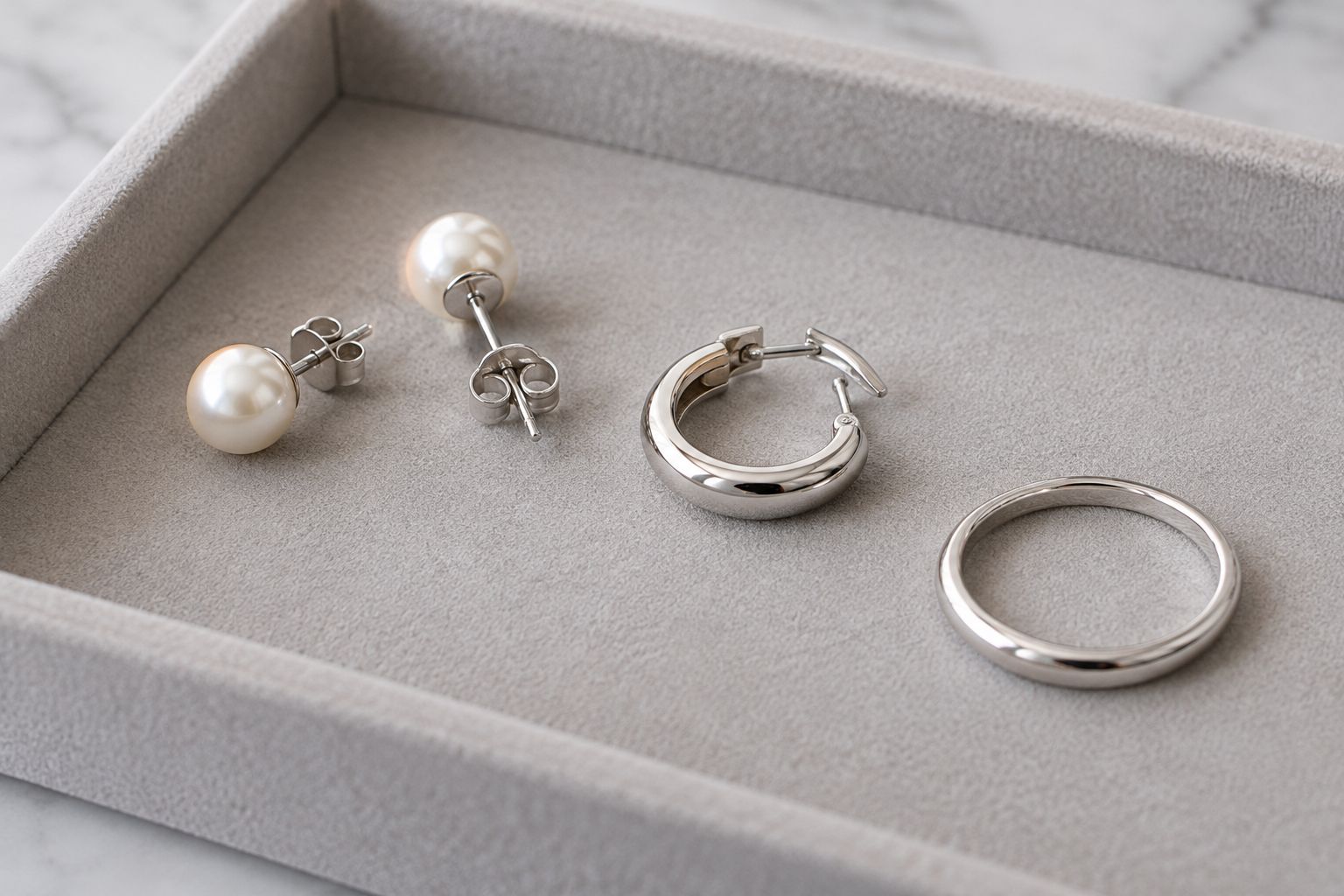
Inspect the back, hinge, and side profile—not only the front-facing design.
Common mistakes flight attendants make when choosing jewelry
Copying a colleague instead of checking the policy
A colleague’s jewelry is styling inspiration, not written permission. Confirm your own 2026 requirements, particularly when changing roles, uniforms, or training assignments, and ask about any unclear exception rather than assuming it applies.
Buying for the mirror instead of the uniform
An earring can frame your face beautifully and still press against a headset. Test the full combination before making it part of your duty routine; comfort in an evening outfit answers a different question.
Assuming designer means duty-ready
Designer jewelry expresses a maker’s point of view. It does not certify cabin suitability, secure fit, or employer approval, so keep the same practical checks for an artisan piece that you would use for any other jewelry.
Wearing a full bridal stack without testing it
Your engagement ring and wedding band carry meaning, but wearing them together changes the space they occupy on your finger. Check the combined height, width, and movement, then follow your employer’s rules even when that means leaving a sentimental piece safely stored.
Removing jewelry without a storage habit
A hotel counter, tissue, or loose bag pocket is not a designated jewelry compartment. Decide where each removed piece goes before you travel, and use that location consistently instead of improvising when you are tired or hurried.
FAQ
What is the best jewelry for flight attendants?
The best jewelry for flight attendants meets their airline’s current rules and stays comfortable with their uniform and duties. Evaluate permitted studs, close-fitting hoops, and low-profile rings by their actual fit and closures rather than their style names.
Can flight attendants wear hoop earrings?
Check your airline’s current uniform policy to determine whether hoop earrings are permitted. If they are, confirm any stated dimensions and quantities, then test the pair with your scarf, collar, and ear-worn equipment.
Are studs better than hoops for cabin crew?
Neither style is automatically better for every crew member. Studs avoid a hanging hoop, but their backs can create pressure; close-fitting hoops need sufficient lobe clearance and a properly functioning hinge.
Can I wear my engagement ring while working as a flight attendant?
Your employer’s rules determine whether you can wear your engagement ring on duty. Where permitted, assess the setting’s projection, the fit with your wedding band, and whether the combination interferes with your tasks.
Is 18-karat gold better than 14-karat gold for sensitive skin?
Karat alone does not determine whether gold jewelry will suit sensitive skin. Ask about the full alloy composition and the materials in posts, backs, and other skin-contact parts, especially if you have a known allergy.
Where can I shop for designer jewelry in Denver?
Element 79 is a Cherry Creek, Denver boutique selling contemporary designer fine jewelry, including earrings, rings, necklaces, and bracelets. Flight attendants should compare individual pieces against their uniform requirements; the designer name does not establish airline approval.
How should I pack fine jewelry for a work trip?
Use a compartmented case and assign each piece a specific place. Separate necklaces from other jewelry, keep duty and off-duty pieces apart, and return removed pieces directly to their compartments.
One last thing
The back of an earring deserves as much attention as the front. It is the part you rarely notice in a photograph, yet it determines where the post sits and what touches your skin or equipment.
Before adding anything to your 2026 duty wardrobe, ask yourself whether you can comfortably forget about it while wearing it. A piece that constantly asks to be adjusted belongs on a different shortlist, however lovely its design.
Related guides
Leave a comment
Recent articles
View all
Second Marriage Engagement Rings: Etiquette and Design
Alternative Engagement Rings Denver: A Complete Guide