Celine Daoust Jewelry: Celestial Gift Guide 2026
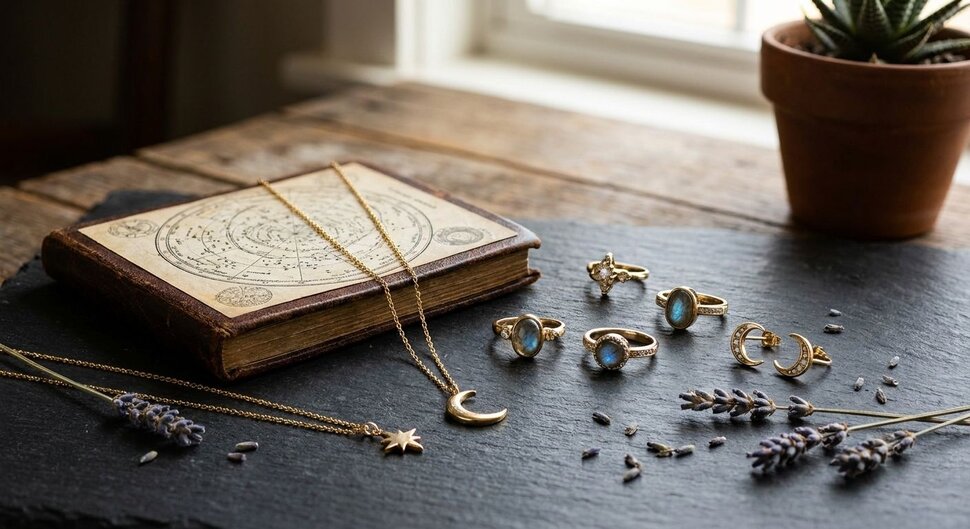
Celine Daoust jewelry built its reputation on celestial motifs — crescent moons, star clusters, and cosmic symbolism cast in gold and set with diamonds. If that dreamy, night-sky aesthetic is the gift you're chasing in 2026, this guide breaks down what actually defines the celestial look, how to shop it without buying a mall-store knockoff, and where a Denver shopper can find pieces that carry the same spirit.
TL;DR
- Celine Daoust jewelry is known for moon, star, and cosmic motifs in gold and diamonds — not solitaire classics.
- Element 79 doesn't carry the Celine Daoust line, but Petra Class and Spinelli Kilcollin pieces share the same organic, celestial texture.
- Match metal tone to what the recipient already wears before you match the motif — a gold-only wearer skips a silver moon pendant.
- A celestial gift lands harder tied to the recipient's real birth chart than to a generic star charm.
- Book a private viewing at the Cherry Creek boutique before buying a celestial-adjacent piece sight unseen.
Why this matters for celestial-gift shoppers
Celestial jewelry sits in an odd spot: it's specific enough to feel personal, symbolic enough to carry meaning, and generic enough that half the pieces sold under "celestial" are indistinguishable stamped moons from a mall counter. Celine Daoust jewelry earned its following because the celestial motif is executed with texture and asymmetry, not a flat die-stamped shape. That distinction matters more to a gift-giver in 2026 than most people realize going in.
If you're buying for someone who already collects designer pieces — an Element 79 Cherry Creek boutique regular, for instance — a flat mass-market star charm will read as a downgrade next to what's already in their jewelry box. The goal is matching craftsmanship level, not just theme.
Define which celestial motif actually fits the recipient
Celestial jewelry isn't one category — it's a handful of distinct visual languages, and picking the wrong one is the most common gifting mistake in this space.
- Moon phase — crescent, half, or full moon, often worn as a pendant
- Star cluster — scattered single stars or a constellation shape
- Sun disc — a rounder, warmer motif that pairs better with bold, statement wearers
- Zodiac symbol — a specific glyph or constellation tied to a birth month
Ask what the recipient already gravitates toward before you pick a symbol. A minimalist who wears one thin chain daily wants a single crescent moon, not a five-star cluster earring.
Match the metal to what they already wear
The motif matters less than the metal tone if the piece is going to get daily wear instead of sitting in a drawer.
- Yellow gold for someone whose everyday pieces skew warm
- White gold or platinum for a cooler, more minimal wardrobe
- Rose gold for a softer, romantic palette
- Mixed metal only if they already stack mixed tones — it's a bolder call, not a safe default
Getting metal tone wrong is the single fastest way to turn a thoughtful celestial gift into a piece that never leaves the box.
Pick a piece style for how they'll actually wear it
A celestial motif can show up as a pendant, a stud, a ring, or a cuff, and each format assumes a different level of daily commitment from the wearer.
- Pendant necklace — the most common celestial format, easy to layer
- Stud or huggie earrings — subtle, works for someone who doesn't wear statement pieces
- Cocktail or stacked ring — better for someone who already wears rings on multiple fingers
- Cuff or bangle — bolder, best for someone with a stacked-wrist habit already
Verdict: pendant necklaces are the safest celestial gift format because they don't require guessing a ring size or ear-piercing preference.
Check for real craftsmanship signals, not just the shape
This is where Celine Daoust jewelry earns its price point versus a generic star pendant: the surface texture, the asymmetry of a hand-set stone, the weight of the metal itself.
- Look for slightly irregular, hand-finished edges rather than a perfectly symmetrical stamped shape
- Check whether stones are bezel-set (more durable for daily wear) or prong-set (more sparkle, less durability)
- Ask about the gold karat — 14k wears better daily than 18k for someone rough on jewelry, while 18k holds richer color
- Confirm hallmark stamps are present, a basic authenticity signal on any fine jewelry piece
Element 79 carries this same craftsmanship standard through its own artisan roster — Petra Class's nature-inspired pieces use the same hand-textured, organic surface approach that celestial-motif collectors respond to, even though the imagery leans botanical rather than cosmic.
Tie the design to their actual sky, not a generic star charm
The strongest version of a celestial gift ties the symbol to something specific about the recipient — their sun sign, their birth month constellation, or their moon placement — instead of a generic five-point star that could belong to anyone.
If you actually want to get the astrology detail right, a birth chart depends on more than the sun sign most people know off the top of their head. The rising sign and moon sign shift by the hour, and if you don't know the recipient's exact birth time, you can still work out the placement — you can discover your rising sign using an approximate time and location instead of guessing. That extra ten minutes of research is what separates a generic star pendant from a gift that reads as personal.
Book time with a jeweler before you buy sight-unseen
Celestial pieces live and die on texture and scale — a moon pendant that looks delicate in a product photo can read as tiny or oversized in person, and no online listing captures that accurately.
See celestial-adjacent pieces in person
Book a private viewing at the Cherry Creek boutique before you commit.
Celestial-style options compared for 2026
Celine Daoust jewelry
- Best for: Shoppers set on the celestial designer specifically
- Aesthetic focus: Moon, star, and cosmic motifs in gold and diamonds
- Key limitation: Not carried at Element 79 — sourced through the designer's own retail channels
Spinelli Kilcollin's linked rings
- Best for: Someone who already stacks rings daily
- Aesthetic focus: Interlocking, orbit-like ring forms
- Key limitation: Reads more architectural than literally celestial
Petra Class
- Best for: Someone who wears organic, textured gold
- Aesthetic focus: Hand-hammered, nature-adjacent surfaces
- Key limitation: Botanical, not literal star or moon imagery
Mall-store star pendant
- Best for: Budget-first buyers with no craftsmanship priority
- Aesthetic focus: Flat, symmetrical stamped shapes
- Key limitation: Thin gold plating, no hand-finishing, low resale value
Verdict: if the celestial motif itself is non-negotiable, Celine Daoust jewelry is the closest match on the market — but if you want that craftsmanship level from a boutique you can walk into in Cherry Creek, Spinelli Kilcollin's orbit-form rings are the nearest equivalent in feel.
Common mistakes celestial-gift shoppers make
- Buying the symbol, not the wearer — a stunning moon pendant is a bad gift if the recipient only wears studs
- Confusing "celestial" with cheap — mass-produced star charms get lumped in with designer celestial work, and the two are not interchangeable in quality or longevity
- Skipping the metal-match step — gifting rose gold to someone who owns nothing but white gold guarantees the piece sits in a drawer
- Guessing the astrology instead of checking it — a sun-sign-only gift ignores the moon and rising placements that give a chart its real specificity
- Buying sight-unseen for a first designer piece — scale and texture rarely translate from a product photo alone
FAQ
What is Celine Daoust jewelry known for?
Celine Daoust jewelry is known for celestial motifs — crescent moons, star clusters, and cosmic symbolism — cast in gold and set with diamonds. The pieces lean toward hand-finished, slightly asymmetrical detailing rather than flat, symmetrical stamped shapes.
Is Celine Daoust jewelry sold at Element 79?
No, Element 79 does not carry the Celine Daoust line directly. The Cherry Creek boutique carries other artisan designers, including Petra Class and Spinelli Kilcollin, whose textured, organic craftsmanship shares a similar sensibility.
What's the difference between celestial jewelry and zodiac jewelry?
Celestial jewelry covers broad sky imagery — moons, stars, suns — while zodiac jewelry ties specifically to one of the twelve astrological signs or their glyphs. Zodiac pieces are more personal to a single birth month; celestial pieces work for anyone.
What metal works best for a moon-and-star pendant?
Match the metal to what the recipient already wears daily — yellow gold for a warm-toned wardrobe, white gold or platinum for a cooler palette. Guessing wrong on metal tone is the fastest way for a celestial gift to end up unworn.
How do I pick the right celestial motif for a gift?
Start with what the recipient already gravitates toward: a minimalist wants a single crescent moon on a thin chain, while someone bolder can handle a full star cluster or sun disc. Tying the motif to their actual sun, moon, or rising sign makes it more personal than a generic star shape.
Can celestial jewelry be layered with existing pieces?
Yes, pendant-style celestial pieces layer well with existing chains as long as the metal tone matches. A single crescent moon on a slightly shorter chain works as a focal point in front of longer existing layers.
Where can I see celestial-inspired designer jewelry in Denver?
Element 79's Cherry Creek boutique carries artisan designers with celestial-adjacent craftsmanship, including Petra Class and Spinelli Kilcollin, and books private appointments for a closer look at texture and scale before you buy.
Is celestial jewelry a good engagement or anniversary gift?
Celestial jewelry works better as a birthday, milestone, or sentimental gift than as an engagement piece, since engagement shopping usually centers on a specific stone and setting rather than symbolic imagery. It's a strong pick for an anniversary gift tied to a shared memory or a specific date.
One last thing
Most shoppers never ask which way a crescent moon faces before buying one, and it changes what the gift actually says. Traditionally, a right-facing crescent (waxing) is given for new beginnings, and a left-facing crescent (waning) marks release or closure — a detail worth checking before you commit to a specific piece in 2026, especially if the gift is tied to a real transition in the recipient's life.
Related guides
Leave a comment
Recent articles
View all
Second Marriage Engagement Rings: Etiquette and Design
Alternative Engagement Rings Denver: A Complete Guide