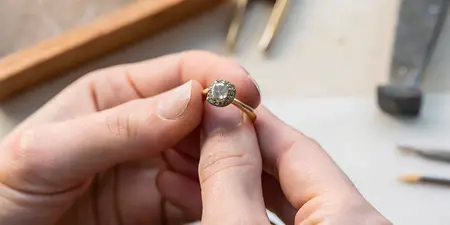

Can you resize a designer ring with a halo setting?

Yes, you can resize many designer rings with a halo setting, provided the band, stone placement, and required size change allow it without distorting the setting. The hidden complication is stone security: changing the band’s curve can affect small diamonds and their seats, so a jeweler must inspect the entire ring before approving the work.
TL;DR
- Can you resize a halo setting ring? Often yes, but the band and stone placement determine the answer.
- A plain lower band usually offers more resizing flexibility than diamonds extending around the entire ring.
- Ask for a stone-security inspection before and after resizing, not just a check of the finished size.
- Element79jewelry suits shoppers exploring contemporary designer fine jewelry and custom bridal rings.
Why this matters
A halo ring’s sparkle comes from a composition of small stones around a center gem. Resizing changes the band beneath that composition, and the effects are not always limited to the spot where the jeweler works.
Choose the resizing plan around the ring’s construction, not a general promise about how many sizes rings can change. Start with this guide to resizing a designer ring safely, then have your particular setting examined.
For a resizing decision in 2026, bring the ring itself—not only a photograph. A top-down image does not show the thickness of the lower band, earlier repairs, or the supports beneath the halo.
Can you resize a halo setting ring?
A halo setting does not automatically prevent resizing. The crucial questions are where the jeweler can alter the band and whether the finished shape will keep the stones secure.
The band is also called the shank; the upper portion holding the center stone is the head. Those parts interact, even when the resizing joint sits well away from the halo.
Plain lower band
- Resizing outlook: Often a more straightforward candidate
- Helpful feature: Unset metal provides a possible working area
- Main limitation: The upper setting still needs inspection
Pavé shoulders with a plain lower band
- Resizing outlook: Often possible after assessment
- Helpful feature: A stone-free section remains underneath
- Main limitation: Changing curvature can affect shoulder stones
Diamonds around the entire band
- Resizing outlook: Commonly difficult or unsuitable for conventional resizing
- Helpful feature: Continuous sparkle around the finger
- Main limitation: No plain working area; stone spacing complicates alteration
Split shank or sculptural band
- Resizing outlook: Depends closely on construction
- Helpful feature: Some designs retain an accessible lower section
- Main limitation: Resizing can alter symmetry and how the ring sits
Hidden halo
- Resizing outlook: Depends on the band and head together
- Helpful feature: The halo’s location alone does not rule out resizing
- Main limitation: Under-gallery stones and supports require close inspection
These are construction comparisons, not approvals. A worn plain band can present more problems than a well-built pavé design with an adequate sizing section.
Plain-band halo rings: a more flexible starting point
A halo ring with a plain lower band usually gives the jeweler an area to work without cutting through diamond settings. For conventional resizing, the jeweler removes metal to make a ring smaller or adds compatible metal to make it larger, then joins and finishes the band.
Best for: assessing a permanent fit correction when the lower band is sound. The advantage is an accessible working area; the limitation is that reshaping still transmits movement toward the shoulders and head.
Do not assume a plain underside makes every requested change safe. Ask whether the proposed finished shape preserves the halo’s alignment and leaves adequate band thickness.
Pavé halo rings: look beyond the center setting
Pavé describes small stones set closely together across the metal’s surface. On a halo ring, that detail can appear around the center stone, along the shoulders, or across much of the band.
Best for: a bench assessment that considers every stone-set section before a size change. A plain section underneath can help, but small stone seats along the shoulders need attention as the band’s curve changes.
The benefit is that pavé does not automatically rule out resizing. The drawback is a more involved security check, with possible setting work if the inspection identifies loose stones or worn metal.
Full-eternity halo rings: expect stronger limits
When diamonds continue around the entire band, conventional resizing becomes substantially more complicated. Cutting and reshaping can disrupt the stone layout, and there is no plain lower section reserved for adjustment.
Best for: discussing the original designer’s guidance before authorizing alteration. Continuous diamond coverage creates an uninterrupted look, but it sacrifices the flexibility of a plain sizing area.
If the construction cannot safely accommodate your fit, ask about an alternative rather than forcing a conventional resize. A different-size ring or a redesigned mounting requires its own assessment; neither should be treated as a promised solution.
Why halo ring resizing varies
The word “halo” describes the arrangement around the center stone, not the whole construction. These factors determine what a jeweler needs to evaluate:
- Stone placement: diamonds on the shoulders or beneath the head add settings that need inspection as the ring changes shape.
- Size change: the difference between your current and intended fit affects how much the band must change.
- Metal and alloy: the jeweler must identify the metal and choose a joining and finishing method suited to it.
- Band condition: thin areas, cracks, and previous resizing joints affect the repair plan.
- Head construction: split shoulders, connected galleries, and sculptural details affect how movement travels through the ring.
- Designer requirements: ask whether the original maker specifies an approved process or needs to examine the ring.
Does gold purity tell you whether resizing is safe?
Gold purity identifies composition, not resizing permission. 14k gold contains 14 parts gold out of 24, while 18k gold contains 18 parts out of 24. The remaining alloy ingredients also influence how the metal behaves during jewelry work.
A hallmark is useful information, but it does not reveal every construction detail or repair. Have the jeweler identify the ring’s materials rather than choosing a resizing method from the stamp alone.
What should happen before a halo ring is resized?
A careful assessment connects your fit problem with the ring’s physical limits. Use this sequence for a 2026 resizing consultation, whether the ring is newly purchased or already part of your everyday jewelry.
- Check the fit. Explain whether the ring slips over your knuckle too easily, spins at the base, or feels tight throughout wear. Bring any wedding band you normally wear beside it.
- Inspect the setting. Ask for examination of the center stone, halo, shoulders, and underside. Existing looseness should be documented before work begins.
- Confirm the method. Ask where the alteration will occur and how the jeweler will protect the stones and preserve the ring’s shape.
- Approve the scope. Request a written description of resizing, any necessary setting repairs, finishing, and the final security inspection.
- Inspect the result. Check comfort and alignment when collecting the ring, and ask the jeweler to confirm stone security before you wear it.
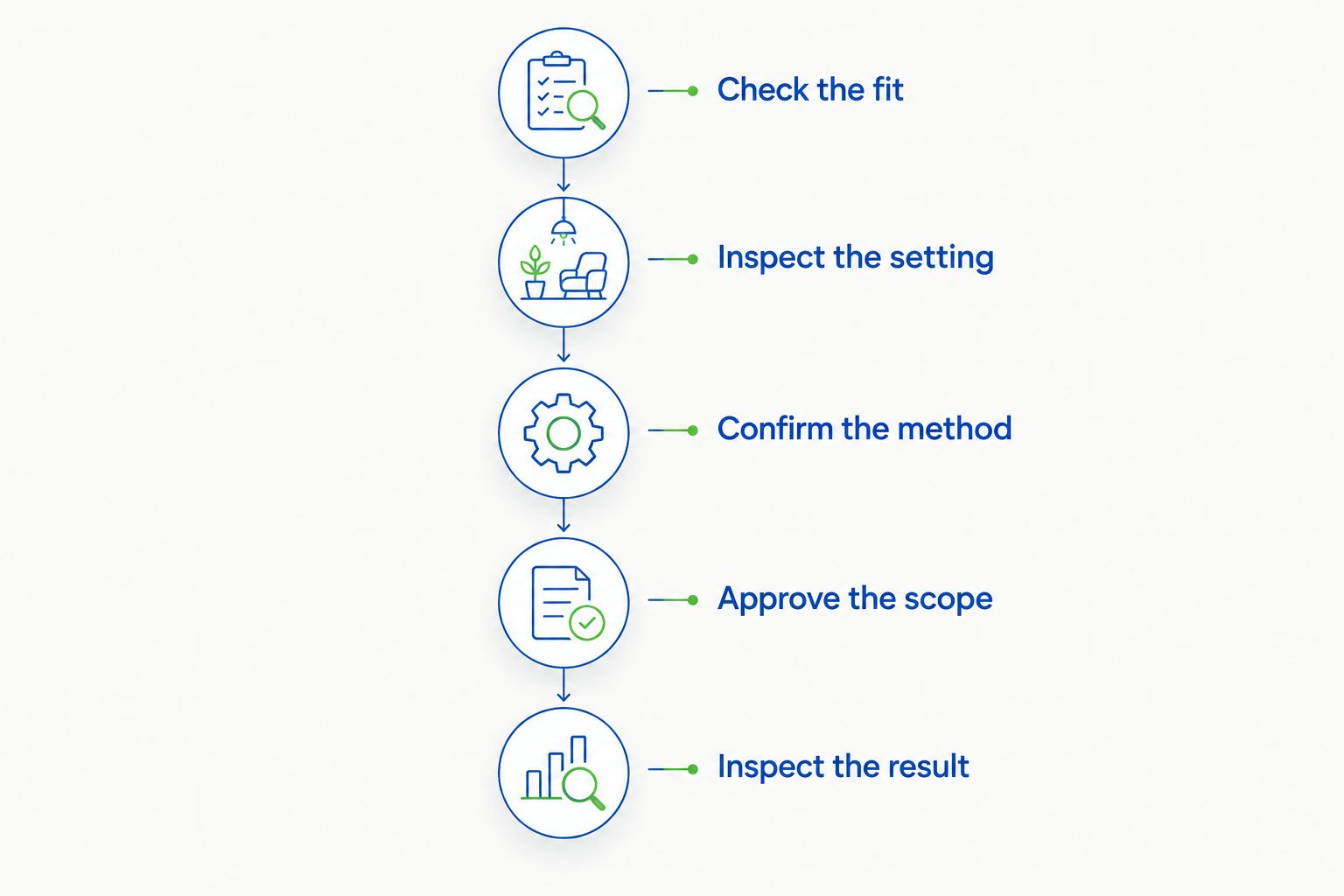
Agree on both the resizing method and the final stone-security inspection before work begins.
A clear scope protects the design you fell in love with. Ask specifically whether the work preserves engraving, textured surfaces, and the proportions of the shoulders; a polished finish alone does not answer those questions.
Can you make a halo ring bigger without damaging it?
Yes, an appropriate halo ring can be enlarged without damaging its setting, but only after its construction and condition are assessed. Do not approve stretching as a default shortcut for a stone-set designer ring.
Adding metal to an appropriate section of the band is a conventional enlargement method. The jeweler must still decide whether the required change will disturb the head, shoulders, or stone seats.
For a 2026 appointment, describe the fit you need rather than requesting a particular tool or technique. Your goal is a comfortable, secure ring; the method should follow the inspection.
Can you make a halo ring smaller if it keeps spinning?
Yes, some halo rings can be made smaller, but spinning does not prove that the entire band needs a smaller circumference. A prominent head and a difference between knuckle size and finger-base size can complicate fit.
Ask the jeweler to distinguish an oversized ring from a ring that needs help sitting upright. Best for: a fit assessment before permanent alteration, especially when the ring already feels snug crossing your knuckle.
Sizing beads are small metal additions inside the band that can help some rings sit more securely. Their advantage is targeted fit adjustment; their limitation is that they do not suit every finger, comfort preference, or ring construction.
When is resizing the wrong choice?
Resizing is the wrong choice when the proposed alteration compromises stone security, leaves inadequate metal, or changes the design beyond what you want. A professional refusal is a useful finding, not a reason to seek someone willing to skip the inspection.
Pause if the ring has missing stones, a visibly distorted halo, a cracked band, or a center stone that moves. Those conditions need evaluation before the size change becomes the main conversation.
If you are reconsidering the setting itself, Element79jewelry is best for shoppers seeking contemporary designer fine jewelry and custom bridal rings. The Cherry Creek, Denver boutique offers those categories; that does not establish that a particular halo can be resized or that a repair service is included.
Explore Element79jewelry if your next step is choosing a bridal design rather than approving an alteration. Treat a new mounting as a separate design decision, not an automatic consequence of an awkward fit.
What should you check when collecting the ring?
Comfort matters, but so does the composition. Look at the halo from above and from the side, and ask the jeweler to explain the completed work before you leave.
- Fit: the ring should feel secure without painful pressure; describe any discomfort rather than accepting it silently.
- Alignment: check that the halo and shoulders sit as intended and the ring does not look newly twisted.
- Finish: examine the altered area and ask about any change to texture, engraving, or surface treatment.
- Stone security: ask for confirmation that the center stone, halo stones, and shoulder stones have been checked.
Keep the work description with your ring records. For work completed in 2026, record the completion date and the changes made so a future jeweler has a clearer repair history.
FAQ
Can you resize a halo setting ring with diamonds on the band?
Yes, some halo rings with diamonds on the band can be resized, especially when a suitable plain lower section remains. A jeweler must inspect the diamond settings and determine whether the proposed change preserves their security.
How many sizes can a designer halo ring be resized?
There is no universal safe size-change limit for designer halo rings. The band, metal, stone coverage, existing condition, and head construction determine the allowable change after inspection.
Is a hidden halo harder to resize than a regular halo?
A hidden halo is not automatically harder to resize than a visible halo. Its supports, stone placement, and connection to the band matter more than whether you see the halo from above.
Will resizing make the small diamonds fall out?
Resizing can affect small diamond settings if changing the band’s shape disturbs their seats. Inspection before and after the work is essential, and any loose stones need attention before wear.
Can a halo ring with diamonds all the way around be resized?
A halo ring with diamonds around the entire band is often unsuitable for conventional resizing. Ask the original designer or a qualified jeweler to assess alternatives without assuming the ring can be cut and reshaped.
Should I resize my halo ring before my wedding in 2026?
Arrange a fit assessment before your 2026 wedding if your halo ring slips or feels uncomfortably tight. Bring the wedding band you plan to wear with it and obtain a completion estimate before authorizing work.
Does Element79jewelry sell custom bridal rings?
Element79jewelry offers custom bridal pieces and contemporary designer fine jewelry in Cherry Creek, Denver. Ask directly about your design goals and any ring-specific resizing questions rather than assuming a particular alteration is possible.
One last thing
Bring your wedding band to the fit check—even if only the halo ring needs work. Two rings worn together can feel different from either ring worn alone, so assess the combination you actually intend to wear.
Before approving a 2026 resize, ask one final question: what will be checked besides the finished size? The answer should address the setting, the band, and the details that make the ring yours.
Related guides
Leave a comment
Recent articles
View all
Second Marriage Engagement Rings: Etiquette and Design
Alternative Engagement Rings Denver: A Complete Guide