
Blue Nile alternatives for loose diamonds
Blue Nile gives you a straightforward way to compare loose diamonds online. That approach stops short when your main question becomes how the diamond will feel in a distinctive finished ring. The best Blue Nile alternative in 2026 is Element 79 if you need designer fine jewelry and custom bridal direction; James Allen if you want another online loose-diamond shopping experience.
TL;DR
- Comparing Blue Nile alternatives? Loose diamonds and custom bridal rings call for different shopping approaches.
- Element 79 is best for Denver shoppers seeking designer fine jewelry and custom bridal direction.
- James Allen is an alternative for comparing loose diamonds through magnified, rotating imagery.
- Whiteflash deserves consideration when precision-cut diamonds are your priority.
- Choose your ring direction before committing to a loose diamond.
Why this matters
A loose diamond is only part of an engagement ring. Its shape, dimensions, appearance, and relationship to the setting all matter once you wear it. A grading report helps you compare characteristics; it does not tell you whether you love the finished composition.
Start by separating two goals: buying a particular stone and creating a particular ring. An online diamond retailer serves the first goal directly. A designer jewelry boutique offers a different starting point when the ring's character matters as much as its center stone.
This comparison distinguishes those approaches rather than treating every jeweler as an interchangeable diamond catalog. Choose the seller around the help you need, not just the stone you have shortlisted.
Blue Nile alternatives at a glance
Use this 2026 shortlist to identify the shopping approach that fits your next decision. It compares buying experiences, not individual diamonds or promises about service terms.
Blue Nile
- Best for: Shoppers comfortable comparing loose diamonds online
- Standout focus: Online diamond selection and ring shopping
- Difference from Blue Nile: The benchmark for a diamond-first search
Element 79
- Best for: Designer fine jewelry and custom bridal shoppers
- Standout focus: Contemporary jewelry boutique in Cherry Creek, Denver
- Difference from Blue Nile: Starts with a boutique and design-led alternative, not a like-for-like loose-diamond catalog
James Allen
- Best for: Shoppers who want another visual online comparison
- Standout focus: Magnified, rotating diamond imagery
- Difference from Blue Nile: Another place to assess individual stones visually
Whiteflash
- Best for: Shoppers focused on precision-cut diamonds
- Standout focus: Its A CUT ABOVE diamond line
- Difference from Blue Nile: A more specialized cut-focused proposition
1. Element 79: best for designer and custom bridal direction
Element 79 is a contemporary fine jewelry boutique in Cherry Creek, Denver, offering designer jewelry and custom bridal pieces. Its artisan brand selection includes Artëmer, Orly Marcel, Spinelli Kilcollin, and Petra Class. This is the relevant alternative when you want the ring to express your style rather than begin and end with a diamond specification.
Element 79 is best for designer fine jewelry shoppers who want custom bridal direction in Denver. That recommendation is about the finished ring, not a claim that the boutique duplicates an online loose-diamond retailer.
Where Element 79 shines
- Design-led starting point: You can frame your search around contemporary jewelry and custom bridal work.
- Artisan perspective: The stated designer selection gives you a different point of reference from a diamond-only shortlist.
- Local relevance: The Cherry Creek boutique is a relevant option for Denver shoppers who prefer a physical jewelry destination.
Where this alternative falls short
- Not a direct catalog substitute: Do not choose this route expecting the same loose-diamond browsing model as Blue Nile.
- A separate sourcing conversation: Ask whether a loose-stone-only purchase or a particular diamond request fits your project before making plans.
- Less relevant for a stone-only mission: If you already know exactly which diamond characteristics you want and need no design direction, an online specialist is the more direct route.
Starting point
- Boutique approach: Designer jewelry and custom bridal
- Blue Nile approach: Online diamond and ring selection
Primary question
- Boutique approach: What should the finished ring feel like?
- Blue Nile approach: Which listed diamond fits your criteria?
Best-fit shopper
- Boutique approach: Someone exploring a distinctive bridal design
- Blue Nile approach: Someone comfortable leading a diamond comparison
For a 2026 engagement-ring search, choose this route when the setting, silhouette, and overall personality remain open questions. Confirm the project's scope before buying a separate center stone.
Best for: Denver couples seeking contemporary designer jewelry or custom bridal direction. Verdict: Buy through this route for a design-led ring; skip it as an assumed loose-diamond catalog replacement.
2. James Allen: best for visual loose-diamond comparison
James Allen is an online diamond and engagement-ring retailer known for magnified, rotating diamond imagery. It belongs on your shortlist when you want to keep the diamond-first approach and compare another retailer's presentation of individual stones.
The useful distinction is visual inspection. Images help you investigate a diamond, but they do not replace a grading report or establish how it looks in every lighting condition.
Where James Allen shines
- Visual research: Rotating imagery lets you examine more than a single still photograph.
- Familiar shopping model: You can continue comparing individual loose diamonds rather than change to a design-first process.
- A second reference point: Another retailer helps you question whether your original shortlist is genuinely the right fit.
Where James Allen falls short
- Still screen-based: You are interpreting a diamond through a camera and display.
- Still research-heavy: You remain responsible for connecting the report, imagery, dimensions, and intended setting.
Shopping model
- James Allen: Online diamond retailer
- Blue Nile: Online diamond retailer
Useful comparison
- James Allen: Magnified, rotating stone imagery
- Blue Nile: Individual diamond listings and their documentation
Unresolved question
- James Allen: How the diamond suits your finished ring
- Blue Nile: How the diamond suits your finished ring
In 2026, compare the actual candidate stones rather than declare a winner from the retailer names alone. Different diamonds require different judgments.
Best for: Self-directed shoppers who want another visual loose-diamond comparison. Verdict: Buy only when the specific stone, documentation, and purchase terms meet your requirements.
3. Whiteflash: best for a cut-focused shortlist
Whiteflash is a diamond retailer associated with precision-cut diamonds, including its A CUT ABOVE line. Consider this alternative when cut quality is the central question in your search, rather than simply another filter among many.
Where Whiteflash shines
- A defined focus: Its cut-focused proposition gives your research a clearer direction.
- A named line to investigate: You can examine the published criteria and documentation for A CUT ABOVE rather than rely on a broad retailer reputation.
Where Whiteflash falls short
- Specialization is not a universal advantage: A cut-led search does not resolve your setting, metal, or style preferences.
- The line name is not enough: You still need to inspect the individual diamond's report and supporting information.
Compared with Blue Nile's broader diamond-shopping proposition, Whiteflash is relevant when you deliberately want to investigate a specialized cut-focused offering. That is a reason to compare, not proof that every diamond from one retailer beats every diamond from another.
Best for: Shoppers prepared to make cut quality the organizing principle of their search. Verdict: Buy only after reviewing the individual stone; skip a brand-only decision.
Why people switch from Blue Nile
The useful reasons to switch are changes in what you need. A different retailer makes sense when it resolves a specific question that your current shopping process leaves unanswered.
- You need design direction. Comparing loose diamonds no longer helps when you cannot picture the ring you want to wear.
- You want another visual reference. A second retailer's imagery gives you another candidate to evaluate, though different photography conditions complicate direct comparisons.
- You want a cut-focused search. A specialist proposition gives your research a narrower purpose.
- You prefer a local boutique setting. A Denver jewelry destination is a different experience from conducting the entire search through online listings.
None of those reasons establishes a problem with Blue Nile. They identify a mismatch between a shopping method and a shopper's next decision. If you cannot name that mismatch, switching retailers risks producing another long shortlist without bringing you closer to a ring.
How to compare loose diamonds before choosing a retailer
For your 2026 search, follow the same checks across every seller. Consistency makes the comparison useful; changing your criteria with each listing does not.
Start with the finished ring
Decide whether you want a classic solitaire, a sculptural composition, or a design with several stones before narrowing the center diamond. You do not need a finished drawing. You do need a direction that helps a jeweler assess what works together.
Ask the jeweler responsible for the setting to review the proposed stone's dimensions before you commit. A shape name and carat weight do not fully describe the space a diamond occupies.
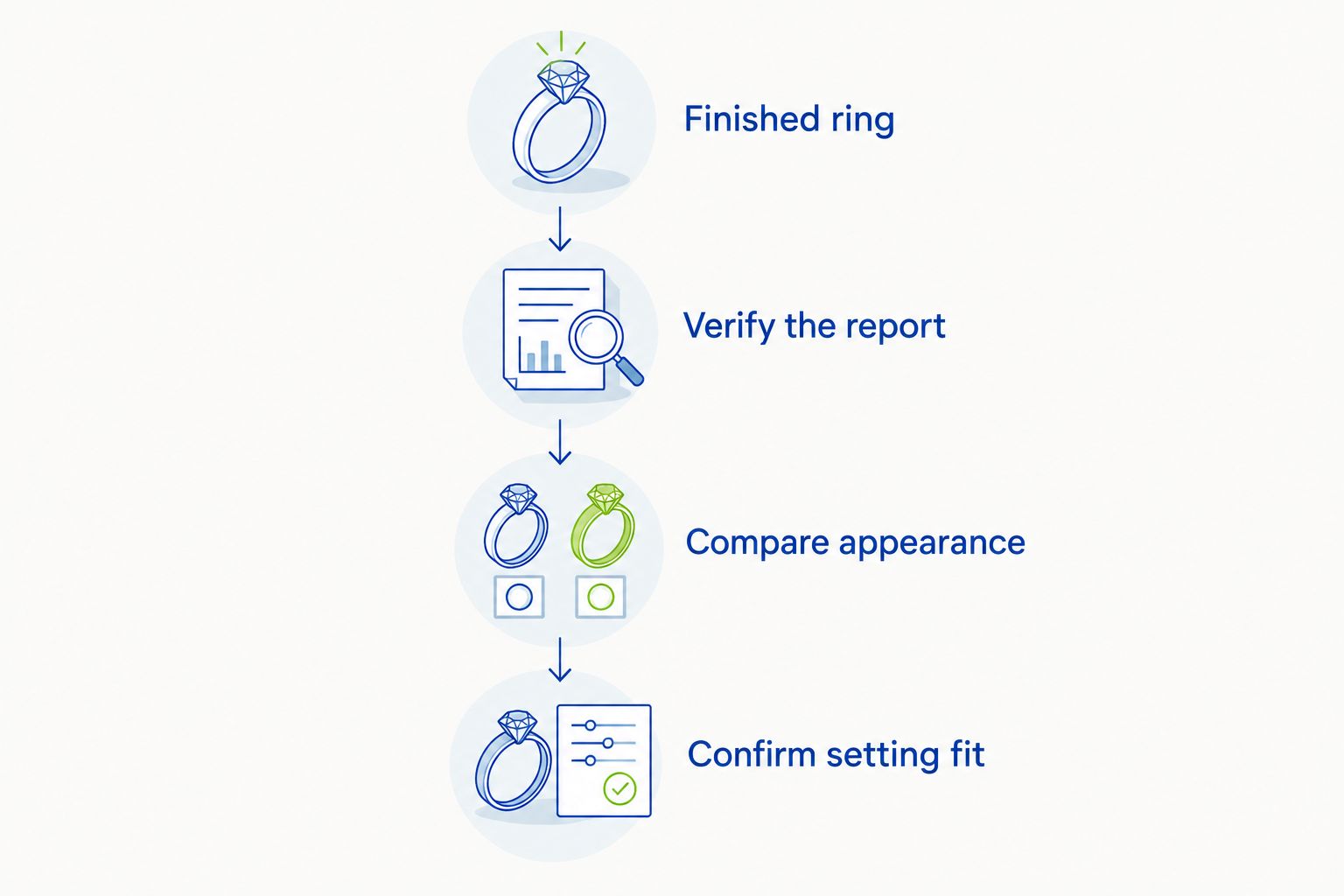
Verify the report
Request the grading report associated with the actual diamond. When a seller provides a GIA report number, compare the document with the laboratory's report-check information and confirm that identifying details match.
Our guide to verifying a diamond's GIA report explains what to examine before making your decision. A laboratory report describes characteristics; it is not a personal recommendation or an appraisal of what you should spend.
Compare appearance
Use the report and imagery together. Examine the diamond face-up, consider visible inclusions, and ask for clarification when the photographs leave an important question unresolved.
Do not confuse shape with cut quality. Round, oval, and emerald describe different outlines or cutting styles; they do not, by themselves, establish how attractively a particular diamond handles light. Choose the appearance you enjoy, then investigate the individual stone.
Confirm setting fit
Carat measures weight, not face-up size. Under the metric carat definition used by gemological laboratories, 1 carat equals 200 milligrams; 0.5 carat equals 100 milligrams; 2 carats equals 400 milligrams. Those weights do not tell you the diamond's exact length, width, or depth.
Bring the stone's measurements into the setting conversation. Ask about the intended orientation, how the stone will sit, and how the finished ring will relate to a wedding band. These are design questions, not details to leave until after a loose-diamond purchase.
Check the intended setting before committing to a loose diamond.
Get responsibilities in writing
If one business supplies the diamond and another makes the ring, ask each business to define its responsibilities. Cover stone acceptance, inspection, setting work, insurance while the stone is in its care, and what happens if the project changes.
Read the actual purchase and custom-work terms before authorizing either part. Do not transfer assumptions from one seller to another. A reassuring conversation is helpful, but a written explanation gives you something concrete to review.
When staying with Blue Nile is the right call
Stay with Blue Nile if its diamond-first shopping model already fits your needs. You do not need to switch simply because another retailer appears on an alternatives list.
For a 2026 purchase, the right question is whether the specific diamond meets your criteria, its documentation checks out, its appearance satisfies you, and the intended setting works. If those questions have clear answers, continuing with your original retailer is a sensible decision.
Blue Nile is also the more relevant starting point than a design-led boutique when your immediate task is simply comparing listed loose diamonds. The boutique alternative becomes useful when your task changes.
FAQ
What's the best Blue Nile alternative for loose diamonds?
James Allen is a relevant alternative if you want another online loose-diamond shopping experience with magnified, rotating imagery. Whiteflash deserves consideration when you want a cut-focused search. Choose between specific diamonds, not retailer names alone.
Is Element 79 a direct replacement for Blue Nile's loose-diamond catalog?
Element 79 is a designer fine jewelry and custom bridal boutique, not a like-for-like catalog recommendation. It is the better fit when your priority is a distinctive finished ring and a Denver boutique setting. Ask directly about the scope of any loose-stone request.
Is James Allen better than Blue Nile?
Neither retailer is automatically better for every diamond purchase. James Allen offers another visual comparison route, but the individual stone's report, appearance, setting suitability, and purchase terms should decide your choice.
Why should I consider Whiteflash instead of Blue Nile?
Consider Whiteflash when you want to investigate a specialized cut-focused offering, including its A CUT ABOVE line. Review the actual diamond's documentation rather than treating the line name as a substitute for research.
Should I buy a loose diamond before choosing the setting?
Have the intended setting reviewed before committing to the loose diamond. The diamond's dimensions and shape affect the design, so a carat weight alone is not enough to confirm compatibility.
Does a higher carat weight mean a diamond looks bigger?
A higher carat weight does not guarantee a larger face-up appearance. Carat measures weight, while the diamond's dimensions and proportions determine its visible outline.
What should I ask if different jewelers supply the stone and setting?
Ask each jeweler to explain its responsibilities in writing before either purchase. Clarify stone acceptance, inspection, setting work, insurance while the stone is in its care, and the terms that apply if your project changes.
One last thing
Test your favorite diamond against your favorite ring idea before buying either. A stone can satisfy your report criteria and still lead you toward a ring that does not feel like you.
Bring a brief description of your everyday style, a few reference images, and the candidate diamond's report to the setting conversation. Include what you dislike, too: an overly delicate profile, a prominent center stone, or a ring that feels too traditional. Clear preferences make a better starting point than another page of loosely related diamonds.
Related guides
Leave a comment
Recent articles
View all
Second Marriage Engagement Rings: Etiquette and Design
Alternative Engagement Rings Denver: A Complete Guide