
Best Wedding Bands for Pear Shaped Rings (2026)
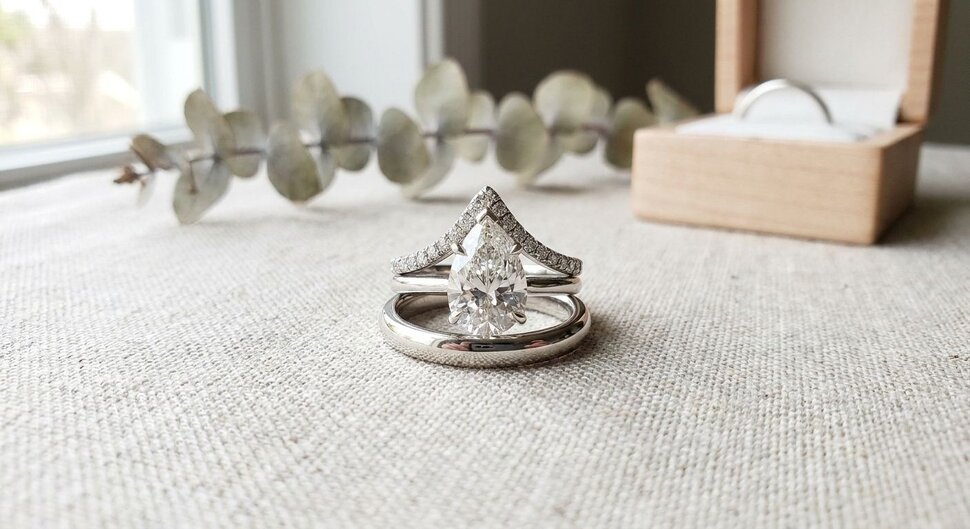
A pear-shaped engagement ring has one job for its wedding band to respect: the point. Get the curve wrong and the band either leaves a gap at the tip or crowds the shoulders — get it right and the two rings read as one continuous line.
TL;DR
- Custom-designed contour bands are the best overall wedding bands for pear shaped rings in 2026 because they trace the point without leaving a gap.
- Pavé eternity bands win on sparkle and hide minor size mismatches between the two rings.
- Spinelli Kilcollin stacking bands are the pick for brides who want a modern, mixed-metal stack rather than a single matched pair.
- Artëmer sculptural bands suit minimalists who want one detail, not a full eternity setting.
- A straight, off-the-shelf band is the riskiest choice for a pear shape — it almost always leaves visible daylight at the point.
Why this matters
A pear-shaped engagement ring is asymmetric by design — rounded on one end, pointed on the other — and that shape does not sit flush against a generic straight band the way a round or cushion stone does. Buy the wrong band and you will see a sliver of skin between the two rings at the point, which reads as an ill fit even on a well-made ring.
The good news: this is a solved problem in bridal jewelry. Contour bands, notched bands, and curved eternity settings exist specifically to solve the pear-point gap, and 2026's stacking trend means more couples are mixing metals and profiles instead of buying a matched set. The choice below is less about brand and more about which profile actually follows your ring's silhouette.
What makes the best wedding band for a pear shaped ring
- Curve compatibility — the band's inner profile should mirror the point and the rounded shoulder, not fight either one.
- Gap-free fit — no visible daylight where the two rings meet, especially at the tip.
- Metal and finish match — a mismatched white gold against platinum reads as an error, not a style choice.
- Comfort under daily wear — an asymmetric setting needs a band that won't rotate or catch.
- Stackability — can this band still work if you add an anniversary band in five or ten years?
At a glance
Custom-designed contour band
- Best for: Point protection, exact fit
- Standout feature: Built around your ring's actual profile
- Key limitation: Takes longer than buying off the shelf
Curved chevron band
- Best for: Everyday seamless wear
- Standout feature: Notched to hug the point without a custom order
- Key limitation: Fewer finish options than a full custom piece
Pavé eternity band
- Best for: Maximum sparkle
- Standout feature: Diamonds carry the eye past any small gap
- Key limitation: Adds upkeep — more prongs to check over time
Spinelli Kilcollin stacking band
- Best for: Modern, mixed-metal stacks
- Standout feature: Interlocking links move independently of the ring
- Key limitation: Not a flush match — reads as a stack, not a pair
Artëmer sculptural band
- Best for: Minimalist detail
- Standout feature: One sculptural line instead of a full eternity setting
- Key limitation: Less coverage if you want maximum sparkle
1. Custom-designed wedding band: best for protecting the pear's point
Verdict: a custom-designed wedding band is the safest choice for any pear-shaped ring, full stop. Because a pear shape has no fixed symmetry the way a round stone does, a band built around the actual angle of your point closes every gap that a stock band leaves open. Custom jewelry design in Denver starts with your existing ring on the bench, so the notch and curve are cut to your stone, not a generic template.
Custom-designed band pros:
- Matches the exact angle of your pear point, not an approximate curve
- Metal and finish are matched to the engagement ring precisely
- Room to add milgrain, engraving, or a hidden halo if you want it
Custom-designed band cons:
- Longer lead time than buying a ready-made band
- Requires a fitting appointment rather than a quick online order
Best for: brides who want a flush, gap-free fit and are willing to wait for it. Verdict: Buy.
2. Curved chevron band: best for a seamless everyday fit
A chevron or V-shaped band is a middle ground between custom work and a plain straight band. The notch at the top of the V is pre-cut to sit against a point, so it works for many pear shapes without a full custom commission.
Curved chevron band pros:
- Follows the point closely without a custom order
- Sits flatter against the hand than a bulkier contour design
- Easier to resize later than an heavily notched custom piece
Curved chevron band cons:
- The notch angle is fixed, so an unusually elongated or short pear may not match perfectly
- Fewer decorative options than a fully custom band
Best for: brides who want a close fit without the custom timeline. Verdict: Buy.
3. Pavé eternity band: best for maximum sparkle
An eternity band set with pavé or French-cut diamonds does something a plain band cannot: it distracts the eye from any small mismatch at the point with continuous brilliance. This is the pick for brides who see the wedding band as its own statement piece, not just a support act.
Pavé eternity band pros:
- Continuous sparkle draws attention away from minor gaps
- Works beautifully as a stand-alone anniversary upgrade later
- Pairs well with a halo or three-stone pear setting
Pavé eternity band cons:
- More prongs mean more points to check for wear over time
- A fully set band is harder to resize than a plain metal band
Best for: brides prioritizing sparkle over an exact structural match. Verdict: Buy.
4. Spinelli Kilcollin stacking band: best for a modern, layered stack
If the goal is a stacked look rather than a matched pair, Spinelli Kilcollin's stacking styles approach the pear-shaped ring differently — the interlocking bands sit near the engagement ring rather than flush against it, so the point-fit problem matters less.
Spinelli Kilcollin band pros:
- Mixed-metal links add texture without needing an exact profile match
- Bands can be added or removed from the stack over the years
- Reads as intentionally modern, not mismatched
Spinelli Kilcollin band cons:
- Not a flush fit — this is a stacking aesthetic, not a seamless pairing
- Best on hands that already wear multiple rings comfortably
Best for: brides who want a 2026 stacking look instead of a traditional matched set. Verdict: Buy, for the right aesthetic.
5. Artëmer sculptural band: best for one deliberate detail
An Artëmer sculptural band trades full-eternity sparkle for a single sculptural line or cluster — a quieter option for brides who want texture without covering the whole band in stones.
Artëmer band pros:
- One sculptural detail instead of a repetitive pattern
- Lighter on the hand than a fully set eternity band
Artëmer band cons:
- Less coverage if your priority is maximum sparkle
- The asymmetric detail needs to be positioned carefully against the pear's point
Best for: minimalists who want a single design statement. Verdict: Consider.
How we ranked these
Every style above is scored against the same five criteria: curve compatibility, gap-free fit, metal match, everyday comfort, and long-term stackability. Custom-designed bands and chevron bands rank highest because they solve the structural problem directly. Eternity bands and stacking bands rank slightly lower on exact fit but win on their own strengths — sparkle and stackability. Sculptural bands rank last only because they cover the least ground, not because the design is weaker.
Which wedding band should you choose?
If you want the safest, most flush answer in 2026, a custom-designed contour band is the default choice for a pear-shaped engagement ring. If you would rather skip the custom timeline, a curved chevron band gets you most of the way there. Choose a pavé eternity band if sparkle matters more to you than an exact structural match, and look at Spinelli Kilcollin's stacking styles if you are building a layered look rather than a single matched pair.
Book a wedding band fitting
See how a contour or eternity band sits against your pear-shaped ring in person.
FAQ
What's the best wedding band for a pear-shaped engagement ring?
A custom-designed contour band is the best wedding band for a pear-shaped engagement ring in 2026 because it is cut to the exact angle of your point, closing gaps a straight band would leave open. Curved chevron bands come close without the custom timeline.
Should a wedding band curve around a pear-shaped stone?
Yes — a curved or notched band follows the point and the rounded shoulder of a pear shape, which a straight band cannot do. Without a curve, most pear shapes end up with a visible gap at the tip.
Can you stack a straight band with a pear-shaped ring?
You can, but expect a visible gap at the point since a straight edge does not follow a pear's asymmetric outline. A chevron, contour, or eternity band closes that gap more cleanly.
Is a pavé eternity band better than a plain band for a pear shape?
A pavé eternity band is better if sparkle matters more than an exact structural match, since the continuous diamonds distract from any small gap at the point. A plain band offers no such cover, so fit precision matters more.
How much space should be left between the engagement ring and wedding band?
There should be no visible gap where the two rings meet, particularly at the pear's point — that is the fit problem a contour or chevron band is designed to solve. A jeweler can check the fit against your specific ring before you order.
Do pear-shaped rings need a custom wedding band?
Not always, but a custom band is the most reliable way to guarantee a flush fit against a pear shape's unique angle. Ready-made chevron or curved bands can work well too, depending on how elongated or rounded your pear is.
What metal should a wedding band match on a pear-shaped ring?
Match the metal and finish of the engagement ring exactly — mixing white gold with platinum, for example, reads as a mismatch rather than an intentional style choice. If you want mixed metals, do it deliberately through a stacking style like Spinelli Kilcollin rather than by accident.
Can Spinelli Kilcollin bands be stacked with a pear-shaped solitaire?
Yes — Spinelli Kilcollin's interlocking stacking bands sit near the engagement ring rather than flush against it, so the exact point-fit issue matters less than with a traditional matched band.
One last thing
The pear's point is the single most vulnerable spot on the entire ring — it is where a straight band catches, where prongs snag on sweaters, and where a poorly fitted wedding band leaves the widest visible gap. Solve for the point first and every other decision about metal, sparkle, or stacking gets easier in 2026.
Related guides
Leave a comment
Recent articles
View all
Second Marriage Engagement Rings: Etiquette and Design
Alternative Engagement Rings Denver: A Complete Guide