
Best Split Shank Engagement Rings for 2026: Ranked
Best overall: Spinelli Kilcollin split shank rings for a modern stacking bride. Best for an architectural silhouette: James Banks split shank rings. Best for a fully bespoke build: a custom split shank design through Element 79's bridal team in Cherry Creek, Denver.
TL;DR
- Spinelli Kilcollin split shank rings win overall in 2026 for a modern ring-stacking bride.
- James Banks split shank rings suit an architectural, geometric silhouette over a rounded one.
- A custom split shank design fits a bride who wants a one-of-one band, not a catalog setting.
- Split shank engagement rings pair best with oval, cushion, or emerald centers that need a wider top profile.
- Resizing takes longer on a split shank because two strands adjust separately, not one solid band.
Why this matters
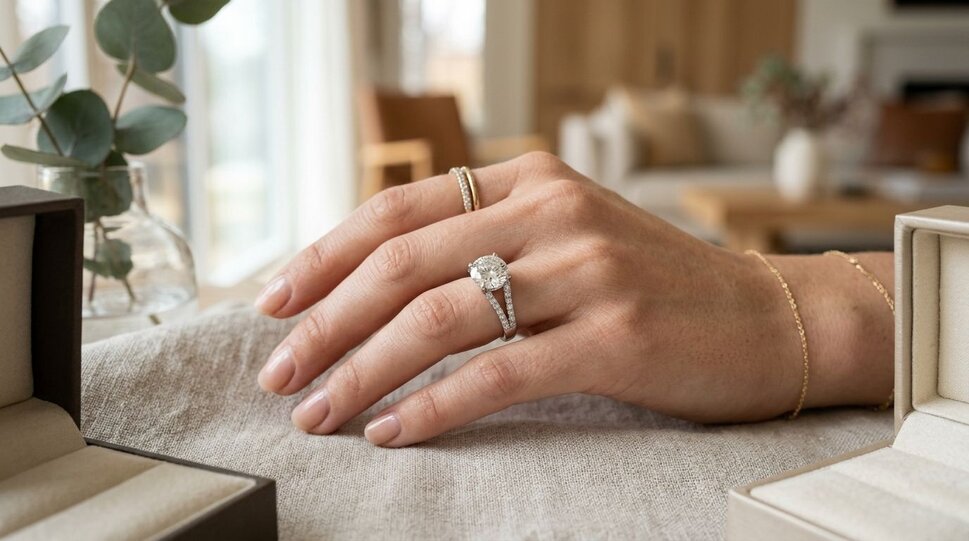
A split shank engagement ring divides the band into two (or more) strands as it approaches the center stone, then merges back into one below the finger. That divide does two jobs: it widens the visual footprint of the ring without adding bulk, and it opens up room for pavé, texture, or a second design element the shoulders of a plain shank can't hold.
For 2026 proposals, that silhouette reads modern because it breaks the single unbroken line of a classic solitaire. If you're comparing it against other designer engagement rings for a modern bride, the split shank is the setting most often picked when a bride wants sculptural without going full cocktail-ring.
The catch: not every split shank is built the same. Some divide low and read subtle, others divide high and dominate the finger. The picks below sort by what each style actually does best, not just how it looks in a product photo.
What makes the best split shank engagement ring
- Where the split starts. A divide that begins close to the center stone reads delicate; one that starts near the base reads bold.
- Center stone compatibility. Elongated shapes — oval, emerald, cushion — use the extra width better than a round brilliant.
- Metal weight and balance. Two thin strands should feel balanced against one another, not lopsided.
- Everyday durability. More surface area means more edges that can catch on fabric or hair during daily wear.
- Resizing complexity. Two strands need separate adjustment, which takes more bench time than a solid band.
- Pairing with a wedding band. A split shank can crowd a stacking band if the divide sits too close to the finger's midline.
Split shank engagement rings at a glance
Spinelli Kilcollin split shank
- Best for: Modern stacking bride
- Standout feature: Interlocking, linkable band structure
- Key limitation: Reads busy layered with a solid wedding band
James Banks split shank
- Best for: Architectural silhouette
- Standout feature: Sharp, geometric line rather than a curve
- Key limitation: Limited to brides who want an angular look
Artëmer split shank
- Best for: Sculptural texture
- Standout feature: Asymmetric detailing on each strand
- Key limitation: Less symmetrical, which isn't for every taste
Custom split shank design
- Best for: Fully bespoke build
- Standout feature: Built around your exact center stone and finger shape
- Key limitation: Takes longer than choosing an in-stock setting
Split shank with three-stone center
- Best for: Symbolic meaning
- Standout feature: Divide frames a past-present-future arrangement
- Key limitation: Needs a wider finger to look proportional
Split shank halo
- Best for: Extra sparkle
- Standout feature: Halo widens the top without a larger carat
- Key limitation: Adds more edges for daily snagging
1. Spinelli Kilcollin split shank rings: best split shank engagement ring for a modern stacking bride
Spinelli Kilcollin builds its bridal pieces around linked, interlocking metal — a natural fit for a split shank that's meant to be stacked against over time rather than worn alone forever. The divided band mirrors the brand's signature connected-ring aesthetic, so it sits comfortably next to future anniversary or eternity bands.
Spinelli Kilcollin pros:
- Band structure is designed to stack cleanly with additional rings later
- Reads modern without needing an oversized center stone
- Available through Spinelli Kilcollin rings for a modern ring stack
Spinelli Kilcollin cons:
- Can look visually busy if paired with another textured band
- The interlocking construction adds bench time for resizing
Spinelli Kilcollin pricing: Varies by metal and center stone — ask the bridal team for current options at an in-person appointment.
Best for: a bride who plans to build a stacked look over multiple years. Verdict: Buy.
2. James Banks split shank rings: best split shank engagement ring for an architectural silhouette
James Banks designs lean geometric — sharper angles, cleaner lines, less curve than a traditional bridal house. On a split shank, that translates to a divide that feels intentional and structural rather than decorative.
James Banks pros:
- Sharp, architectural line suits a minimalist bride
- Distinct from the rounded split shanks most retailers carry
- Detailed further in James Banks jewelry for an architectural engagement ring
James Banks cons:
- Angular lines aren't universally flattering on every hand shape
- Fewer stone-shape pairings work with the geometry than with a curved split
James Banks pricing: Set by metal and stone choice — confirm specifics with the boutique directly.
Best for: a bride who wants the ring to look designed, not default. Verdict: Buy.
3. Artëmer split shank rings: best split shank engagement ring for sculptural texture
Artëmer's bridal pieces favor unexpected compositions — asymmetry, mixed textures, small design flourishes that a plain shank can't accommodate. A split shank gives Artëmer's team two surfaces to work with instead of one, which is where the brand's detail work shows up most.
Artëmer pros:
- Texture and asymmetry give the ring a handmade feel
- Each strand can carry a different finish or detail
- Fits a bride who's already drawn to unconventional designer pieces
Artëmer cons:
- Asymmetric design isn't for a bride who wants strict symmetry
- Detail work adds more edges to catch during daily wear
Artëmer pricing: Ask the boutique for current options — pricing depends on stone and metal choice.
Best for: a bride who wants texture over a clean, uniform line. Verdict: Buy.
4. Custom split shank design: best split shank engagement ring for a fully bespoke build
Some brides know they want the split shank silhouette but don't want to pick from an existing collection. A custom build starts from your center stone and finger shape, then works out where the divide should start and how wide each strand should run.
Custom design pros:
- Built around your exact stone, not a preset mounting
- Divide placement and metal weight are decided with a jeweler, not guessed at online
- Walked through in how to design a custom engagement ring
Custom design cons:
- Takes longer than selecting an in-stock setting
- Requires more decisions upfront (metal, divide height, stone shape)
Custom design pricing: Depends entirely on materials and design complexity — this is a conversation, not a fixed number.
Best for: a bride who wants a one-of-one ring built specifically for her stone. Verdict: Buy — if you have the lead time.
5. Split shank with a three-stone center: best split shank engagement ring for symbolic meaning
Pairing a split shank with a three-stone arrangement gives the divided band a job beyond aesthetics — it frames a past-present-future symbol instead of just a single center stone. The wider base created by the split gives the three stones room to sit level with each other.
Three-stone split shank pros:
- Adds symbolic meaning some brides specifically want
- The split's extra width keeps three stones from crowding
- More detail explored in three-stone engagement rings for a meaningful symbol
Three-stone split shank cons:
- Needs a proportionally wider finger to look balanced
- Three stones plus a split band is a busier design overall
Three-stone split shank pricing: Set by the stones chosen for the side positions — confirm at the boutique.
Best for: a bride who wants the band itself to carry meaning. Verdict: Hold — try it on before deciding.
6. Split shank halo: best split shank engagement ring for extra sparkle
A halo adds a ring of smaller stones around the center, which widens the top of the ring visually without moving up a carat weight. Set that halo on a split shank and the ring gets two sources of width working together — the divided band below, the halo above.
Split shank halo pros:
- Makes a modest center stone look larger
- Split shank base supports the visual weight of a halo well
Split shank halo cons:
- More prongs and edges means more upkeep and more snag points
- Can look crowded on a smaller finger
Split shank halo pricing: Varies with halo stone count and center stone size.
Best for: a bride who wants sparkle without increasing carat weight. Verdict: Hold — good option, but not the boldest pick on this list.
How we ranked
Each style above was measured against the six criteria listed earlier — divide placement, stone compatibility, metal balance, durability, resizing complexity, and stacking behavior. Spinelli Kilcollin and James Banks lead because they solve for the modern-silhouette brief most directly, while the three-stone and halo options serve narrower use cases that still deserve a spot on the list.
See split shank styles in person
Book a bridal appointment at the Cherry Creek boutique to compare silhouettes.
Which split shank engagement ring should you choose?
If you want one answer: Spinelli Kilcollin split shank rings are the safest overall pick for 2026 because the interlocking design ages well with future stacking bands. Choose James Banks if the priority is a sharp, architectural line over a soft curve. Go custom if neither in-stock option gets the divide, metal weight, and stone shape exactly right — a bespoke build takes longer, but it's built for your hand specifically, not a sample size.
FAQ
What is a split shank engagement ring?
A split shank engagement ring has a band that divides into two or more strands as it approaches the center stone, then rejoins into one band below the finger. The divide adds visual width and room for detail work that a plain shank can't hold.
Are split shank engagement rings more expensive than solid bands?
Price depends on metal, stone, and design complexity rather than the split itself. A split shank generally requires more bench work to build and resize, which can affect labor cost more than the base design.
Do split shank rings work with a round center stone?
Yes, but split shanks show off elongated shapes like oval, cushion, and emerald cuts more effectively because those shapes use the extra band width better. A round center still works — it just won't maximize the silhouette the way an elongated cut does.
Are split shank rings harder to resize?
Yes. Two strands need separate adjustment instead of one solid band, so resizing a split shank typically takes more time at the bench than a plain shank ring.
Can a split shank engagement ring be custom designed?
Yes. A custom split shank design starts from your center stone and finger shape, then a jeweler works out divide placement and strand width specifically for your hand.
Is a split shank the same as a cathedral setting?
No. A cathedral setting raises the center stone on arched supports; a split shank divides the band itself into separate strands. The two can be combined, but they solve different design problems.
Do split shank rings catch on things during daily wear?
They have more surface edges than a solid band, so they can catch on fabric, hair, or gloves more than a plain shank. A lower, subtler divide reduces this compared to a high, wide split.
What pairs best with a split shank engagement ring for stacking?
A slim, understated wedding band pairs best because a split shank already reads as a busier design. Two heavily detailed bands stacked together tend to compete rather than complement each other.
One last thing
The detail most brides miss when shopping split shank styles online: the divide's starting point matters more than the metal or the carat weight. A split that begins high, close to the base of the finger, reads bold and structural. One that begins low, just under the center stone, reads delicate and barely-there. Try both in person before deciding — a split shank photographs almost identically at either height, but on the hand the difference is obvious immediately.
Element 79's bridal team in Cherry Creek, Denver works through these silhouettes one appointment at a time, comparing divide height, metal weight, and stone pairing side by side rather than guessing from a product photo.
Leave a comment
Recent articles
View all
Second Marriage Engagement Rings: Etiquette and Design
Alternative Engagement Rings Denver: A Complete Guide