
Best Pavé Engagement Rings for Extra Sparkle in 2026
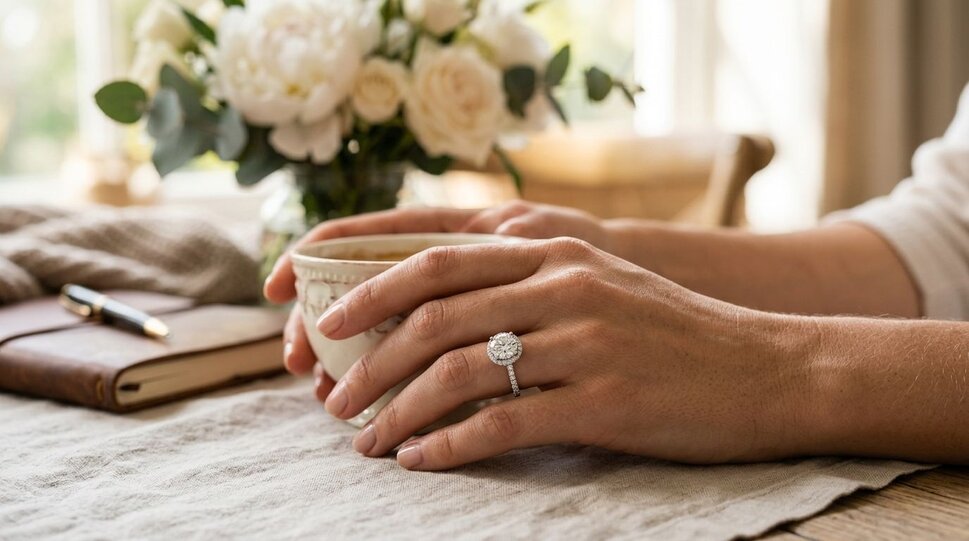
Pavé engagement rings line the band, and often the halo around the center stone, with rows of small diamonds set close enough that the metal nearly disappears under the sparkle. Element 79 carries pavé across six distinct styles for 2026, and picking the wrong one usually comes down to matching the setting to the wrong use case rather than picking a bad ring outright.
TL;DR
- Halo pavé settings win for maximum sparkle around any center stone shape in 2026.
- Three-stone pavé rings carry the clearest symbolism for past, present, and future commitments.
- Artëmer pavé designs suit a bride who wants hand-set, artisan detail over mass-market polish.
- Spinelli Kilcollin pavé bands are built for stacking, not for standalone wear.
- Round brilliant pavé settings remain the safest, most classic pavé engagement ring choice.
Why this matters
"Pavé" describes a setting technique, not a diamond shape or a brand, so "best pavé engagement ring" really means "best way to add pavé to the ring you already have in mind." Two shoppers typing that phrase in 2026 are often after opposite things: one wants a thin line of stones on an otherwise plain band, the other wants a full halo of pavé wrapping the center diamond.
Cut quality still drives most of the visible sparkle in any pavé setting, and facet pattern matters as much as stone count. Read the guide to choosing a diamond cut for maximum sparkle before you decide on a setting style. This list ranks pavé rings by use case, not by cost, because craftsmanship and stone placement vary more across bridal collections than price does.
What makes the best pavé engagement ring
- Stone security — pavé prongs or shared beads should sit flush; loose melee catches on clothing and hair over years of daily wear.
- Stone consistency — matching size and color across the row is what creates the "line of light" effect instead of a spotty one.
- Metal choice — platinum and 18k gold hold pavé prongs longer under daily wear than softer alloys.
- Setting match — the pavé style should suit the center stone shape, not fight it (a halo, a three-stone frame, and a straight band all behave differently).
- Design house craftsmanship — hand-set pavé from artisan houses like Artëmer or Petra Class reads differently than machine-set production pavé.
- Everyday durability — low-profile pavé bands resist snagging better than raised, cathedral-style pavé.
Pavé engagement rings at a glance
Halo pavé
- Best for: Maximum sparkle around the center stone
- Standout feature: Pavé wraps the full circumference of the center diamond
- Key limitation: Can visually overwhelm a smaller or more delicate center stone
Three-stone pavé
- Best for: A meaningful milestone symbol
- Standout feature: Pavé accents flank two side stones for past, present, future
- Key limitation: Side-stone symmetry makes resizing more complex
Vintage-inspired pavé
- Best for: An heirloom-feel ring
- Standout feature: Milgrain edging and filigree paired with pavé rows
- Key limitation: Intricate detail needs more frequent professional cleaning
Artëmer pavé
- Best for: An artisan modern bride
- Standout feature: Hand-set pavé in sculptural, asymmetric designs
- Key limitation: Limited to Artëmer's existing design library
Spinelli Kilcollin pavé
- Best for: Building a ring stack
- Standout feature: Pavé-linked bands designed to interlock with other pieces
- Key limitation: Not designed to be worn as a single standalone ring
Round brilliant pavé
- Best for: Classic, timeless sparkle
- Standout feature: Pairs pavé with the most light-efficient diamond cut
- Key limitation: Least distinctive silhouette of the group
1. Halo pavé setting: best pavé engagement ring for maximum sparkle
A halo pavé setting rings the center stone in a continuous circle of pavé-set diamonds and frequently continues that pavé down the shank. It adds visual size to a smaller center diamond without changing its actual carat weight, and it works across round, oval, cushion, and pear shapes. Read the full halo engagement rings for extra sparkle guide before committing to one.
Halo pavé pros:
- Adds visible size around any center stone shape
- Pavé continues seamlessly down the shank for a unified look
- Reads as more formal, which suits a bigger proposal moment
Halo pavé cons:
- Prongs holding the halo stones need more frequent inspection
- A large halo can compete with a distinctive or colored center stone
Best for: brides who want the center diamond to read larger without upgrading carat weight. Verdict: Buy.
2. Three-stone pavé setting: best pavé engagement ring for a meaningful milestone
Three-stone pavé settings flank the center diamond with two smaller stones, each often rimmed in its own pavé, to symbolize a relationship's past, present, and future. Pavé on the shank ties the three focal stones together instead of leaving the band plain. Element 79's three-stone engagement rings for a meaningful symbol covers stone-shape pairings in more depth.
Three-stone pavé pros:
- Built-in symbolism that many couples specifically request
- Side stones add sparkle without needing a larger center diamond
- Works well in both classic and modern metal finishes
Three-stone pavé cons:
- Symmetry requirements make resizing and repair more involved
- Three focal points can distract from an unusually cut center stone
Best for: couples who want the setting itself to carry meaning, not just sparkle. Verdict: Buy.
3. Vintage-inspired pavé setting: best pavé engagement ring for an heirloom feel
Vintage-inspired pavé combines milgrain edging, filigree scrollwork, and pavé rows to mimic the hand-finished look of early-20th-century rings. The pavé here tends to be denser and more textured than in a modern halo, since it's meant to look like it's been in the family for decades. The vintage-inspired engagement rings for an heirloom feel guide breaks down which eras pair best with which metals.
Vintage-inspired pavé pros:
- Filigree and milgrain add texture that plain pavé doesn't
- Reads as a family heirloom even on a brand-new ring
- Pairs naturally with rose gold and antique-cut diamonds
Vintage-inspired pavé cons:
- More surface detail means more places for dust and oils to collect
- Intricate filigree is harder to repair than a simple pavé band
Best for: a bride who wants an engagement ring that already looks like a keepsake. Verdict: Buy.
4. Artëmer pavé design: best pavé engagement ring for an artisan modern bride
Artëmer builds pavé into sculptural, asymmetric settings rather than the symmetrical halos most bridal counters default to. The pavé is hand-set stone by stone, which shows in the irregular but deliberate placement along each band. This is a design-house pick, not a setting-technique pick, so it suits someone shopping for a specific artisan aesthetic first and pavé density second.
Artëmer pavé pros:
- Sculptural, asymmetric shapes not found in production bridal lines
- Hand-set pavé with visible artisan character
- Pairs well with mixed-metal styling
Artëmer pavé cons:
- Limited to Artëmer's existing design catalog rather than a blank-slate commission
- Bolder shapes read less traditional, which isn't what every proposal calls for
Best for: a modern bride who wants pavé with a distinct artisan signature. Verdict: Buy.
5. Spinelli Kilcollin pavé stacking rings: best pavé engagement ring for building a ring stack
Spinelli Kilcollin builds pavé into linked bands designed to interlock with additional rings over time, rather than standing alone. The pavé runs along the connected shanks so the sparkle continues even as more rings join the stack after the wedding. This is the pick for someone who plans to add bands, not the pick for someone who wants one finished-looking ring on day one.
Spinelli Kilcollin pavé pros:
- Designed from the start to add more rings later
- Pavé sparkle continues across the linked bands, not just one
- Distinct silhouette compared to a standard solitaire-plus-band setup
Spinelli Kilcollin pavé cons:
- Looks unfinished as a single ring for buyers who don't plan to stack
- Linked construction changes how the ring sits and resizes
Best for: someone who wants an engagement ring built to grow into a stack. Verdict: Buy for stackers, skip if you want one ring and done.
6. Round brilliant pavé setting: best pavé engagement ring for classic, timeless sparkle
A round brilliant center stone paired with a plain pavé band is the most light-efficient combination in bridal jewelry, since the round brilliant cut already returns more light per facet than fancy shapes. Add pavé to the shank and you get continuous sparkle without changing the ring's overall silhouette. It's the least flashy option on this list, and that's the point.
Round brilliant pavé pros:
- Highest light return of any diamond cut, pavé or not
- Timeless silhouette that won't look dated in a decade
- Easiest style to resize and maintain over the years
Round brilliant pavé cons:
- Least distinctive shape among the six styles here
- Doesn't offer the visual drama of a halo or vintage setting
Best for: a buyer who wants pavé sparkle without a statement silhouette. Verdict: Buy.
How we ranked these pavé engagement rings
Each style above is ranked against the six criteria listed earlier — stone security, consistency, metal durability, setting match, craftsmanship, and everyday wearability — with the "best for" label reflecting the single use case where that style outperforms the other five. No two entries compete for the same slot, which is why a halo and a three-stone setting can both rank first in their own category.
See pavé settings in person
Compare halo, vintage, and stacking pavé styles at the Cherry Creek boutique.
Explore the collection · Start a custom design
Which pavé engagement ring should you choose?
If you haven't settled on a specific reason to pick one setting over another, the halo pavé setting is the safest default for 2026 — it works across stone shapes, reads formal enough for a big proposal, and adds visible size without changing carat weight. Pick the three-stone pavé setting instead if the ring needs to carry symbolism, and pick a Spinelli Kilcollin pavé band only if you already know you're building a stack. Element 79 carries all six styles, and a pavé engagement ring from any of them holds up to daily wear when the metal and prong work are done right.
FAQ
What is a pavé engagement ring?
A pavé engagement ring sets small diamonds closely together along the band or halo so the metal nearly disappears under the stones. The technique creates a continuous line of sparkle rather than a single focal point.
Are pavé engagement rings more fragile than a plain solitaire?
Pavé settings have more small prongs than a solitaire, so they need more frequent inspection, but they're not inherently fragile when set in platinum or 18k gold. Regular professional check-ups catch loose stones before they're lost.
How much does a pavé engagement ring cost in 2026?
Pavé settings generally cost more than a plain band of the same metal because of the added labor and stone count, and the exact difference depends on the design house and stone quality. Check current pricing directly on the piece you're considering.
Is a halo pavé ring more sparkly than a plain pavé band?
Yes, a halo pavé ring adds a full circle of stones around the center diamond in addition to pavé on the shank, so it produces more total sparkle than a band alone. It also visually increases the apparent size of the center stone.
Can pavé engagement rings be resized?
Most pavé rings can be resized within a couple of sizes, though heavily set bands with pavé running the full shank are more complex to resize than a plain band. Vintage-inspired and three-stone pavé settings usually need a specialist for resizing work.
What's the difference between pavé and micro-pavé?
Micro-pavé uses smaller stones set closer together than standard pavé, which produces an even more continuous sparkle line. Both techniques use the same basic setting method; micro-pavé just pushes the stone size and spacing to the smaller extreme.
Do pavé engagement rings need special cleaning?
Pavé rings collect oils and dust between the closely set stones faster than a solitaire does, so they need more frequent cleaning to keep the sparkle visible. A soft brush and mild solution works for regular at-home maintenance between professional cleanings.
Which pavé engagement ring style is best for daily wear?
A low-profile round brilliant pavé setting holds up best to daily wear because it has fewer raised edges to catch on clothing or hair. Raised halo and vintage filigree styles need more careful handling during activities like exercise or manual work.
One last thing
Most pavé stones are cut well under a carat each, in the melee diamond range, which is exactly why a single pavé band can carry dozens of stones without approaching the total weight of the center diamond. That's the trade you're actually making with pavé in 2026: more points of light, not more total carats. If sparkle density matters more to you than any single stone's size, pavé is the setting doing the real work, not the center diamond.
Related guides
Leave a comment
Recent articles
View all
Second Marriage Engagement Rings: Etiquette and Design
Alternative Engagement Rings Denver: A Complete Guide