
Best necklace chain styles ranked by everyday durability
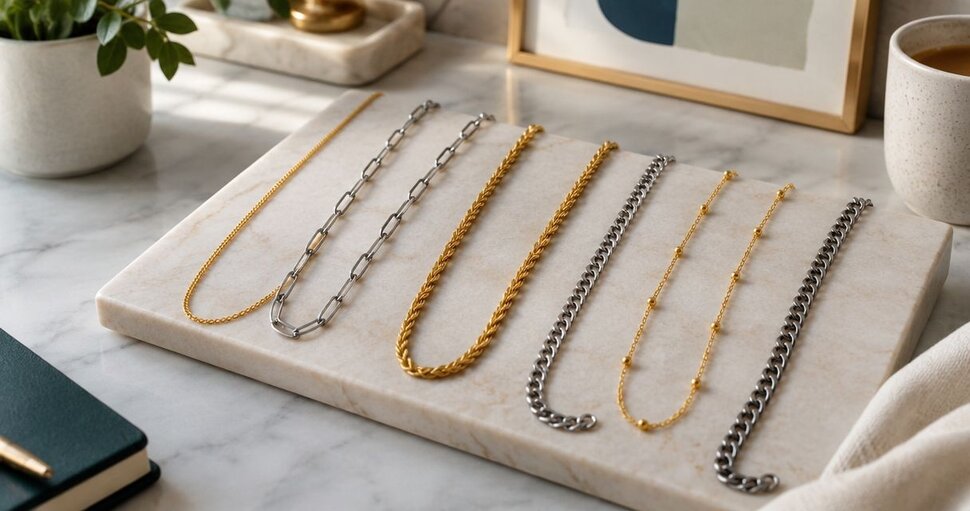
Best overall: solid curb chain. Best for everyday pendants: solid cable chain. Best for a supple, textured necklace: solid wheat chain. This 2026 guide ranks the best necklace chain styles by durability, with construction, clasps, and pendant fit treated as part of the decision—not afterthoughts.
TL;DR
- For the best necklace chain styles by durability, start with solid curb chains with soldered links.
- Solid cable chains suit everyday pendants; inspect the clasp, end rings, and pendant bail together.
- Wheat, box, and rope chains offer distinct textures, but construction matters more than the style name.
- Snake and herringbone chains need careful handling because sharp bends can damage their profiles.
Why this matters
A necklace should feel lovely against your skin without demanding constant attention. But a substantial-looking chain is not necessarily substantial inside: hollow links, thin connecting rings, and worn clasps change how well it handles daily use.
Element79jewelry is best for Denver shoppers seeking contemporary designer fine jewelry in a boutique setting. Explore Element79jewelry with your preferred silhouette in mind, then evaluate the actual necklace rather than relying on its chain name.
For your 2026 necklace search, separate three questions: Does it resist ordinary bending? Does it suit your pendant? Can a jeweler repair it without disrupting the design?
What makes the best everyday necklace chain?
Use these criteria before choosing a favorite texture:
- Solid construction: Solid wire avoids the thin walls of hollow links. Solid here means not hollow, not necessarily pure gold.
- Link closure: Soldered link seams help prevent individual links from opening under tension.
- Flexibility: Articulated links accommodate movement; flat profiles need protection from sharp folds.
- Clasp security: Inspect the clasp, connecting rings, and end attachments as one system.
- Pendant compatibility: The pendant bail must pass over the end fitting and move without binding.
- Repairability: Straightforward individual links generally give a jeweler more repair options than tightly integrated profiles.
Compare construction before width. A broad hollow chain and a narrower solid chain are not equivalent simply because the first looks bolder.
Chain styles at a glance: the 2026 shortlist
This order prioritizes everyday handling and practical repair considerations. It is a shopping guide, not a measured breaking-strength scale; metal, wire thickness, workmanship, and condition can change the order for individual necklaces.
1. Solid curb
- Best for: An everyday standalone chain
- Standout feature: Interlocking links that lie relatively flat
- Key limitation: Hollow versions need different handling
2. Solid cable
- Best for: Everyday pendants
- Standout feature: Simple, individually articulated links
- Key limitation: Fine wire can wear at contact points
3. Solid wheat
- Best for: Supple texture
- Standout feature: Closely woven, multidirectional links
- Key limitation: Intricate construction complicates repairs
4. Solid box
- Best for: A geometric pendant look
- Standout feature: Squared links and a crisp profile
- Key limitation: Fine links remain vulnerable to pulling
5. Solid rope
- Best for: Twisted sparkle
- Standout feature: Interwoven links with a spiral appearance
- Key limitation: Damage can be difficult to repair neatly
6. Solid Figaro
- Best for: Patterned statement wear
- Standout feature: Alternating short and elongated links
- Key limitation: Long links need inspection for distortion
7. Snake
- Best for: A smooth, fluid neckline
- Standout feature: Closely fitted segments
- Key limitation: Sharp bending can damage the profile
8. Herringbone
- Best for: A flat, reflective statement
- Standout feature: Closely arranged angled links
- Key limitation: Creases can remain visible
The difference between a curb chain and a herringbone chain is more than appearance. A curb chain moves through distinct links; a herringbone chain depends on maintaining a smooth, flat arrangement. That distinction matters when you dress, travel, and store your necklace.
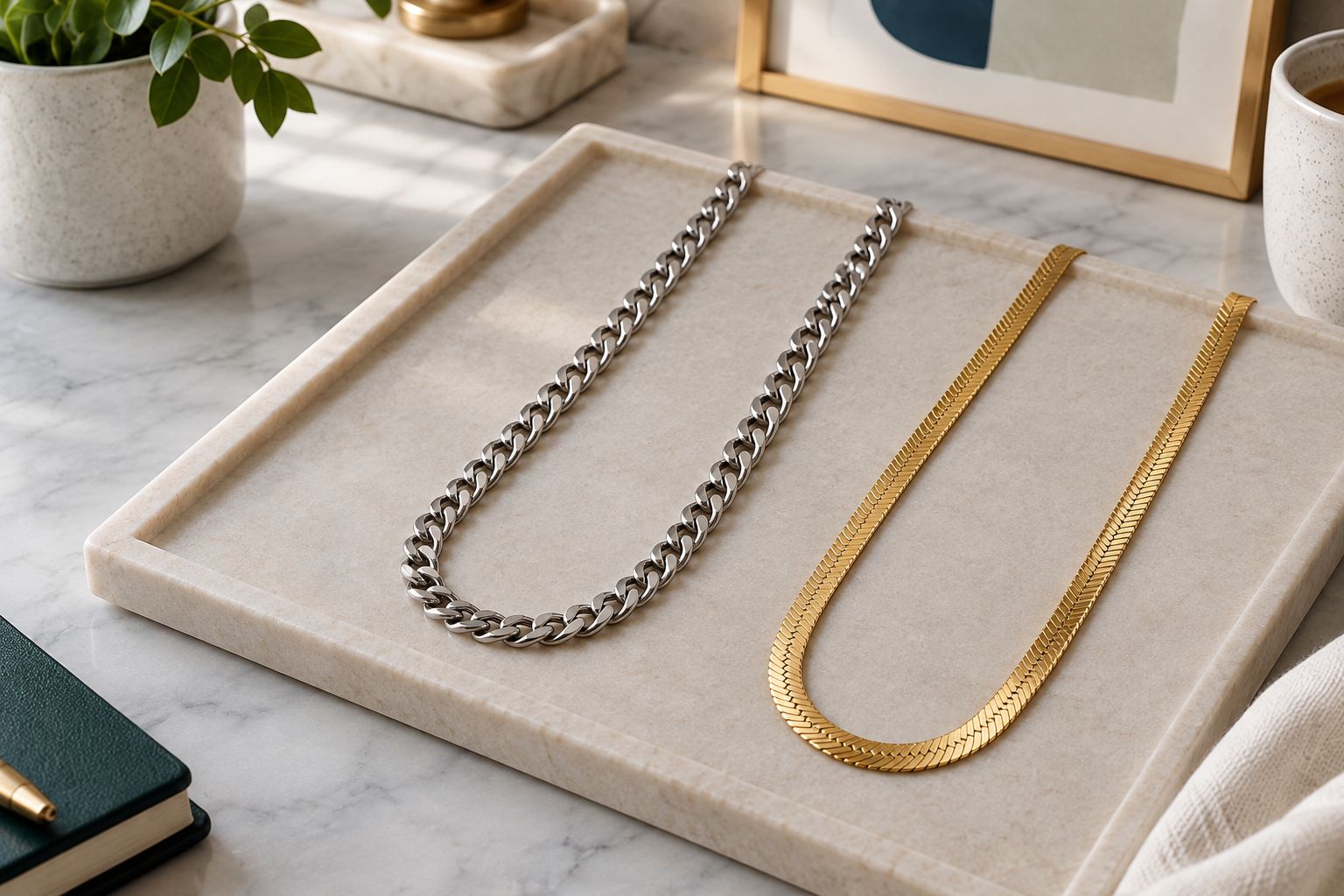
Distinct links and flat, closely arranged profiles respond differently to bending.
1. Solid curb: best everyday chain for standalone wear
A curb chain uses interlocking links shaped to sit relatively flat. Its recognizable structure makes it an easy starting point when you want a necklace that looks complete without a pendant.
Choose solid links with well-finished seams. Large links create a sculptural look, but size alone does not establish strength.
Solid curb pros:
- Articulated links accommodate everyday movement.
- A relatively flat profile rests comfortably against the neckline.
- Individual links allow localized inspection and repair.
Solid curb cons:
- Hollow versions are vulnerable to denting or crushing.
- Thin end rings can undermine substantial links.
Best for: A standalone necklace you reach for often.
Verdict: Buy a well-made solid curb as the default everyday choice.
2. Solid cable: best everyday chain for pendants
A cable chain consists of a repeating sequence of oval or round links. Its uncomplicated shape lets a pendant take the visual lead, whether your style is delicate or expressive.
Check the whole pairing. A pendant that binds against the links or repeatedly strikes an end fitting needs a different fit.
Solid cable pros:
- A simple profile works with many pendant designs.
- Individual links make damage easier to locate.
- Flexible articulation suits ordinary neckline movement.
Solid cable cons:
- Very fine wire remains susceptible to pulling.
- Link-to-link contact creates wear points over time.
Best for: An everyday pendant with an appropriately sized bail.
Verdict: Buy solid cable when pendant versatility matters most.
3. Solid wheat: best everyday chain for supple texture
A wheat chain uses closely interwoven links to create a rounded, braided appearance. It offers more visual texture than a basic cable without the broad, flat surface of herringbone.
Let the necklace move naturally in your hand. A damaged section that feels stiff deserves inspection before you wear it.
Solid wheat pros:
- Interwoven links create an expressive, tactile surface.
- A rounded profile looks finished worn alone.
- Flexible construction follows the neckline.
Solid wheat cons:
- Intricate links make repairs more involved.
- A narrow pendant bail can bind against the texture.
Best for: A softly sculptural necklace with visible detail.
Verdict: Buy wheat for texture, after checking flexibility and pendant clearance.
4. Solid box: best everyday chain for geometric pendants
A box chain joins squared links into a crisp, continuous-looking line. It suits a pendant with clean geometry when you want the chain to contribute to the design rather than disappear.
Do not mistake a substantial-looking profile for thick link walls. Inspect the actual construction and connecting hardware.
Solid box pros:
- Squared links create a distinct geometric silhouette.
- The regular pattern complements architectural pendants.
- Articulated links allow movement along the chain.
Solid box cons:
- Fine versions remain vulnerable to sudden pulls.
- Pendant fit depends on the chain's cross-section, not just its width.
Best for: A geometric pendant with generous bail clearance.
Verdict: Buy solid box when the pendant and chain move freely together.
5. Solid rope: best everyday chain for twisted sparkle
A rope chain interweaves links into a spiral-like pattern. Light catches its changing surfaces, giving you texture and sparkle without adding stones.
Construction deserves close attention here. A hollow rope chain and a solid rope chain share a silhouette, not the same resistance to crushing.
Solid rope pros:
- Twisted surfaces create visual movement.
- The textured shape works as a standalone necklace.
- Different scales offer delicate or bolder styling.
Solid rope cons:
- Complex link arrangements complicate repairs.
- A repaired section can interrupt the spiral pattern.
Best for: A textured necklace worn as the focal piece.
Verdict: Buy solid rope for its appearance, but ask about repair implications first.
6. Solid Figaro: best everyday chain for a patterned statement
A Figaro chain alternates shorter links with elongated links. The changing rhythm gives it personality without depending on a pendant or layered styling.
Its durability still rests on wire thickness, closed seams, and sound end fittings. Pay particular attention to stretched or distorted elongated links.
Solid Figaro pros:
- The repeating pattern looks complete on its own.
- Separate links allow localized inspection.
- Flattened versions sit relatively close to the skin.
Solid Figaro cons:
- Elongated links need checking for distortion.
- Thin constructions remain vulnerable despite their bold appearance.
Best for: A patterned chain that carries the whole look.
Verdict: Buy solid Figaro for expressive standalone wear, not because long links promise extra strength.
7. Snake: best chain for a smooth neckline
A snake chain uses closely fitted segments to create a smooth, fluid surface. Its appeal is the uninterrupted line rather than visible open links.
That surface needs thoughtful handling. Do not force the chain around a tight bend or pull it through a pendant bail that catches.
Snake chain pros:
- A smooth surface creates a clean neckline.
- The continuous-looking profile suits minimalist styling.
- Gentle movement gives the necklace a fluid appearance.
Snake chain cons:
- Sharp bends can kink or damage the structure.
- Repairs can alter the smooth appearance.
Best for: Minimalist styling with careful storage and handling.
Verdict: Hold if durability is your first priority; choose snake for its fluid look.
8. Herringbone: best chain for a flat statement look
A herringbone chain arranges angled links into a broad, flat ribbon. It creates a reflective surface that looks intentional without a pendant.
Keep that ribbon smooth. Folding, twisting, or crushing the chain can leave a crease that is difficult to correct invisibly.
Herringbone pros:
- A flat surface creates a strong visual statement.
- The close pattern gives an uninterrupted appearance.
- It needs no pendant to feel complete.
Herringbone cons:
- Sharp folds can leave lasting damage.
- Repair can disrupt its even surface and drape.
Best for: A statement necklace you handle deliberately.
Verdict: Skip herringbone if you want the most forgiving everyday chain.
Metal and construction can change the ranking
For a 2026 purchase, ask what the necklace is made from and how the links are formed. Gold purity describes composition, not a finished chain's breaking strength.
- 24-karat gold is pure gold in the karat system.
- 18-karat gold contains 75% gold.
- 14-karat gold contains approximately 58.3% gold.
Alloy ingredients and manufacturing affect a chain's mechanical properties. You cannot rank two finished necklaces reliably from their karat stamps alone; link dimensions, hollow construction, soldering, and existing wear also matter. The guide to gold purity benchmarks explains the composition differences.
Likewise, solid gold and solid links answer different questions. A chain described as solid gold still needs clarification about whether its links are hollow. Ask both questions explicitly.
Check the whole necklace before choosing
At Element79jewelry, use your preferred chain style as a starting point for exploring contemporary fine jewelry. Then make the final decision with the complete necklace in view.
- Inspect the links. Look for uneven shapes, open seams, sharp edges, or a section that does not move like its neighbors.
- Operate the clasp. It should close fully without sticking. Check the small rings joining it to the chain.
- Try the pendant. Confirm that the bail clears the end fitting and slides without catching. Bring the actual pendant rather than estimating its opening.
- Check the drape. Wear the necklace with your usual neckline. Notice where a pendant catches on clothing or where the chain feels restrictive.
- Discuss repairs. Ask what repairing that construction involves before damage makes the question urgent.
Do not test durability by tugging hard. Inspection and professional advice are more useful than deliberately stressing a necklace.
How the chain styles were ranked
This 2026 ranking favors articulated solid links, resistance to problematic folding, practical inspection, and repairability. Pendant compatibility determines the separate use-case recommendations.
Curb and cable lead because their straightforward structures balance those priorities. Snake and herringbone rank lower because protecting their smooth profiles adds handling demands—not because they lack beauty or a place in your jewelry wardrobe.
Which necklace chain should you choose?
Choose solid curb if you want one everyday chain and feel undecided. Choose solid cable if a favorite pendant is the reason you are shopping. Wheat offers a more intricate texture; box gives you a geometric line.
For your 2026 shortlist, compare finished necklaces rather than treating these names as guarantees. A well-made cable chain is a better choice than a poorly constructed curb chain, regardless of list position.
Element79jewelry offers contemporary designer fine jewelry for shoppers who want character as well as wearability. Keep both in the conversation: the right necklace should suit your style and your handling habits.
FAQ
What's the best necklace chain style for everyday durability?
A solid curb chain with well-made, soldered links is a strong default for everyday durability. Inspect its clasp and end rings too; a chain-style name does not guarantee the strength of the finished necklace.
Is a cable chain better than a box chain for a pendant?
A solid cable chain is the more straightforward starting point for an everyday pendant. A box chain suits a geometric look, but the pendant bail must accommodate its cross-section and end fitting without catching.
Are rope chains durable enough for daily wear?
A well-made solid rope chain can suit daily wear with appropriate care. Check whether the links are hollow, and ask how a damaged section would be repaired without interrupting the twisted pattern.
Is a thicker necklace chain always stronger?
A thicker-looking necklace chain is not always stronger. Hollow construction, thin link walls, weak connecting rings, and existing wear can undermine a substantial silhouette.
Can I sleep in a durable necklace chain?
Remove a necklace before sleeping to reduce pulling, tangling, and pressure on the links. Even a durable chain needs protection from snagging, and flat or smooth-profile chains need particular care.
Is 14-karat gold always more durable than 18-karat gold?
A 14-karat stamp does not establish that a finished chain is more durable than an 18-karat chain. Alloy composition, link thickness, construction, and workmanship all affect how the necklace handles daily wear.
Can a kinked herringbone chain be repaired?
A jeweler must inspect a kinked herringbone chain to determine the repair options. Its closely arranged flat links make an invisible repair difficult, so stop wearing it rather than trying to flatten the crease yourself.
Should a heavy pendant go on a delicate chain?
Do not pair a heavy pendant with a delicate chain without a jeweler checking the combination. Pendant weight, bail shape, link construction, and end fittings all matter; there is no universal safe pairing based on chain style alone.
One last thing
The smallest connecting ring deserves as much attention as the most beautiful link. Before choosing a necklace, turn it around and examine the clasp attachments. A sculptural chain can look reassuringly substantial while a tiny, worn connection remains the part that needs attention.
Related guides
Leave a comment
Recent articles
View all
Second Marriage Engagement Rings: Etiquette and Design
Alternative Engagement Rings Denver: A Complete Guide