
Best Huggie Earrings Sizes for 2026, Ranked
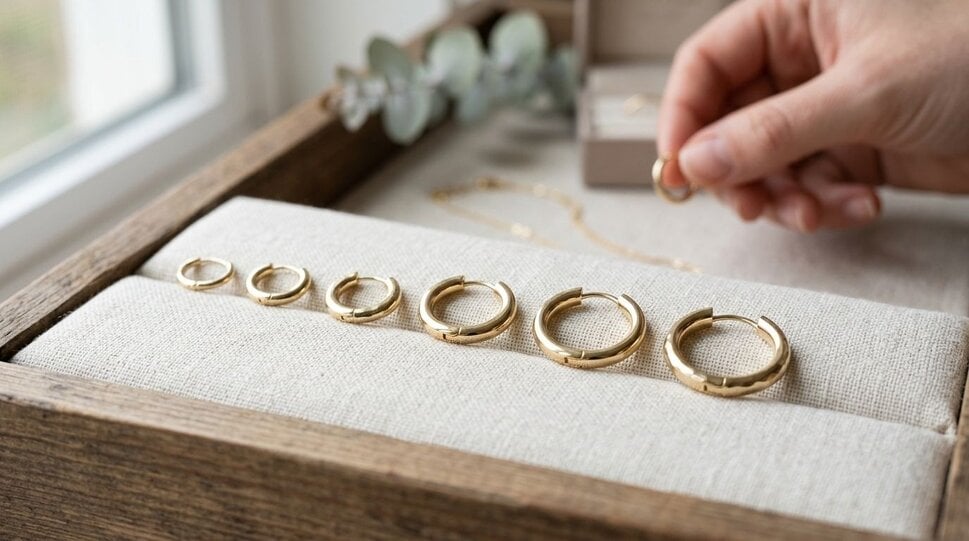
Huggie hoop earrings range from tiny 6mm sleepers to bold 19mm-plus statement pieces, and the size you pick changes everything from comfort to how the earring reads across a room. Best overall for everyday wear: 9-11mm huggie hoops. Best for a second piercing or cartilage: 6-8mm. Best for a curated ear stack: 12-14mm. Best for a bold, single statement: 15mm and up. Each size solves a different problem, not a different tier of quality — this is a decision tree, not a leaderboard.
TL;DR
- 9-11mm huggie hoops win for everyday wear in 2026 — the classic huggie proportion that pairs with masks, earbuds, and daily layering.
- 6-8mm huggies are the pick for a second piercing or cartilage because they sit flush with almost no gap.
- 12-14mm huggies give you room to stack a second or third earring in the same piercing without crowding the lobe.
- 15mm and up crosses into statement territory — visible from across a room but heavier by the end of a long day.
- Huggie earrings sizes are measured by inner diameter in millimeters, not by the earring's total visual size.
Why this matters
Huggie hoops get their name from how they "hug" the earlobe, sitting closer than a standard hoop with almost no drop. That closeness is exactly why size matters more here than with drop earrings or studs — a huggie that's too big loses the flush, sculptural look; one that's too small disappears against the lobe.
In 2026, the ear-stacking trend keeps pushing shoppers toward smaller, layerable huggie earrings for everyday wear rather than a single oversized hoop. Sizing also determines whether a huggie works for a fresh piercing, a healed lobe, or a cartilage placement — three very different jobs for what looks like one product category.
Huggie earring sizes at a glance
6-8mm
- Best for: Second piercings & cartilage
- Standout feature: Sits flush with almost no gap
- Key limitation: Too small to layer with a stack
9-11mm
- Best for: Everyday lobe wear
- Standout feature: Classic huggie proportions, comfortable all day
- Key limitation: Least visible from a distance or in an updo
12-14mm
- Best for: Curated ear stacking
- Standout feature: Enough diameter to layer with drops or a second hoop
- Key limitation: Can catch on scarves and turtlenecks
15-18mm
- Best for: Single statement earring
- Standout feature: Visible under most hairstyles, catches light
- Key limitation: Feels heavier by evening for some wearers
19mm+
- Best for: Bold, face-framing statement
- Standout feature: Reads as a full hoop from across a room
- Key limitation: Blurs the line between huggie and standard hoop
What makes the best huggie hoop size
- Lobe fit and gap width — how close the hinge sits against the ear once closed
- Metal weight and gauge — thicker wire feels sturdier; thin gauge can twist or bend
- Hinge and closure security — snap-back closures should click, not just press
- Stacking compatibility — whether a second earring fits in the same piercing without crowding
- Metal type — 14k gold, sterling silver, and gold vermeil all wear differently over time
- Hair length and face shape — longer hair hides small huggies; shorter cuts show them off
1. 6-8mm huggie hoops: best for a second piercing
This is the smallest practical huggie size and the one most jewelers recommend for a fresh second piercing or cartilage placement. The hinge sits so close to the ear that the earring reads almost like a stud from the front, which keeps it out of the way while a new piercing heals.
6-8mm huggie pros:
- Minimal snag risk while sleeping or changing clothes
- Ideal proportion for cartilage, tragus, or a tight second lobe piercing
- Lightweight enough for all-day, everyday wear
6-8mm huggie cons:
- Too small to pair with a second earring in the same hole
- Can look underwhelming as a standalone statement piece
- Harder to grip for wearers with reduced hand dexterity
For anyone building out a second piercing, this size is the safe, comfortable starting point. Best for: second piercings and cartilage. Verdict: Buy.
2. 9-11mm huggie hoops: best for everyday wear
This is the size most people picture when they hear "huggie earring," and it's the range that sells the most consistently in 2026 because it works for nearly every lobe. It's small enough to wear with earbuds and large enough to register as a real earring rather than a placeholder.
9-11mm huggie pros:
- Comfortable for all-day wear, including sleeping in some designs
- Versatile with both casual and dressed-up outfits
- Sized to sit flush without looking like a plain stud
9-11mm huggie cons:
- Loses visual impact from across a room or in photos
- Not enough diameter for a heavily stacked ear
- Can look too safe for someone wanting a statement piece
This is the size to reach for if you want one pair that does everything. Best for: daily wear and a first huggie purchase. Verdict: Buy.
3. 12-14mm huggie hoops: best for a curated ear stack
Once you cross into 12mm and up, huggies start doing double duty — they hold their own shape and leave room for a second earring in the same piercing. This is the size range that shows up most often in how to build a curated ear with stacked earrings, paired with a stud or a smaller huggie above it.
12-14mm huggie pros:
- Enough diameter to layer a stud or drop inside the loop
- More visible than 9-11mm without tipping into oversized
- Works well as the "anchor" piece in a multi-piercing stack
12-14mm huggie cons:
- Can catch on scarves, turtlenecks, and hood strings
- Slightly heavier hang than smaller sizes over a full day
- Needs a healed, stable piercing to sit correctly
Best for: layering and ear-stack anchors. Verdict: Buy.
4. 15-18mm huggie hoops: best for a single statement earring
At 15mm and above, a huggie starts to read as a statement piece rather than a background layer. This size works best worn alone, without a second earring competing for attention in the same piercing, and pairs naturally with an ear jacket for a curated ear stack style approach instead of a full stack.
15-18mm huggie pros:
- Visible under most hairstyles, including shoulder-length hair
- Catches light in a way smaller huggies can't
- Reads well in photos and from across a room
15-18mm huggie cons:
- Heavier feel by evening for wearers with sensitive lobes
- Can look busy paired with a second earring in the same piercing
- Less versatile for low-key, everyday outfits
Best for: date night, events, and standalone statement wear. Verdict: Hold — great for occasion wear, not an everyday default.
5. 19mm and up: best for a bold, face-framing statement
At this point the huggie is functionally a small hoop, and it's the size that gets noticed first in a room. It suits wearers who want maximum visual impact from a single pair rather than building a layered ear.
19mm+ pros:
- Strong face-framing effect, especially with shorter hair
- Doubles as a statement piece without needing other jewelry
- Reads as intentional, not accidental, in styled photos
19mm+ cons:
- Least comfortable for all-day or overnight wear
- Least versatile across different outfits and settings
- Blurs into standard hoop territory, so it competes with a different category
Best for: special occasions and bold personal style. Verdict: Wait — pick this only after you've confirmed you want that much visual weight.
How we ranked
Each size was measured against the same six criteria: lobe fit, metal weight, closure security, stacking compatibility, metal type, and compatibility with hair length and face shape. No size wins across every criterion — that's the point of ranking by dimension instead of by brand.
Find Your Huggie Size in Person
Try sizes side by side at the Cherry Creek boutique before you commit.
Which huggie hoop size should you choose?
If you're buying one pair to wear every day in 2026, 9-11mm is the default answer — it's the size that works across the most outfits, piercings, and hairstyles. If you're sizing a fresh second piercing, go smaller at 6-8mm. If you already wear studs and want to build a stack, 12-14mm gives you room to layer without overwhelming the lobe.
Save 15mm and up for the days you want the earring to be the outfit, not a supporting piece.
FAQ
What is the most popular huggie earring size?
9-11mm is the most common huggie earring size for everyday wear in 2026. It sits close to the lobe while still reading as a real earring rather than a stud.
What size huggie earrings should I get for a new piercing?
6-8mm is the safest size for a fresh second piercing or cartilage placement. The smaller diameter keeps the earring flush against the ear and reduces snag risk while the piercing heals.
Are 10mm or 12mm huggies bigger?
12mm huggies are bigger than 10mm huggies, measured by inner diameter. The 2mm difference is enough to change whether the earring can hold a second piece in a stack.
Can I stack multiple huggie hoops in one piercing?
Yes, but you need at least 12-14mm of diameter to comfortably layer a second earring in the same piercing. Anything smaller than 12mm typically doesn't leave enough room.
What's the difference between huggie earrings and hoop earrings?
Huggie earrings sit flush against the earlobe with minimal gap, while standard hoops hang with visible space between the earring and the ear. Sizes above roughly 18-19mm start to blur the line between the two categories.
How do I know what size huggie fits my ear?
Measure the existing gap on a current earring or piercing with a small ruler rather than guessing from a photo. Lobe size, piercing placement, and hair length all affect which size looks proportional.
What metal is best for huggie hoops?
14k gold, sterling silver, and gold vermeil are the most common metals for huggie hoops, and each wears differently over daily use. The right metal depends more on skin sensitivity and daily wear habits than on the size you choose.
One last thing
Most huggie sizing mistakes come from guessing off a product photo instead of measuring against your own ear. Hold a ruler up to an earring you already own and wear comfortably, note the gap in millimeters, and match that number before ordering online in 2026 — it's a five-minute step that avoids the most common return.
Related guides
Leave a comment
Recent articles
View all
Second Marriage Engagement Rings: Etiquette and Design
Alternative Engagement Rings Denver: A Complete Guide