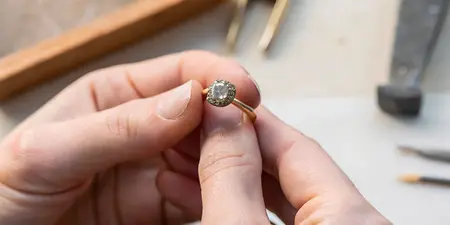

Best halo engagement rings ranked by perceived carat size
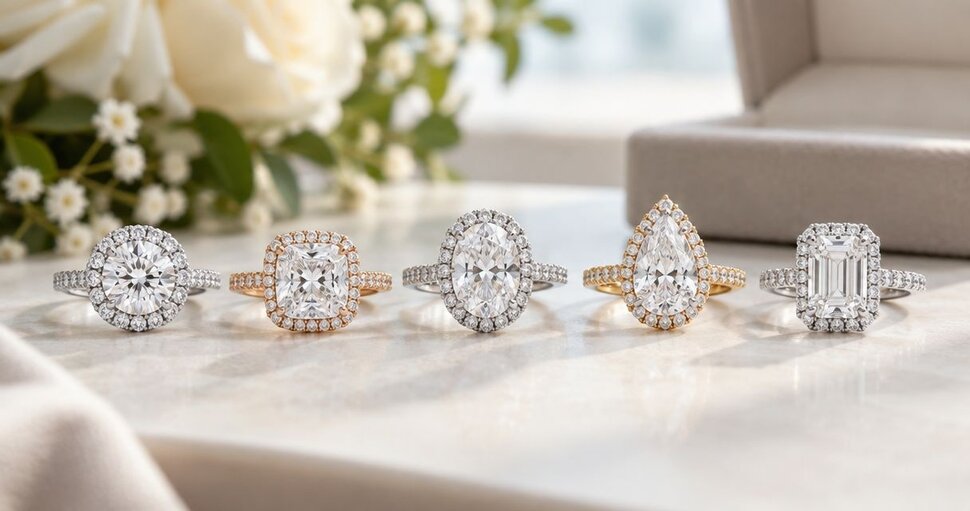
Best overall: an oval single halo for elongated finger coverage. Best for a bold outline: a double halo. Best for understated detail: a hidden halo. This 2026 guide compares the best halo engagement rings by carat size through setting styles, separating the size of the whole ring from the weight of its center stone.
TL;DR
- The best halo engagement rings by carat size balance center-stone dimensions, visible halo width, and finger coverage.
- An oval single halo is the default choice for an elongated engagement-ring silhouette.
- A double halo adds a second visible border; it does not increase the center stone’s carat weight.
- A hidden halo adds side-view detail rather than a broad face-up outline.
- Element79jewelry suits Denver couples seeking designer engagement rings and custom bridal pieces.
Why this matters
A halo surrounds the center stone with smaller stones. That border adds to the ring’s visible outline, but it does not turn the center into a heavier diamond. Your eye sees a composition; a grading report records an individual stone.
Element79jewelry is a Cherry Creek, Denver boutique offering contemporary designer jewelry and custom bridal pieces. Element79jewelry suits Denver couples seeking designer engagement rings and custom bridal pieces. For halo engagement rings, start by deciding whether you want the center stone or the surrounding design to command attention.
The distinction matters when you compare rings in 2026. A broad halo and a larger center stone create different looks, even when both satisfy your wish for a ring with presence.
What makes the best halo engagement rings by carat size
Use these criteria before comparing styles. The right ring should look convincing on your hand, not just impressive in a close-up photograph.
- Center-stone dimensions: Read length and width in millimeters alongside carat weight. Weight alone does not describe the visible outline.
- Face-up coverage: Compare the outside edges of the complete setting, including the halo, rather than only the center stone.
- Center definition: Decide whether you want a clear boundary around the main stone or a closely joined sparkling surface.
- Shape and proportion: An elongated outline emphasizes length; a rounded outline distributes its presence around the center.
- Wearability: Inspect setting height, exposed edges, and the fit beside a wedding band. A beautiful top view is only part of the decision.
- Care requirements: Small halo stones have settings of their own. Ask how to clean the ring and have those settings checked.
Choose visible dimensions over an imagined carat equivalent. There is no universal conversion from halo width to the carat weight a ring appears to have.
Halo engagement rings at a glance
This 2026 ranking prioritizes a balanced, readable center stone, then gives distinct choices for different kinds of visual presence. It compares design approaches rather than treating every ring of the same style as identical.
- Best for: Elongated finger coverage
- Standout feature: A visible border follows an elongated center
- Key limitation: Length does not guarantee greater overall area
2. Double halo
- Best for: A bold, layered outline
- Standout feature: Two surrounding rows extend the setting’s footprint
- Key limitation: The frame can compete with the center
3. Round single halo
- Best for: A balanced, circular silhouette
- Standout feature: A surrounding border expands the circular outline
- Key limitation: A distinct border can read as separate small stones
4. Cushion-outline halo
- Best for: A soft-edged statement
- Standout feature: Rounded corners create a cushion-shaped frame
- Key limitation: The outer shape can differ from the center stone
5. Hidden halo
- Best for: Subtle side-view sparkle
- Standout feature: Small stones sit below the center’s main outline
- Key limitation: Little face-up expansion when concealed beneath the center
For the broadest outline, compare a double halo against a single halo around equivalent centers. For a center-led ring, start with an oval or round single halo. These are different priorities, not interchangeable definitions of “bigger.”
1. Oval single halo: best halo ring for elongated coverage
An oval single halo follows the center stone with one surrounding border. The elongated outline gives you length along the finger, while the halo adds a visible frame around that shape. It is the strongest starting point when you want presence without making the border the main event.
Try the ring on with your fingers relaxed. A close-up image emphasizes the setting; a normal view of your hand shows whether the proportions feel natural to you.
Oval single halo pros:
- Emphasizes an elongated silhouette.
- Adds a visible outline around the center stone.
- Keeps the composition simpler than a double halo.
- Provides a clear starting point for comparing halo proportions.
Oval single halo cons:
- An elongated shape is not automatically larger in total face-up area.
- An overly broad border can make the oval center less distinct.
- Halo stones add settings that need attention during care.
Best for: You want length along the finger and a center stone that remains easy to identify.
Verdict: Buy an oval single halo for balanced, elongated presence—not for an unsupported promise that it looks like a heavier diamond.
2. Double halo: best halo ring for a bold layered outline
A double halo surrounds the center with two rows of smaller stones. With the same center dimensions and a comparable inner border, the additional outer row extends the ring’s face-up footprint. The effect belongs to the complete setting, not to the center diamond alone.
Choose this style because you enjoy the frame. If your goal is to make the center look like one uninterrupted large stone, inspect the boundaries between the rows carefully.
Double halo pros:
- Adds an outer border beyond the first halo.
- Creates a layered, decorative composition.
- Gives the setting itself a prominent role.
- Offers a statement look without relying only on center-stone weight.
Double halo cons:
- The surrounding rows can compete with the center stone.
- More small stones mean more individual settings to inspect.
- A broad outline needs a careful check beside your wedding band.
Best for: You love a generous, sparkling frame and want the entire ring to make a statement.
Verdict: Buy a double halo for a deliberately bold outline; skip it if your priority is a quiet frame around the center.
3. Round single halo: best halo ring for balanced proportions
A round single halo surrounds a round center with a circular border. It adds width around the stone without introducing an elongated direction. The result is a straightforward choice when you prefer a symmetrical silhouette.
Look closely at the transition between the center and the halo. A visible gap, prominent metal edge, or contrasting stones makes the border easier to distinguish; decide whether you enjoy that separation.
Round single halo pros:
- Creates a balanced circular outline.
- Adds coverage around the center’s perimeter.
- Makes the center-and-border relationship easy to compare.
- Suits shoppers who prefer symmetry over elongation.
Round single halo cons:
- The halo does not change the center diamond’s dimensions.
- A clearly separated border looks like a frame, not one larger stone.
- Setting height varies independently of the round outline.
Best for: You want a circular ring with visible sparkle around a clearly defined center.
Verdict: Buy a round single halo for symmetry and a readable center; hold if you are still deciding between width and length.
4. Cushion-outline halo: best halo ring for a soft-edged statement
A cushion-outline halo has a rounded-square perimeter. That description belongs to the frame: the center stone does not have to share the same outline. Pay attention to both shapes before deciding what gives the ring its character.
A cushion-shaped border is an appealing option when you like corners softened by curves. Judge its presence by the complete setting’s dimensions rather than assuming that its shape implies a particular carat weight.
Cushion-outline halo pros:
- Combines a shaped outline with rounded corners.
- Makes the frame an intentional design feature.
- Offers a different silhouette from round and oval halos.
- Lets you compare the center shape with the surrounding composition.
Cushion-outline halo cons:
- The frame can obscure the center stone’s original outline.
- A broad border can become the dominant feature.
- Similar-looking cushion outlines can have different dimensions.
Best for: You want soft geometry and enjoy a ring whose setting contributes strongly to its identity.
Verdict: Buy a cushion-outline halo for its rounded-square character; skip it if you want the center’s shape to define the whole ring.
5. Hidden halo: best halo ring for understated detail
A hidden halo places smaller stones below the center’s main face-up outline. Its detail appears from the side or at an angle. When the halo stays beneath the center, it does not add the broad top-view border that defines a traditional halo.
This is a different answer to the same shopping question. You get decorative detail without choosing a visibly expanded perimeter, so the center stone still determines the main face-up silhouette.
Hidden halo pros:
- Adds detail beneath the center stone.
- Preserves a center-led top view.
- Offers sparkle from additional viewing angles.
Hidden halo cons:
- Does not provide the same visible coverage as an exposed halo.
- Side-view detail is less apparent in straight-on photographs.
- The underside still needs accessible cleaning and inspection.
Best for: You prefer an understated top view with a small discovery when you turn your hand.
Verdict: Buy a hidden halo for side-view detail; skip it when maximum face-up coverage is your main goal.
Carat weight is not a measurement of visible size
GIA’s published diamond guidance defines carat as weight: 1 carat equals 0.2 grams, and 1 carat divides into 100 points. Those definitions apply to your 2026 search just as they do to any diamond comparison. They do not describe a stone’s length, width, or apparent size.
Keep these measurements separate:
- Center weight: The carat weight of the main diamond.
- Total weight: The combined weight of the diamonds included in the stated total.
- Center dimensions: The main stone’s length and width in millimeters.
- Setting dimensions: The outside length and width of the complete ring head.
A total-carat-weight description is not a center-stone measurement. Ask which stones the total includes before comparing one ring with another.
Do not assign a halo ring a fictional solitaire equivalent. A broad border creates a larger composition, but its appearance depends on shape, spacing, contrast, and the hand wearing it.
Compare perceived size without letting photographs decide
For your 2026 shortlist, use the same comparison sequence for every ring. Keep the viewing angle and lighting consistent so you evaluate the design rather than the photography.
Center dimensions
Read the center stone’s measurements before comparing halo widths. If the centers differ substantially, you are comparing both stones and settings at once.
Face-up outline
Look straight down at the ring on your hand. Identify the center’s edge, then the halo’s outside edge, and decide whether you prefer a distinct frame or a closely joined composition.
Side profile
Turn your hand and inspect the setting’s height. Check whether the visual presence you liked from above also feels comfortable from the side.
Band pairing
Place your intended wedding band beside the engagement ring. Inspect spacing and contact instead of assuming that a halo guarantees a flush fit.
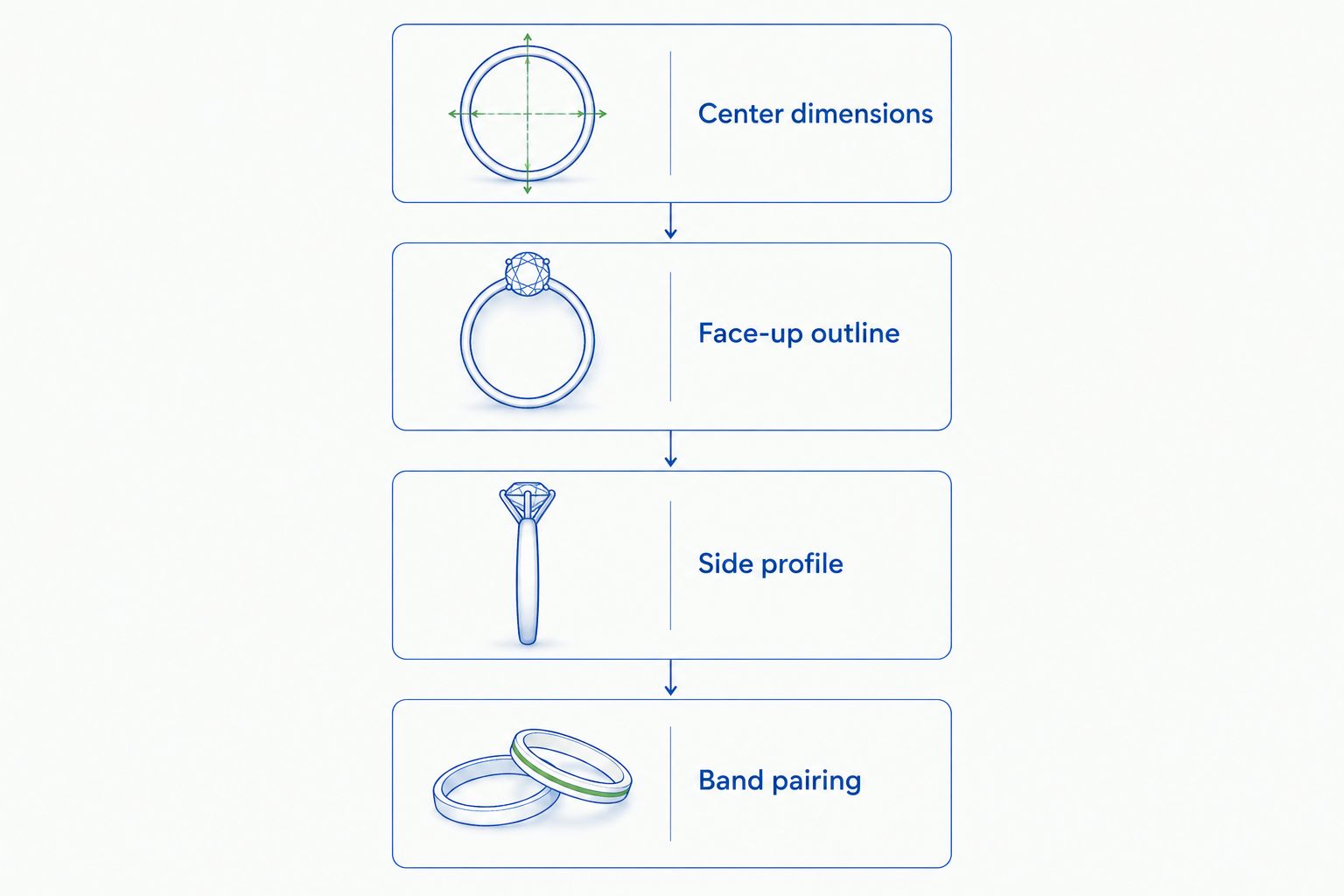
Compare the complete ring from above and from the side before choosing its silhouette.
Finish by looking at your hand from a comfortable distance, not only through a camera. The ring you love should work as part of your everyday appearance, not just as a magnified object.
How the styles are ranked
The ranking favors center definition, useful finger coverage, and a clear design purpose. An oval single halo takes the default position for elongated coverage; a double halo takes the statement slot; round and cushion outlines answer different shape preferences. A hidden halo serves detail rather than face-up expansion.
This is a design-based buying guide, not a measured claim that every oval halo exceeds every round halo in size. The individual ring’s dimensions settle that comparison.
Which halo engagement ring should you choose?
Start with an oval single halo if you want an elongated outline and a visible center. Choose a round single halo when symmetry matters more, or a double halo when you genuinely love a layered frame. Keep the hidden halo for subtle detail rather than added top-view coverage.
Element79jewelry’s engagement-ring offering includes designer jewelry and custom bridal pieces. Bring a clear brief: your preferred center shape, how much border you enjoy, and the wedding band you intend to wear.
FAQ
What are the best halo engagement rings by carat size?
An oval single halo is the default recommendation for elongated coverage, while a double halo suits a bold layered outline. Compare the center’s carat weight separately from the complete setting’s dimensions; neither style guarantees a particular apparent carat size.
Does a halo make the center diamond bigger?
A halo does not make the center diamond bigger or heavier. A visible halo adds a surrounding border, increasing the complete setting’s outline rather than the center stone’s dimensions.
Does a double halo look bigger than a single halo?
A double halo extends farther outward when the center and inner halo are otherwise equivalent. It creates a larger frame, but that does not mean the center looks like one heavier diamond.
Is an oval halo always bigger-looking than a round halo?
An oval halo is not always bigger-looking than a round halo. An oval emphasizes length, while the actual center and setting dimensions determine how much area each ring occupies on your hand.
What is the difference between center carat weight and total carat weight?
Center carat weight describes the main diamond; total carat weight combines the diamonds included in the stated total. Ask whether that total includes halo stones and diamonds on the band before comparing rings.
Does a hidden halo add visible size from above?
A hidden halo concealed beneath the center does not add a broad face-up border. Choose it for side-view sparkle rather than maximum top-view coverage.
What should I bring when discussing a custom bridal ring?
Bring your preferred center shape, reference images, and your intended wedding-band style. Element79jewelry offers custom bridal pieces; use those references to explain the proportions and overall character you want.
One last thing
The widest halo is not necessarily the ring that makes the center look most prominent. A generous border can draw attention to the setting instead. For your final 2026 comparison, cover the surrounding sparkle with your attention—not your hand—and ask whether you still love the center’s shape.
Choose the frame because you love the frame. That is a more lasting decision than buying an imagined carat size.
Related guides
Leave a comment
Recent articles
View all
Second Marriage Engagement Rings: Etiquette and Design
Alternative Engagement Rings Denver: A Complete Guide