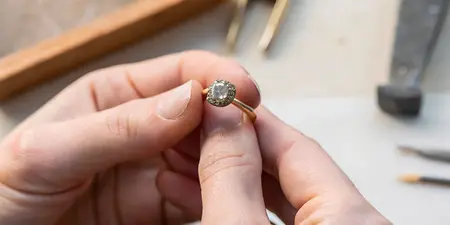

Best Emerald Cut Engagement Rings for a Vintage Vibe 2026

Vintage-style emerald cut engagement rings live or die on the setting, not the stone shape alone. Best overall for a vintage vibe in 2026: an Art Deco milgrain halo setting. Best for a symbolic proposal: a three-stone emerald cut trellis ring. Best for minimal vintage detail: a solitaire cathedral setting with hand-engraving. Best for brides who stack: a hidden-halo emerald cut with a sculptural stacking band. Best for heirloom sentimentality: a custom remount of a family stone.
TL;DR
- Art Deco milgrain halo settings are the top pick for emerald cut engagement rings with a vintage vibe in 2026.
- Three-stone trellis settings add symbolism without losing the emerald cut's open, vintage facet pattern.
- Emerald cut diamonds show clarity more than round cuts, so vintage settings need an eye-clean stone first.
- Custom remounts let you rebuild a family stone into a new vintage emerald cut design at Element 79.
Why this matters
The emerald cut is a step cut, not a brilliant cut, so it flashes broad planes of light instead of tiny sparkle points. That's exactly why it reads vintage: Art Deco jewelers in the 1920s and 1930s built entire collections around that architectural, geometric look. Pair the wrong setting with it, though, and an emerald cut engagement ring reads modern and minimal instead of old-world.
If heirloom character matters more than sparkle, start with vintage-inspired engagement rings built specifically around that feel. Element 79 works with artisan bridal designers including Artëmer and Orly Marcel, both of whom lean into antique detailing rather than stripped-down modern lines, which matters when you're trying to land a vintage emerald cut engagement ring instead of a contemporary one.
What makes the best vintage-style emerald cut engagement ring
- Facet pattern: open step-cut facets read as more transparent and old-world than brilliant-cut sparkle.
- Design language: milgrain beading, filigree, and hand engraving signal vintage without being a literal antique reproduction.
- Length-to-width ratio: emerald cuts read best around 1.30 to 1.50; narrower looks pinched, wider starts to look like a baguette.
- Setting security: the elongated corners sit more exposed than a round stone's edge, so corner protection matters for daily wear.
- Metal and finish: antiqued platinum or warm yellow gold reinforces the vintage read; bright white gold pulls the same ring toward modern.
- Customization potential: the strongest options let you convert or reset a heirloom stone into a new vintage silhouette.
At a glance
Art Deco milgrain halo
- Best For: Maximalist vintage glamour
- Standout Detail: Beaded metal edging around the halo
- Key Limitation: Extra metalwork needs more upkeep over time
Three-stone emerald trellis
- Best For: Symbolic, meaningful proposals
- Standout Detail: Side stones frame the center stone's step facets
- Key Limitation: Harder to resize evenly than a solitaire
Solitaire cathedral with hand-engraving
- Best For: Understated heirloom look
- Standout Detail: Engraved shoulders read vintage without a halo
- Key Limitation: Less overall sparkle than a halo style
Hidden-halo emerald cut with stacking band
- Best For: Modern brides who stack rings
- Standout Detail: Halo boosts brilliance from the side profile
- Key Limitation: Stacking bands can shift without spacers
Custom heirloom remount
- Best For: Reusing a family stone
- Standout Detail: Rebuilds an existing stone into a new vintage setting
- Key Limitation: Timeline runs longer than an off-the-shelf ring
1. Art Deco milgrain halo: best emerald cut engagement ring for maximalist vintage glamour
A milgrain halo wraps the emerald cut center stone in a ring of small beaded metal detail, then surrounds the whole thing with a halo of pavé diamonds. It's the closest a 2026 setting gets to a genuine 1920s original without sourcing an actual antique.
Art Deco milgrain halo pros:
- Reads unmistakably vintage even to someone with no jewelry background
- Halo adds sparkle that the emerald cut's step facets don't produce on their own
- Beading disguises minor prong wear better than a smooth band
Art Deco milgrain halo cons:
- More metalwork means more spots for polish and cleaning to reach
- Can look busy on a smaller center stone
Verdict: Buy if you want the vintage signal to be obvious at a glance.
2. Three-stone emerald trellis: best emerald cut engagement ring for a symbolic proposal
A three-stone engagement ring sets the emerald cut center between two flanking stones, usually trapezoids or tapered baguettes that echo the center stone's straight lines instead of fighting them. The symbolism angle (past, present, future) is real, but the visual payoff is what makes it a vintage staple: three step-cut shapes in a row is a pattern jewelers were already using in the 1930s.
Three-stone emerald trellis pros:
- Side stones extend the emerald cut's linear geometry instead of interrupting it
- Built-in symbolism for couples who want meaning attached to the design
- Reads formal and heirloom-appropriate for daily wear and photos
Three-stone emerald trellis cons:
- Resizing later is more involved since three stones move together
- Matching side stone color and clarity to the center takes more sourcing time
Verdict: Buy for couples who want a story behind the ring, not just a shape.
3. Solitaire cathedral with hand-engraving: best emerald cut engagement ring for understated heirloom style
This setting skips the halo entirely. A cathedral shank arches up to cradle the emerald cut, and the shoulders carry hand-engraved detail instead of extra stones. It's the quiet option on this list, and it's the one that ages the most gracefully across decades of wear.
Solitaire cathedral with hand-engraving pros:
- Vintage detail lives in the engraving, not in flashy extras that can loosen
- Easier to keep clean than a pavé halo
- Pairs well under a wedding band without crowding
Solitaire cathedral with hand-engraving cons:
- Noticeably less sparkle than the halo or trellis options above
- Engraving can wear thin after many years of daily polishing
Verdict: Buy if you want vintage character without a halo's upkeep.
4. Hidden-halo emerald cut with a sculptural stacking band: best for modern brides who stack rings
A hidden halo sits underneath the center stone, invisible from the top view but catching light from the side profile. Paired with a sculptural, contoured stacking band, this setting lets a vintage-leaning emerald cut sit comfortably next to more contemporary designer pieces.
Hidden-halo emerald cut pros:
- Adds brilliance without changing the emerald cut's clean top-down silhouette
- Sculptural stacking bands fit against curved shanks better than straight ones
- Bridges vintage and modern instead of committing fully to one or the other
Hidden-halo emerald cut cons:
- Stacking bands can shift or rotate without a fitted spacer
- Hidden halo adds cost and complexity a simpler setting avoids
Verdict: Hold unless you already know you want to build a stack around it.
5. Custom heirloom remount: best emerald cut engagement ring for reusing a family stone
A custom remount takes an existing stone, often a family emerald cut or a diamond cut down from an older piece, and rebuilds it into a new vintage-styled setting. This is the option with the longest timeline of the five, since it starts with design consultation instead of a ready setting.
Custom heirloom remount pros:
- Keeps the sentimental stone while updating the setting to daily-wear standards
- Full control over milgrain, engraving, and metal choice
- Often the only route for a stone with sentimental value that can't be replaced
Custom heirloom remount cons:
- Takes longer than choosing an existing setting
- Requires an in-person or detailed consultation to get proportions right
Verdict: Buy if the stone already exists and the setting is the only thing missing.
If emerald cut isn't quite right
Some buyers land on emerald cut for the vintage association but actually want more brilliance from the same era. Asscher cut engagement rings for a vintage feel share the same step-cut geometry and Art Deco pedigree, just squared off instead of elongated, with slightly more fire because the facets are cut at a steeper angle.
How we ranked these
Each setting above gets weighed against the six criteria listed earlier: facet pattern, design language, length-to-width ratio, setting security, metal and finish, and customization potential. The Art Deco halo and three-stone trellis rank highest because they hit the vintage design language criterion hardest while still protecting the stone's exposed corners. The custom remount ranks last on speed but first on authenticity, since nothing reads more genuinely vintage than an actual inherited stone.
Which vintage emerald cut engagement ring should you choose?
If you're undecided, default to the Art Deco milgrain halo — it's the setting that reads vintage fastest to anyone who sees it, and it still protects the emerald cut's corners with a full perimeter of metal and stones. Choose the three-stone trellis instead if the proposal carries specific meaning you want built into the design. Choose the custom remount only if you're starting from an actual heirloom stone rather than a new purchase.
Book a Denver ring consultation
Talk through vintage settings and heirloom options in person.
Meet Element 79 · Explore designer rings
FAQ
What is the best emerald cut engagement ring for a vintage look in 2026?
An Art Deco milgrain halo setting is the strongest overall pick for a vintage emerald cut engagement ring in 2026, since the beaded edging and pavé halo signal the 1920s-1930s design era at a glance.
Is emerald cut or asscher cut more vintage?
Both cuts share Art Deco roots, but the emerald cut's elongated shape and open table make it read slightly more vintage, while the asscher cut's square shape gives it more fire and brilliance.
How much does an emerald cut engagement ring cost?
Cost depends on carat weight, clarity, metal, and setting complexity, so ask a jeweler for current pricing on the specific stone and setting combination you're considering.
What setting best highlights vintage details on an emerald cut stone?
A milgrain halo or hand-engraved cathedral setting highlights vintage detail best, because both add texture directly to the metal instead of relying only on the stone shape.
Can I convert a family heirloom stone into a vintage emerald cut ring?
Yes, a custom remount can rebuild an heirloom stone into a new vintage-styled setting, though the process takes longer than choosing an existing ring since it starts with a design consultation.
Does an emerald cut show inclusions more than a round cut?
Yes, the emerald cut's large open facets show clarity flaws more visibly than a round brilliant's smaller, more numerous facets, so eye-clean clarity matters more when shopping this shape.
What metal pairs best with a vintage emerald cut ring?
Antiqued platinum and warm yellow gold both reinforce a vintage look, while bright white gold or high-polish finishes tend to pull the same setting toward a modern feel.
How do I keep an emerald cut ring looking vintage instead of modern?
Stick to milgrain, filigree, or hand engraving rather than a plain polished band, and keep the length-to-width ratio between 1.30 and 1.50 so the proportions match historical Art Deco examples.
One last thing
The detail most buyers miss: emerald cut corners are the most exposed point on the entire ring, more than the culet on a round stone. A vintage setting that skips corner protection, no matter how good the milgrain looks, is the one most likely to chip during years of daily wear.
Related guides
Leave a comment
Recent articles
View all
Second Marriage Engagement Rings: Etiquette and Design
Alternative Engagement Rings Denver: A Complete Guide