
Best diamond tennis bracelets ranked by clasp security
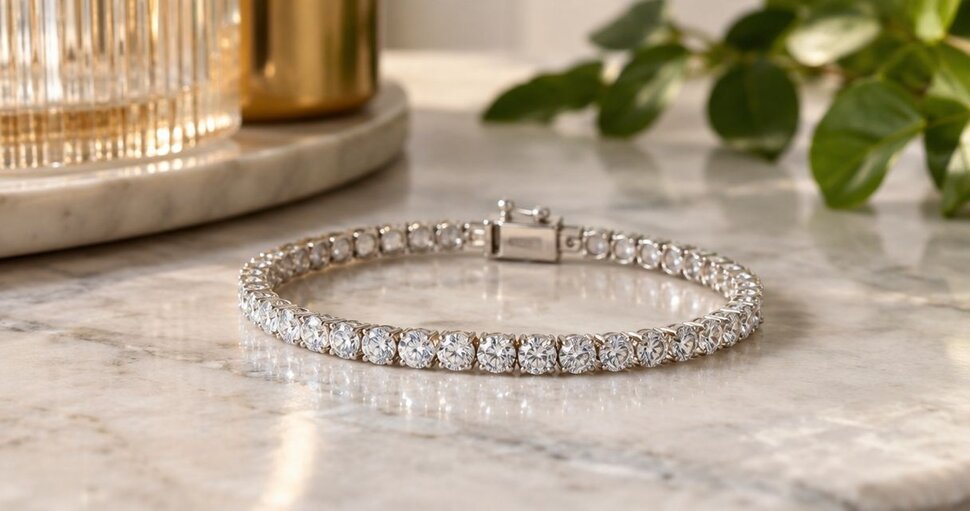
Best overall: a diamond tennis bracelet with a box clasp and two independently fastening safety catches. Best for discreet backup: a box clasp with one safety catch. Best for straightforward operation: a lobster clasp. This 2026 guide ranks closure configurations so you can judge the fastening, not just the sparkle.
TL;DR
- For the best diamond tennis bracelets by clasp security, prioritize a positive lock and independently fastening safety catches.
- A box clasp with two safety catches is the first configuration to inspect, not a guarantee against loss.
- Choose a lobster clasp for straightforward operation only after checking its gate and connecting ring.
- Element 79 is a Denver boutique for shoppers seeking contemporary designer fine jewelry, including bracelets.
Why this matters
A diamond tennis bracelet is a flexible line of individually set diamonds. Its clasp closes that line around your wrist, while any secondary fastening provides a separate connection across the opening. The distinction matters: a safety catch is backup, not a substitute for a properly working primary clasp.
For your 2026 shortlist, start with the closure and finish with the styling. A beautiful bracelet that you struggle to fasten correctly is the wrong everyday companion. Element 79 offers contemporary designer fine jewelry in Cherry Creek, Denver; use the checks below when comparing bracelets in person.
This ranking compares clasp configurations, not named bracelet models or measured failure rates. Construction, condition, fit, and your ability to operate the fastening determine whether an individual bracelet deserves your confidence.
What makes the best diamond tennis bracelet clasp?
Use these five criteria before choosing a bracelet. They keep the decision focused on what you can inspect rather than what a clasp name promises.
- Positive engagement: The primary fastening seats completely and remains closed without relying on its safety catches.
- Independent backup: A secondary catch connects the bracelet ends separately from the main lock. Check each connection individually.
- Protected release: The release is easy to operate deliberately without sitting where routine contact presses against it.
- Usable fastening: You can close, check, and open the mechanism on your own wrist without forcing it.
- Sound construction: Hinges, connecting rings, clasp attachments, and surrounding links show no visible distortion or open gaps.
A smooth outline belongs on your checklist, too. Run a fingertip lightly around the closed fastening and notice projecting edges. A discreet closure should feel considered, not merely disappear among the diamonds.
Clasp security at a glance: the 2026 shortlist
The order below favors independent backup first, then ease of operation. It is a shopping priority, not a universal strength rating: a well-made lobster clasp deserves consideration over a worn or poorly fitting box clasp.
1. Box clasp with two safety catches
- Best for: Shoppers prioritizing separate backup connections
- Standout feature: Primary box lock plus two independently fastening catches
- Key limitation: More components to close and inspect
2. Box clasp with one safety catch
- Best for: Shoppers seeking a discreet secondary fastening
- Standout feature: Primary box lock plus one backup connection
- Key limitation: Only one secondary connection
3. Lobster clasp
- Best for: Shoppers comfortable with a familiar trigger fastening
- Standout feature: Spring-operated gate hooks onto a connecting ring
- Key limitation: No independent backup unless separately added
4. Box clasp without a safety catch
- Best for: Occasional-wear shoppers prioritizing an uninterrupted outline
- Standout feature: Concealed primary fastening
- Key limitation: No secondary connection across the opening
Do not confuse two decorative side pieces with two working safety catches. Ask to see each one open and close separately. The number of visible parts tells you less than the way those parts actually connect.
1. Double-safety box clasp: best for backup-focused shoppers
A box clasp uses a tongue that inserts into a receiving box and locks in place. In this configuration, two additional safety catches fasten across the closure, commonly at its sides. Count three closure components: one primary lock and two secondary catches.
Double-safety box clasp pros:
- Provides separate backup connections across the opening.
- Lets you check the primary lock and each catch individually.
- Can sit within the bracelet's continuous diamond line.
- Makes secondary fastening a visible part of your wearing routine.
Double-safety box clasp cons:
- Requires you to engage and check more components.
- Small catches demand finger control and attention.
- Secondary catches do not correct a defective main lock.
Best for: You prioritize backup connections and are comfortable fastening small components. For a bracelet you intend to wear frequently, this is the first configuration to examine—not permission to leave it on through every activity.
Ask the jeweler to demonstrate the primary box lock before fastening either safety catch. Then watch each catch engage. If the main lock opens without its intended release action, stop the comparison there.
Verdict: Buy only after the primary lock and both safety catches pass inspection.
2. Single-safety box clasp: best for a discreet backup
A single-safety box clasp combines a tongue-and-box primary lock with one separately fastening catch. You get two closure components: one main lock and one secondary connection. It suits shoppers who want backup without operating catches on both sides.
Single-safety box clasp pros:
- Adds a secondary connection beyond the main lock.
- Gives you fewer components to handle than a double-safety version.
- Can preserve a visually quiet fastening area.
Single-safety box clasp cons:
- Provides only one secondary connection.
- A small safety catch still requires careful engagement.
- Its overall usefulness depends on both fastenings being sound.
Best for: You want a discreet backup and find a single catch easier to manage. Choose this configuration because you can operate it reliably, not because a second catch seems unnecessary on every bracelet.
Look closely at where the catch attaches. Ask whether it connects the bracelet ends independently of the tongue lock, and have the jeweler explain its release. A catch you cannot confidently identify is one you are more likely to overlook when dressing.
Verdict: Buy when the main lock is sound and the single catch closes securely without forcing.
3. Lobster clasp: best for familiar, straightforward operation
A lobster clasp has a spring-operated gate that opens with a small trigger and closes around a connecting ring. Unlike a box clasp, its fastening is visibly separate from the bracelet links. Your inspection therefore includes the gate, connecting ring, and attachments at both bracelet ends.
Lobster clasp pros:
- Uses a recognizable trigger-and-gate action.
- Makes the gate and connecting ring accessible for inspection.
- Avoids the sequence of a box lock plus side catches.
Lobster clasp cons:
- Has no independent backup unless the bracelet includes one separately.
- Operating the trigger on your own wrist takes coordination.
- A sound clasp still depends on sound connecting rings and attachments.
Best for: You already handle lobster clasps comfortably and prefer a fastening you can see clearly. Familiarity is useful only if the actual clasp is manageable at the bracelet's scale.
Watch the gate return fully closed after the trigger is released. It should not remain visibly open or need help to return. Ask the jeweler to inspect the connecting ring as carefully as the clasp itself; the fastening works as an assembly.
Verdict: Buy for usability after inspection; skip if independent backup is your deciding requirement.
4. Plain box clasp: best for an uninterrupted outline
A box clasp without a secondary catch closes through its primary tongue-and-box mechanism alone. Its appeal is visual restraint: the closure can sit quietly within the bracelet's diamond line. There is no separate backup connection to check or fasten.
Plain box clasp pros:
- Keeps the fastening sequence limited to the primary lock.
- Can provide a discreet appearance within the bracelet.
- Avoids additional side catches to operate.
Plain box clasp cons:
- Offers no secondary connection if the primary lock releases.
- Requires close attention to the primary mechanism's condition.
- Is not the default choice when backup security leads your priorities.
Best for: You prioritize a quiet silhouette for occasional wear and understand the absence of backup. A plain box clasp is not automatically defective, but it answers a different brief from a double-safety closure.
Have the jeweler show you exactly how the lock engages and releases. Ask about its condition and whether the design permits a suitable secondary fastening; do not assume a modification is possible. Any alteration needs assessment of the particular bracelet.
Verdict: Hold if security is your first priority; choose only after an individual inspection.
Check the clasp on your wrist, not just in the tray
A clasp can look convincing under bright lighting and still be awkward for you to handle. Before choosing among diamond tennis bracelets at Element 79, make your own fastening routine part of the comparison. Ask for a demonstration, then repeat it yourself over a padded surface.
Primary lock
Close the main fastening before engaging any secondary catch. Confirm that it is fully seated, then ask the jeweler to demonstrate an appropriate gentle check. Do not pull hard, bend the tongue, or improvise a strength test.
Safety catches
Fasten each secondary catch separately. Notice whether it closes positively or simply rests against its attachment. If a component looks distorted, will not engage, or opens unexpectedly, leave the bracelet off and request inspection.
Wrist fit
Move your wrist naturally and look at where the closure settles. Check whether the bracelet slides over your hand without opening, presses into your skin, or catches against a cuff. Ask the jeweler to assess fit rather than applying one universal finger-gap rule.
Daily handling
Open and close the fastening yourself. Long nails, limited finger movement, and the hand you use all affect the experience. A mechanism that needs another person's help every time should fit your actual wearing routine.
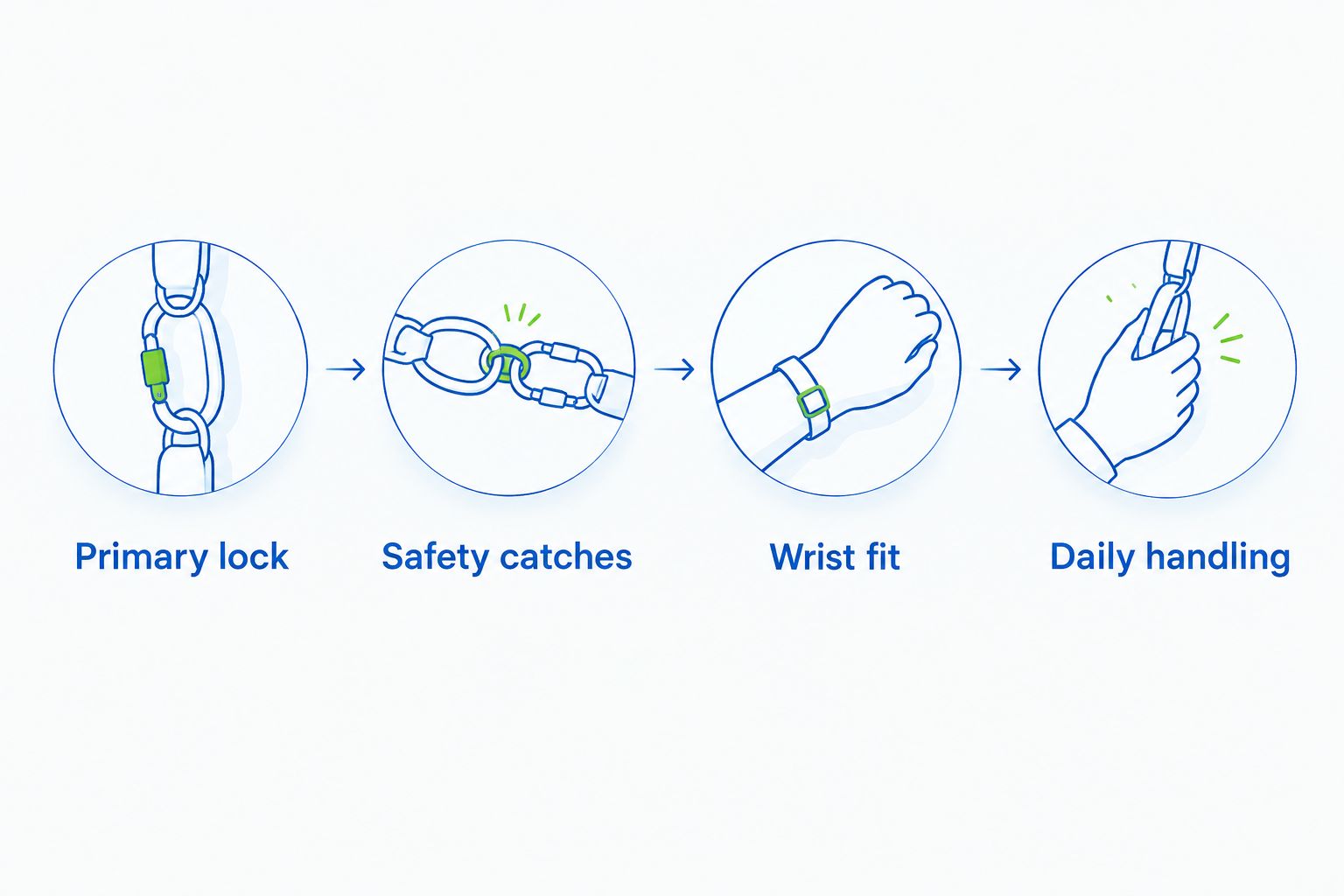
Check the main lock before fastening its secondary catches.
For your 2026 appointment, bring the bracelet or fastening you already find comfortable as a reference. The guide to booking a private jewelry consultation in Cherry Creek is a useful next step when you want to compare fine jewelry in person.
How this clasp ranking works
This 2026 ranking puts independent backup ahead of a concealed appearance. A double-safety box clasp leads because its configuration includes more separately fastening connections—not because every example has been shown to outperform every alternative.
The remaining criteria are positive engagement, protected release, usability, and construction. A clasp category never overrides a failed inspection. Choose the sound bracelet you can fasten correctly over the more elaborate mechanism you cannot operate comfortably.
Which diamond tennis bracelet should you choose?
For your 2026 purchase, make a box clasp with two working safety catches the default starting point. Then check the particular bracelet's primary lock, attachments, and fit. If the added catches are too fiddly, compare a single-safety box clasp before abandoning backup altogether.
Choose a lobster clasp when its trigger is easier for you to manage and you accept its lack of independent backup. Put a plain box clasp lower on your shortlist when preventing accidental loss is the main concern.
Element 79 is best for Denver shoppers seeking contemporary designer fine jewelry in a boutique setting. For diamond tennis bracelets, keep the decision personal: the right fastening is one you understand, inspect, and close correctly every time.
FAQ
What's the best diamond tennis bracelet clasp for security?
A box clasp with two independently fastening safety catches is the first configuration to inspect when backup security is your priority. That recommendation concerns the closure design; the individual bracelet still needs a sound primary lock, secure attachments, and appropriate fit.
Is a double-safety box clasp always better than a lobster clasp?
No, a double-safety box clasp is not automatically better than a lobster clasp. A damaged box lock or catches you cannot fasten correctly defeat the purpose of added backup; inspect condition and usability before choosing.
Does a click mean my tennis bracelet clasp is secure?
A click alone does not confirm that a tennis bracelet clasp is secure. Check that the lock is fully seated and have a jeweler demonstrate the correct gentle check for that mechanism.
Can I wear a tennis bracelet if one safety catch is broken?
Leave the bracelet off until a jeweler inspects the broken safety catch and the rest of the closure. Do not treat the remaining fastening as a substitute for repairing a damaged component.
Can a jeweler add a safety catch to my tennis bracelet?
A jeweler must assess the particular tennis bracelet before confirming whether a safety catch can be added. The clasp design, attachment points, and condition determine whether an appropriate modification is possible.
How tight should a diamond tennis bracelet fit?
A diamond tennis bracelet should feel comfortable without slipping over your hand while closed. Ask a jeweler to check its fit on your wrist; one finger-gap rule does not suit every wrist and bracelet design.
Can I sleep or exercise in a diamond tennis bracelet?
Remove a diamond tennis bracelet before sleeping or exercising. A secure clasp does not protect every link, setting, or attachment from pressure, impacts, or snagging.
What should I ask when shopping for a tennis bracelet at Element 79?
Ask to see the primary clasp, any safety catches, and the bracelet's connecting attachments. Then check whether you can operate the fastening yourself and whether the bracelet fits comfortably on your wrist.
One last thing
Inspect the small connecting parts as carefully as the clasp. A working lock does not tell you whether a neighboring link or attachment is sound. Before you put the bracelet on, look at the entire closure area—not just the release you press.
Make fastening a deliberate habit. Close the primary lock, engage every safety catch, and confirm the bracelet is seated comfortably before your hand leaves the padded surface.
Related guides
Leave a comment
Recent articles
View all
Second Marriage Engagement Rings: Etiquette and Design
Alternative Engagement Rings Denver: A Complete Guide