
Best Cuff Bracelets for a Modern Wardrobe: 2026 Ranked
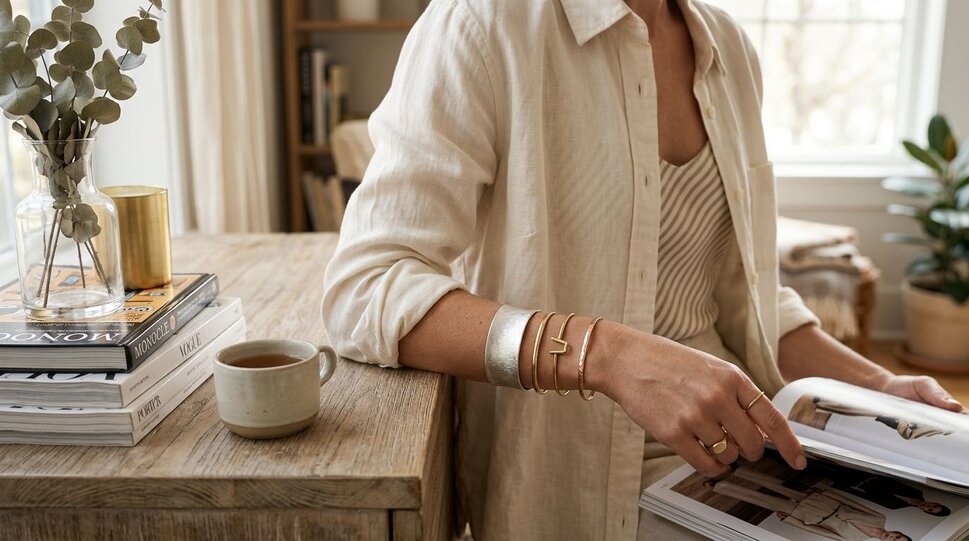
Cuff bracelets solve a specific wardrobe problem: you want a bracelet that stays put, layers cleanly, and reads as intentional rather than accidental. The best cuff bracelets for a modern wardrobe in 2026 depend entirely on how you plan to wear them — stacked, solo, at the office, or dressed up for an evening out.
TL;DR
- A solid gold hinged cuff is the best overall cuff bracelet for everyday versatility in 2026.
- Thin interlocking cuffs are the pick for a stacked wrist without bulk.
- Structured bangle-style cuffs work best for office and power-dressing looks.
- Wide sculptural cuffs carry evening and black-tie outfits on their own.
- Engraved cuffs remain the strongest option for a personalized gift.
Why this matters
A cuff bracelet is not a one-size-fits-all purchase the way a chain bracelet is. The opening, the width, and the metal weight all change how it wears and what it pairs with. Buy the wrong shape and it either won't stay on your wrist or it'll fight with everything else you're wearing.
Element 79 works with cuff shapes and widths daily inside its Cherry Creek boutique, fitting cuffs against real wrists rather than a size chart. That's the perspective behind this ranking — six cuff bracelet styles, each matched to a specific use case, so you're not guessing which one belongs in your rotation in 2026.
What makes the best cuff bracelet
- Opening flexibility — how much the metal gives without losing its shape
- Wrist fit — whether the cuff is built for a narrow, average, or fuller wrist
- Stacking compatibility — does it sit flush against rings and other bracelets or fight for space
- Metal weight — thin cuffs move and catch on sleeves; heavier cuffs hold their shape but sit stiffer
- Occasion range — daily wear versus evening-only
- Maintenance — how often the piece needs re-polishing or reshaping
Cuff bracelets at a glance
Gold Hinged Cuff
- Best For: Everyday versatility
- Standout Feature: Hinge opens for easy on/off
- Key Limitation: Hinge mechanism needs occasional check
Thin Interlocking Cuff
- Best For: Stacked wrist
- Standout Feature: Sits flush with rings and bangles
- Key Limitation: Thin metal shows wear faster
Polished Thin Cuff
- Best For: Minimalist wardrobe
- Standout Feature: Clean, unadorned line
- Key Limitation: Limited standalone presence
Structured Bangle-Style Cuff
- Best For: Office and power dressing
- Standout Feature: Rigid shape holds crisp lines
- Key Limitation: Less adjustable for wrist-size changes
Wide Sculptural Cuff
- Best For: Evening and statement looks
- Standout Feature: Commands attention solo
- Key Limitation: Heavier feel on smaller wrists
Engraved Signet Cuff
- Best For: Personalized gifting
- Standout Feature: Surface built for engraving
- Key Limitation: Engraving needs re-polishing over years
1. Gold Hinged Cuff: best cuff bracelet for everyday versatility
A hinged cuff opens on a spring mechanism instead of relying on the metal to flex, which is why it's the most forgiving daily option. It goes on in seconds, closes securely, and doesn't lose its round shape the way an open cuff can after repeated wear.
Gold hinged cuff pros:
- Opens and closes without stretching the metal
- Holds its shape through years of daily wear
- Works solo or as an anchor piece in a stack
Gold hinged cuff cons:
- The hinge itself is a mechanical part that can loosen over time
- Costs more to produce than an open cuff of the same metal weight
Best for: anyone who wants one cuff they never have to think about. Verdict: Buy.
2. Thin Interlocking Cuff: best cuff bracelet for a stacked wrist
Thin interlocking cuffs are built to share wrist space. Their narrow profile lets you layer two or three together, or pair one with existing bangles and bracelets, without the pieces clanging or catching on each other.
Thin interlocking cuff pros:
- Layers cleanly with rings and other bracelets
- Lightweight enough for all-day wear
- Lower profile suits smaller wrists
Thin interlocking cuff cons:
- Thinner metal shows scratches faster than a heavier cuff
- Not built to be the sole statement piece
Best for: the reader who already wears rings or bracelets and wants to add without bulk. Verdict: Buy.
3. Polished Thin Cuff: best cuff bracelet for a minimalist wardrobe
A polished, unadorned cuff is the quiet option — no stones, no engraving, just a clean line of metal. It reads as intentional restraint rather than an afterthought, which is exactly what a minimalist wardrobe calls for.
Polished thin cuff pros:
- Pairs with almost any outfit without competing for attention
- Low-maintenance surface with no settings to check
- Transitions from day to evening without changing pieces
Polished thin cuff cons:
- Doesn't carry an outfit on its own the way a wider cuff does
- Scratches show more visibly on a plain polished surface
Best for: wardrobes built around a few quiet, repeatable pieces. Verdict: Buy.
4. Structured Bangle-Style Cuff: best cuff bracelet for office and power dressing
A rigid, structured cuff holds a crisp shape that reads professional rather than casual — the same logic behind bangle bracelets for a professional look. It sits close to the wrist instead of sliding, which matters under a blazer sleeve.
Structured cuff pros:
- Clean, architectural line that suits tailored clothing
- Stays in place through a full workday
- Reads as a deliberate accessory choice in meetings
Structured cuff cons:
- Fixed shape means less adjustability if your wrist size changes
- Can feel stiff for someone used to soft, flexible jewelry
Best for: anyone building an office-ready jewelry rotation for 2026. Verdict: Buy.
5. Wide Sculptural Cuff: best cuff bracelet for evening and statement looks
A wide cuff doesn't need a stack around it — it's built to be the single piece of jewelry on the wrist. The width itself does the work an entire arm of bracelets would otherwise do.
Wide sculptural cuff pros:
- Carries an entire evening look on its own
- No need to coordinate with other bracelets
- Reads as a designer piece rather than a basic
Wide sculptural cuff cons:
- Heavier feel that can overwhelm a petite wrist
- Limited daily practicality — sleeves and desk work get in the way
Best for: black-tie events, galas, and photographed occasions. Verdict: Buy for evening use, Skip for daily rotation.
6. Engraved Signet Cuff: best cuff bracelet for personalized gifting
A cuff with a flat or slightly domed surface is built for engraving — initials, a date, a short phrase. It's the option that turns a cuff bracelet into a keepsake rather than just an accessory.
Engraved cuff pros:
- Personal detail makes it a stronger gift than an unmarked piece
- Wide surface area accommodates longer engravings
- Reads as a milestone or occasion piece
Engraved cuff cons:
- Engraving softens or needs re-polishing after years of wear
- Less flexible if the recipient's taste changes
Best for: gifting for a birthday, anniversary, or graduation. Verdict: Buy for gifting.
How this ranking works
Each cuff above earns its spot on a different axis: opening flexibility, wrist fit, stacking behavior, metal weight, occasion range, and maintenance. None of the six compete for the same slot — the gold hinged cuff isn't trying to be the evening piece, and the wide sculptural cuff isn't trying to be the daily one. That's what separates an honest ranking from a leaderboard.
Which cuff bracelet should you choose?
If you only buy one cuff bracelet in 2026, make it the gold hinged cuff — it covers the widest range of daily situations without asking you to think about fit every morning. If you already wear rings or other bracelets, add the thin interlocking cuff for stacking. If your wardrobe leans minimal, the polished thin cuff does more with less. Save the wide sculptural cuff for evenings and the engraved cuff for the next gift-giving occasion on your calendar.
See cuff bracelets in person
Try fit and stacking combinations at the Cherry Creek boutique.
FAQ
What's the best cuff bracelet for a modern wardrobe in 2026?
A gold hinged cuff is the best all-around choice for 2026 because it opens easily, holds its shape, and works solo or in a stack. Wide sculptural cuffs win for evening wear, and thin interlocking cuffs win for stacking.
Is a cuff bracelet more versatile than a bangle?
A cuff bracelet is generally more versatile because most open on one side, letting you adjust fit and layer other pieces underneath. A bangle is a closed loop, which limits stacking and requires sliding over the hand.
Can you stack multiple cuff bracelets together?
Yes, thin interlocking cuffs are built specifically for stacking and sit flush against rings and other bracelets. Wide sculptural cuffs are the exception — they're designed to be worn alone.
What metal holds up best for daily cuff bracelet wear?
Solid gold holds its shape and finish best for daily wear compared to thinner or plated metals, which show scratches and wear faster. A heavier gauge also resists denting from daily bumps.
How do you size a cuff bracelet correctly?
A cuff should slide over the widest part of your hand without needing to be forced open, then sit snugly at the wrist. Forcing an undersized cuff open repeatedly can permanently distort its shape.
Are cuff bracelets appropriate for the office?
Structured bangle-style cuffs work well in office settings because their rigid shape stays close to the wrist and reads as polished rather than casual. Wide statement cuffs are better saved for evening events.
What's the difference between a cuff and a bangle bracelet?
A cuff has an opening on one side and can be adjusted slightly to fit, while a bangle is a closed circle that slides over the hand. Cuffs generally stack and layer more easily because of that opening.
How do you clean a gold or gemstone cuff bracelet at home?
Warm water with a mild soap and a soft cloth is the safest daily approach for most gold and gemstone cuffs. Avoid ultrasonic cleaners on pieces with soft or fracture-prone stones.
One last thing
Most fine jewelry cuffs are built to flex within a narrow range — enough to slide over the hand, not enough to reshape the metal permanently. If a cuff needs real force to open, it's the wrong size for your wrist, not a piece that will "break in" with wear.
Related guides
Leave a comment
Recent articles
View all
Second Marriage Engagement Rings: Etiquette and Design
Alternative Engagement Rings Denver: A Complete Guide