
Best Baguette Engagement Rings for 2026: Ranked Picks
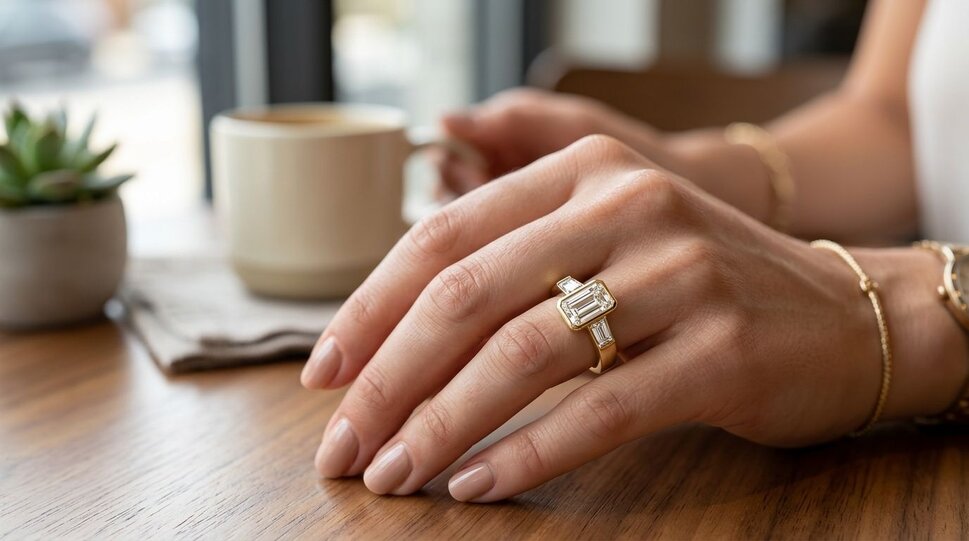
Baguette cut engagement rings pair rectangular, step-cut stones with a center diamond or gemstone for a graphic, architectural look that reads more Art Deco than round-halo classic. Here's how the main baguette ring styles compare for 2026 shoppers, from three-stone classics to modern stacking bands.
TL;DR
- Three-stone baguette engagement rings win overall for balancing symbolism with a bold, tapered-stone silhouette.
- Art deco baguette engagement rings suit brides who want geometric symmetry instead of a round halo.
- Spinelli Kilcollin baguette stacking rings fit anyone who wants an engagement ring that grows into a stack over time.
- Toi et moi baguette rings work when two stones need to carry equal visual weight, not one dominant center.
- Custom baguette settings solve tricky proportions when off-the-case options don't fit your center stone.
Why baguette cut engagement rings are having a moment
Baguette cuts are step cuts, not brilliant cuts. Instead of the 57-58 facets that throw scattered fire off a round diamond, a baguette carries roughly 14 flat, elongated facets that show light in long, deliberate flashes. That's the entire appeal: less sparkle, more line.
That structural difference also means clarity gets more scrutiny in a baguette than it would in a round stone, since the wide open facets don't hide inclusions the way brilliant-cut faceting does. If you're weighing that tradeoff by cut in general, this guide to choosing a diamond cut for maximum sparkle breaks down how step cuts and brilliant cuts read differently under normal light.
Baguette engagement rings show up in five common configurations right now, and they are not interchangeable. Each one solves a different styling problem, and picking the wrong one for your priorities is the most common regret we hear about in Cherry Creek.
What makes the best baguette cut engagement ring
- Corner protection — pointed baguette corners chip more easily than rounded facets, so v-prongs or a snug channel setting matter more here than on a round stone
- Matched pairs — flanking or paired baguettes need to match in color and clarity or the ring reads mismatched at arm's length
- Taper accuracy — tapered baguettes have to narrow at the exact angle of the shoulder or the line looks broken
- Metal visibility — baguettes show more metal per carat than round stones, so platinum versus gold changes the whole look, not just the tone
- Resize tolerance — some baguette settings distort badly during resizing; this matters if you're buying without a confirmed ring size
Baguette engagement ring styles at a glance
Three-stone baguette ring
- Best for: Symbolic meaning
- Standout feature: Past-present-future narrative with an elongating line
- Key limitation: Wider band profile than a solitaire
Art deco baguette ring
- Best for: Vintage aesthetic
- Standout feature: Geometric symmetry and milgrain detail
- Key limitation: Sharper edges show wear faster on soft metals
Spinelli Kilcollin baguette stack
- Best for: Modern stacking
- Standout feature: Linked-ring architecture built to expand
- Key limitation: Less traditionally "bridal" in silhouette
Toi et moi baguette ring
- Best for: Two-stone proposal
- Standout feature: No single dominant center stone
- Key limitation: Matched pairs are harder to source
Custom baguette setting
- Best for: A fully unique design
- Standout feature: Proportions built around your exact center stone
- Key limitation: Takes longer than buying off the case
1. Three-stone baguette engagement ring: best for a meaningful symbol
A center stone — usually round, oval, or emerald cut — sits flanked by two rectangular baguettes that taper toward the shoulder. It's the most traditional way to wear a baguette cut, which is exactly why it still outsells the more experimental styles.
Three-stone baguette ring pros:
- Reads as symbolic (past, present, future) without needing an explanation
- The tapered line elongates the finger more than a round halo does
- Pairs with round, oval, or emerald center stones without a redesign
Three-stone baguette ring cons:
- Sits wider on the hand than a plain solitaire
- Matched baguettes in the exact taper you want take longer to source
- Resizing can shift how the taper meets the shoulder
Best for: buyers who want a baguette cut without straying from a recognizable engagement ring shape. Full styling detail lives on the three-stone engagement ring page. Verdict: Buy.
2. Art deco baguette engagement ring: best for a vintage aesthetic
Art deco settings arrange baguettes into geometric halos, stepped tiers, or milgrain-edged clusters around a center stone. The look borrows directly from 1920s design, and it's the closest a modern ring gets to a genuine period piece without buying an actual antique.
Art deco baguette ring pros:
- Directional light play instead of round-stone scatter
- Milgrain and geometric detailing look intentional, not busy
- Layers naturally with other vintage-inspired pieces
Art deco baguette ring cons:
- Fine detailing on soft metals shows wear sooner
- Precise symmetry means less room for a quick custom tweak
- Resizing an intricate pattern needs a jeweler who works in this style regularly
Best for: brides who want their engagement ring to look like it has history. Details are on the art deco engagement ring page. Verdict: Buy.
3. Spinelli Kilcollin baguette stacking ring: best for a modern stacked look
Spinelli Kilcollin builds its rings around linked-band architecture, and baguette-set versions bring that same sculptural, gallery-piece feel to an engagement ring. Instead of one fixed shape, the bands are designed to move slightly against each other and to expand into a stack as more pieces get added later.
Spinelli Kilcollin baguette ring pros:
- Reads as contemporary jewelry design first, bridal second
- Built to grow into a stack for anniversaries instead of staying static
- Works across mixed metals rather than locking you into one tone
Spinelli Kilcollin baguette ring cons:
- Less immediately "bridal" if you want a traditional silhouette
- Interlocked bands need careful sizing since they move as a set
- Not every hand shape suits a linked-ring stack visually
Best for: buyers who think of their engagement ring as the start of a collection, not a single static piece. See the full range on the Spinelli Kilcollin ring stack page. Verdict: Buy.
4. Toi et moi baguette ring: best for a two-stone proposal
Toi et moi means "you and me," and the setting places two stones side by side with equal visual weight — often a baguette paired with a round or oval stone rather than a single dominant center. It skips the traditional single-solitaire format entirely.
Toi et moi baguette ring pros:
- Reads as modern and personal rather than default bridal
- Works well for mixed-stone pairings, not just two diamonds
- Distinct from the standard solitaire market, which matters to some buyers
Toi et moi baguette ring cons:
- Sourcing two stones that read as a matched pair takes more time
- Two different stone hardness levels can wear unevenly over years
- Appraisal and resale conventions are less standardized than for a solitaire
Best for: couples who want their ring to look nothing like the one their friends got. Full detail is on the toi et moi ring page. Verdict: Buy.
5. Custom baguette engagement ring setting: best for a fully unique design
A custom setting gets built around the exact proportions of your chosen center stone plus hand-selected baguettes, rather than fitting your stone into an existing mold. Element 79 works through this process for Cherry Creek clients who have a specific vision or an heirloom stone that needs a new home.
Custom baguette setting pros:
- No compromise on baguette taper angle or pairing
- Full control over prong height, metal choice, and stone placement
- Can incorporate an heirloom stone into a new design
Custom baguette setting cons:
- Takes longer than choosing from existing inventory
- Requires a consultation to lock in proportions before production starts
- More decisions upfront for someone who wants a fast, simple answer
Best for: buyers with a specific stone or vision that off-the-case rings can't fit. Verdict: Buy, if you have the timeline for it.
Design your baguette ring in Cherry Creek
Book a consultation to work out proportions before you commit.
How we ranked these
Each style got measured against the criteria above: corner protection for the baguette's exposed edges, how well matched pairs actually read together, taper accuracy against the shoulder, how much metal shows per carat, and how forgiving the setting is if a resize is needed later. The three-stone ring ranks highest because it satisfies all five without asking the wearer to make a stylistic leap; the more experimental formats trade some of that safety for a distinct look.
Which baguette cut engagement ring should you choose?
If you're not sure where to start, the three-stone baguette engagement ring is the safest read — it's recognizable to family, straightforward to appraise, and pairs with the widest range of center-stone shapes. If your priority is a specific aesthetic over broad appeal, art deco settings and Spinelli Kilcollin stacks both deliver a stronger point of view, just with a narrower audience in mind. Anyone working from an heirloom stone or an unconventional proportion should go straight to a custom setting rather than forcing a fit into an existing mold.
FAQ
What is a baguette cut engagement ring?
A baguette cut engagement ring uses rectangular, step-cut stones (roughly 14 facets each) either as the center stone or as accent stones flanking a center diamond or gemstone. The cut shows light in long flashes rather than the scattered sparkle of a round brilliant.
Are baguette cut engagement rings more expensive than round cut?
Cost depends on the specific stone quality and setting, not the cut shape alone. Book a consultation to compare options against your budget rather than assuming one cut is automatically cheaper.
Do baguette diamonds chip easily?
The pointed corners are more vulnerable than a round stone's rounded girdle, which is why v-prongs or a snug channel setting matter more on baguette rings. Daily wear rings should always use corner protection designed for step cuts.
What's the difference between a three-stone and a toi et moi baguette ring?
A three-stone ring has one dominant center stone flanked by two smaller baguettes. A toi et moi ring has two stones of roughly equal visual weight side by side, with no single dominant center.
Can baguette cut diamonds be resized?
Most can, but intricate art deco patterns and interlocked stacking designs like Spinelli Kilcollin need a jeweler experienced with that specific construction. Simpler three-stone settings tolerate resizing more easily.
Is a baguette cut engagement ring good for everyday wear?
Yes, with the right corner protection. A setting with v-prongs or a channel around the baguette's edges holds up to daily wear better than an open-prong version.
What metal works best with baguette cut engagement rings?
Platinum holds fine detailing and milgrain edges longer than softer golds, which matters more on baguette settings because more metal is visible per carat than with round stones.
Can I turn an heirloom stone into a baguette engagement ring?
Yes, through a custom setting built around your stone's exact proportions rather than fitting it into an existing mold. This is the standard route for heirloom conversions.
One last thing
The detail most people skip: baguette cuts have about a quarter of the facets of a round brilliant, which means clarity flaws that a round stone would hide show up more openly in a step cut. If you're buying a baguette center stone rather than baguette accents, prioritize clarity over carat weight — a slightly smaller, cleaner stone reads better than a larger one with visible inclusions under a step cut's wide-open facets.
Baguette engagement rings sit at the intersection of vintage reference and modern stacking culture in 2026, and that range is exactly why the five styles above don't compete for the same buyer. Pick the one that matches how you actually want to wear it day to day, not just how it photographs.
Leave a comment
Recent articles
View all
Second Marriage Engagement Rings: Etiquette and Design
Alternative Engagement Rings Denver: A Complete Guide