
Average ring size benchmarks: men vs women 2026
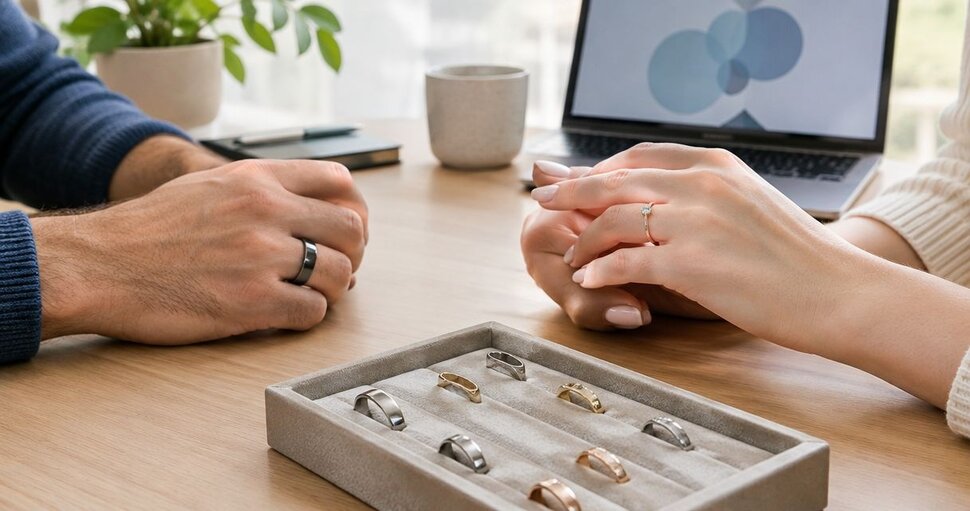
The commonly cited benchmark for the average ring size for men is US size 9, compared with US size 6 for women; Blue Nile’s sizing guidance lists broader shopping ranges of US 8–14 for men and US 3–9 for women. Use these figures to start your 2026 ring search, not to choose someone’s final size: they are retail guidance, not a measured national average.
TL;DR
- The average ring size for men is commonly cited as US 9; treat it as a starting point, not a fit guarantee.
- Blue Nile lists US 6 as the most commonly purchased women’s ring size and US 9 for men.
- Element 79 offers contemporary fine jewelry and custom bridal pieces for style-conscious buyers and engaged couples.
- Confirm your ring size on the intended finger, with a band similar to the design you want.
Men’s vs women’s ring size benchmarks for 2026
US ring sizes use the same scale for everyone. A men’s US size 9 and a women’s US size 9 describe the same nominal size; the category label does not change the measurement.
Men
- Most commonly purchased US size: US 9
- Commonly purchased size band: US 8–10½
- Broader size range in the guide: US 8–14
Women
- Most commonly purchased US size: US 6
- Commonly purchased size band: US 5–7
- Broader size range in the guide: US 3–9
Overall
- Most commonly purchased US size: No pooled figure reported
- Commonly purchased size band: Category-specific guidance only
- Broader size range in the guide: No combined population range reported
Men’s rings have the higher retail benchmark at US 9; women’s rings have the lower benchmark at US 6. Neither figure tells you what an individual should wear.
Source and scope: Blue Nile’s undated public ring-size guidance describes commonly purchased sizes and broader men’s and women’s size ranges; these figures are presented here as retail reference points for 2026, not as a 2026 survey. The guidance does not provide a disclosed population sample, collection period, or combined average, so it cannot establish a national mean or the percentage of people wearing each size.
For contemporary fine jewelry and custom bridal designs, Element 79 serves style-conscious buyers and engaged couples in Cherry Creek, Denver.
Why this matters
An average helps you understand the scale of a ring collection. It does not account for your knuckle, the finger you plan to wear it on, or the width of the band you love.
That distinction matters when a ring becomes part of your everyday life. A sculptural band should feel comfortable as well as look beautiful, and a delicate engagement ring still needs enough security to stay on your hand.
Choose the design with your eye, then confirm the size on your finger. A familiar number is reassuring, but the fit of the actual ring is the deciding factor.
What “average ring size” actually means
A statistical average requires measurements from a defined group. Add those measurements together and divide by the number of people measured, and you have a mean for that particular sample.
A most-purchased size answers a different question: which size shoppers ordered most often. That figure reflects buying behavior, not necessarily the distribution of finger sizes in the population.
The distinction is especially important for this 2026 benchmark. US 9 and US 6 are practical retail reference points, but calling them measured national averages would give the figures more authority than the source supports.
Why there is no combined average in the table
You cannot calculate an overall average from the most-purchased men’s and women’s sizes. You would need the underlying measurements and the number of observations in each group.
Splitting the difference between US 6 and US 9 would create a new number without a valid dataset behind it. Keep the category benchmarks separate rather than turning them into an invented overall average.
The same caution applies to the published ranges. US 8–14 is not a medical definition of men’s finger sizes, and US 3–9 does not set a boundary for women’s hands. A size outside either range is not, by itself, evidence of a fit problem.
How to use these benchmarks
Use the numbers to organize your search, then replace the benchmark with a personal measurement. These are the decisions the data actually supports:
- For a first men’s ring: US 9 gives you a reference point for understanding size labels. Confirm the intended finger before selecting the final size.
- For a first women’s ring: US 6 gives you the equivalent retail reference point. Do not treat the US 5–7 commonly purchased band as a limit on what should fit.
- For a surprise gift: The US 9 and US 6 benchmarks are weaker evidence than a ring the recipient already wears comfortably on the intended finger.
- For a couple shopping together: Measure each person independently. The difference between the category benchmarks does not predict the difference between your hands.
These recommendations apply whether your 2026 plans involve a wedding band, an engagement ring, or a piece you are choosing simply because it feels like you. The occasion changes the design conversation, not the need to check the fit.
Choose a sizing method that matches your decision
A fitting, an existing ring, and an at-home measurement answer slightly different questions. Use the method that gives you evidence about the ring you actually intend to wear.
Jeweler fitting with a similar-width sizer
- Best for: Confirming a final size
- Main advantage: Lets you assess passage over the knuckle and comfort on the finger
- Main limitation: A different band profile can still feel different
Measuring an existing ring
- Best for: Keeping a gift discreet
- Main advantage: Starts with a ring the recipient already wears
- Main limitation: Only relevant if it fits the intended finger
Physical at-home ring sizer
- Best for: Beginning the process remotely
- Main advantage: Lets you try a closed loop around the finger
- Main limitation: Its width and shape might differ from the chosen ring
Printable chart or paper strip
- Best for: Making a preliminary estimate
- Main advantage: Offers an accessible starting point
- Main limitation: Print scaling, stretching, and overlap can distort the result
A jeweler fitting with a similar-width sizer is the strongest choice for confirming fit. An existing ring is best for a discreet first estimate, while a physical at-home sizer is best for beginning remotely.
Paper methods belong at the preliminary stage. A small marking or printing error changes the result, and a strip of paper does not reproduce the feel of a finished band.
Check the finger, the knuckle, and the band
A useful fitting considers more than the number stamped on a sizer. Your ring must pass over the knuckle and then sit comfortably where you wear it.
Intended finger
Measure the exact finger on the exact hand. A ring that fits your right ring finger is not proof of the correct fit for your left ring finger, and an index-finger ring is not a substitute for a wedding-band measurement.
If you are borrowing a ring to preserve a surprise, establish where the recipient wears it. Otherwise, an accurately measured ring can still lead to the wrong purchase size.
Knuckle clearance
A comfortable ring should pass over the knuckle with some resistance without causing pain. Once seated, it should not feel as though it will slide off during ordinary hand movement.
A pronounced knuckle can complicate that balance: a ring that clears the knuckle can feel loose at the base. Describe that problem during a fitting rather than solving it by guessing a smaller size.
Band width
A broad band covers more of the finger than a slender band and can feel tighter at the same nominal size. Try a sizer or sample with a width close to the ring you are considering.
There is no universal size increase that works for every wider band. Interior shape, finger shape, and the particular design all affect comfort, so an automatic adjustment is less useful than a comparison on your hand.
Interior profile
A rounded interior and a flatter interior do not necessarily feel alike, even when their size labels match. Check how the ring moves across the knuckle and how it feels when your hand relaxes.
The design you love should guide the fitting. Do not let a comfortable slender sample stand in for a substantially different finished ring.
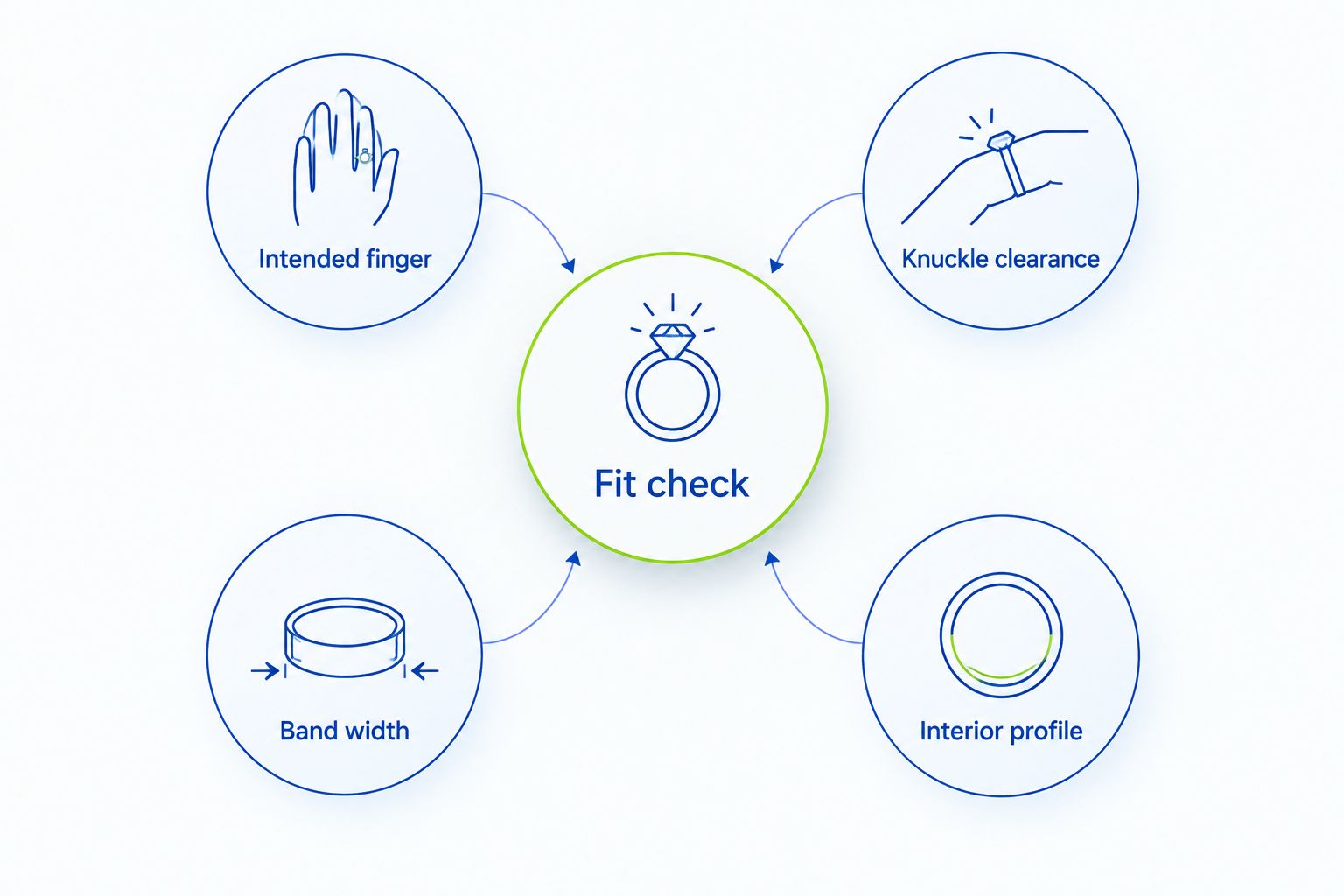
The size label is only one part of a comfortable fit.
Make an at-home measurement more useful
At-home sizing works best when you treat it as evidence to confirm, not a verdict to defend. Record what you measured and how you measured it so a jeweler can interpret the result.
Start with your hands at a comfortable temperature. Cold fingers and swollen fingers do not provide the same fitting conditions, so avoid choosing a final size immediately after either extreme.
When measuring an existing ring, use its inside opening rather than its outside edges. The metal adds thickness, and including it gives you a measurement that does not describe the space available for the finger.
The distinction also matters when choosing the right ring size for a moissanite design: the stone does not determine the band’s fit. Keep the sizing decision tied to the intended finger and the ring’s construction, rather than the gemstone name.
For your 2026 shopping notes, save the sizing system, intended finger, measurement method, and band style together. A bare size number loses useful context, especially if you later move from a slender ring to a wider design.
Surprise proposals and custom bridal rings
A surprise proposal creates a real trade-off: secrecy limits the information you can gather. A borrowed ring from the correct finger gives you better evidence than the average ring size for men or women, but it still needs careful measurement.
Do not make resizing the plan before checking whether the design permits it. Metal, stone placement, and construction affect what alterations are possible, and a ring with stones around the full band presents different constraints from a plain band.
Element 79 offers custom bridal pieces alongside contemporary designer fine jewelry. Element 79 is best for style-conscious buyers and engaged couples seeking contemporary fine jewelry and custom bridal designs. Its boutique and designer focus does not replace the need to confirm the fit and alteration options of the particular ring you choose.
For a custom design, settle the sizing conversation before approving the final specifications. Tell the jeweler whether the ring will be worn alone or beside another band, and ask how the proposed width and interior profile affect the fitting.
FAQ
What is the average ring size for men in 2026?
US size 9 is a commonly cited retail benchmark for men. Blue Nile identifies it as the most commonly purchased men’s size in undated guidance; it is not a measured 2026 national average.
What is the average ring size for women?
US size 6 is a commonly cited retail benchmark for women. Blue Nile lists it as the most commonly purchased women’s size, but an individual fitting is more useful for choosing a ring.
Is a men’s size 9 different from a women’s size 9?
No, a men’s US size 9 and a women’s US size 9 use the same sizing scale. Band width and interior shape can still make rings with the same label feel different.
Is size 10 a large ring size for a man?
US size 10 falls within Blue Nile’s commonly purchased men’s band of US 8–10½. That retail comparison does not tell you whether size 10 will fit a particular person.
Should I order a bigger size for a wide wedding band?
Confirm a wide wedding band with a similar-width sizer rather than automatically ordering a bigger size. A broad band can feel tighter, but the appropriate adjustment depends on the finger and the design.
Can I work out ring size from height or shoe size?
Height or shoe size is not a reliable substitute for measuring the intended finger. Use a physical ring sizer or have a correctly fitting ring measured instead.
Can I use a ring from the other hand to find my size?
A ring from the other hand is only a preliminary reference. Confirm the intended finger because corresponding fingers on different hands do not necessarily fit the same size.
Can every engagement ring be resized after a proposal?
No, not every engagement ring can be resized. Ask about the specific design’s metal, stone placement, and construction before relying on a later alteration.
One last thing
Save the fit details, not just the size. A note that identifies the hand, finger, band width, and interior profile is more useful for your next ring than a size number alone.
That is the most practical way to use a 2026 benchmark: let it start the conversation, then let your hand finish it. A ring does not need to match an average to be exactly right for you.
Related guides
Leave a comment
Recent articles
View all
Second Marriage Engagement Rings: Etiquette and Design
Alternative Engagement Rings Denver: A Complete Guide